





















Service Hotline
Columnist

Columnist

Huaqiangbei Traders Pivot to Domestic Semiconductor Substitution: A Market Full of Opportunities
2026-11-07
800
Song Shiqiang, an expert on Huaqiangbei's economy and business ecosystem, delivered a speech recently at the Huaqiangbei Lecture Hall under the title “Traders Pivoting to Domestic Semiconductor Substitution Have Plenty of Room to Grow.” A well-known entrepreneur in Shenzhen's Huaqiangbei, Song shared his insights into the opportunities presented by domestic substitution in electronic components and its considerable growth potential. Song, general manager of Slkor (www.slkoric.com), argued that China's semiconductor industry still trails the advanced economies by a wide margin while its home market is enormous, and that domestic semiconductor substitution offers traders a way to change course. By working with Chinese semiconductor makers, they can bring Chinese semiconductor brands and products to end customers while earning profits and benefiting from the industry's growth.
The global semiconductor industry has an annual output value of about USD 600 billion, and China's semiconductor self-sufficiency rate is below 20 per cent, which leaves around 80 per cent as room for imagination and growth. Traders in Huaqiangbei should take note: domestic semiconductor substitution holds promise in market size, profitability, market opportunities and product demand, and under today's difficult trading conditions at home and abroad, shifting towards Chinese-made semiconductor components offers tangible advantages.
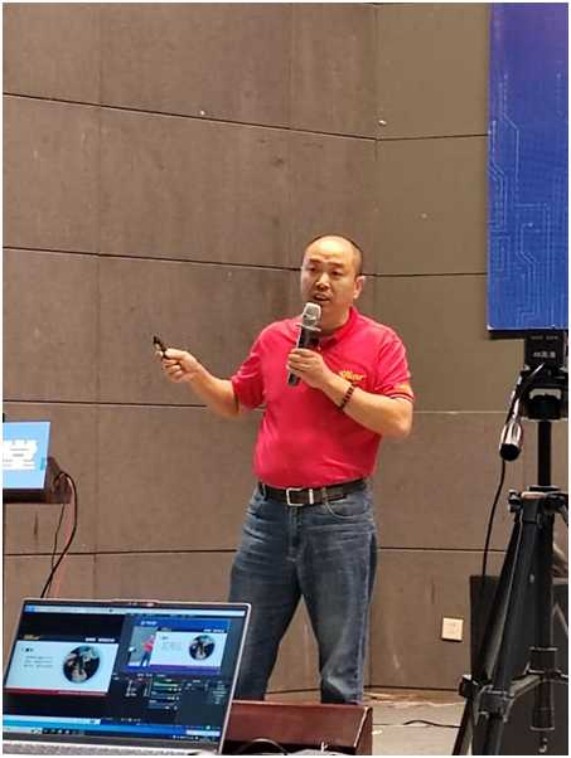
Song Shiqiang, general manager of Slkor and Kinghelm, giving his talk
One: Volume
Song Shiqiang said the semiconductor industry is a cornerstone of the global industrial economy, with enormous market potential. China's self-sufficiency rate sits well below the world average: global output is valued at about USD 600 billion a year, China makes less than 20 per cent of what it consumes, and the gap between domestic supply and demand leaves considerable room for growth. As the economy grows quickly and technological innovation pushes forward, demand for semiconductor products in China keeps rising, yet reliance on imports remains the reality of the industry. Domestic semiconductor substitution can serve that home demand and give Chinese companies more chances to grow.
Slkor (www.slkoric.com) recognised this early. From the outset the company made domestic semiconductor substitution its core business and has remained committed to this direction ever since. Its progress has attracted considerable attention: after several years of growth Slkor has become a recognised name in China's domestic semiconductor sector, attracting an increasing number of end-product manufacturers and electronics engineers seeking cooperation. Slkor's development illustrates the opportunities available in the domestic semiconductor market.
Two: Margin
The gap between China's semiconductor industry and the advanced economies cannot be ignored. China is one of the world's biggest consumer markets for semiconductors, but the technological gap remains substantial, with some areas reportedly lagging by more than a decade. Even so, the industry continues to evolve, with real momentum and potential, and it is precisely that gap that has created business opportunities for downstream traders in Huaqiangbei.
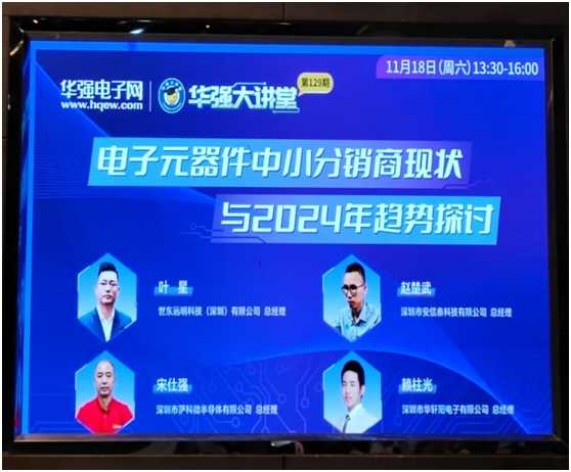
The speakers at the 129th session of the Huaqiangbei Lecture Hall
The business opportunities created by domestic semiconductor substitution come from two main sources. The first is market demand, and it keeps growing: China is one of the world's biggest consumer markets for semiconductors, and demand continues to grow. Its consumer electronics, automotive and industrial control industries all need more chips, creating a broad range of business opportunities for traders — even the lights, speakers and projector in the Huaqiangbei Lecture Hall rely on various semiconductor components. As Chinese-made products improve and gain market share, traders will find more ways to serve that demand. The second is price: in many cases a Chinese-made replacement part costs less than the import it replaces, thanks to the advantages China has built in material costs, labour costs and supply-chain efficiency. As domestic manufacturers improve production efficiency and technological capabilities, this price advantage is likely to become stronger.
Three: New Markets
The rise of new markets has been one of the brighter developments in the world economy in recent years. Among many industries, solar photovoltaics and smart vehicles stand out for fast growth, expanding scale and healthy margins, and both look set to keep growing. Smart vehicles in particular have developed quickly and are now one of the key development trends in the global automotive industry. These vehicles rely on technologies such as artificial intelligence, big data and the Internet of Things (IoT), and all of them depend on semiconductor components. Radar, cameras and LiDAR systems rely on semiconductor chips for sensing, data processing and control. Kinghelm's RF connectors and antenna solutions (www.kinghelm.net), meanwhile, support RF signal connections and wireless communication in automotive applications.
New markets generate substantial demand for electronic components, creating opportunities for high-volume trading — an area in which Shenzhen's Huaqiangbei has a clear advantage. Huaqiangbei, China's renowned electronics marketplace, is known around the world for its scale and its busy business ecosystem. Its reputation is backed by figures such as 500,000 daily visitors and RMB 1 billion in daily transaction volume, and it has produced countless millionaires and billionaires. Hundreds of thousands of people come in every day to talk, to shop and to look for business. Huaqiangbei is more than a distribution hub; it functions like an enormous shared inventory network. Any trading stall there may become a supplier to a neighbouring business, so traders hold stock for one another. Whoever you are, once you walk into Huaqiangbei you can find what you need. Through its market channels, the district's merchants sell across Shenzhen, the Pearl River Delta, the rest of the country and overseas. This highly flexible, interconnected inventory system creates extensive opportunities for traders.
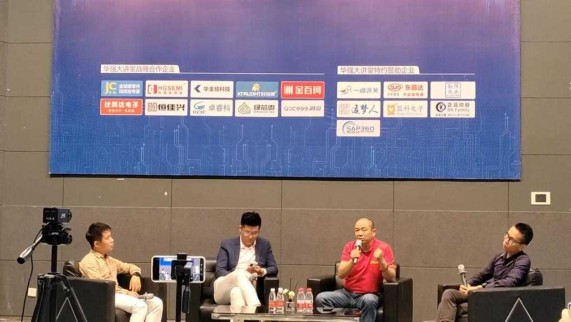
The round-table discussion, with Song Shiqiang third from the left
Slkor's high-end lines include silicon carbide (SiC) diodes, SiC MOSFETs, IGBTs and fifth-generation ultrafast recovery power diodes, and they meet the needs of new energy vehicles, high-end equipment, communications and power equipment, solar photovoltaics, medical devices and industrial automation. Its general-purpose lines include Schottky diodes, ESD protection diodes, TVS diodes, and general-purpose diodes and transistors. Its power devices cover high-, medium- and low-voltage MOSFETs, thyristors and bridge rectifiers, alongside power management ICs, including LDO and AC-DC products, as well as ADC chips, plus supporting parts such as Hall sensors, high-speed optocouplers and crystal oscillators. These products are widely used in smartphones, laptops, robots, smart homes, the Internet of Things (IoT), LED lighting, 3C digital products, smart wearables and a wide range of connected devices. The range fits what new markets are asking for.
Four: Standardisation and Compatibility
Domestic semiconductor substitution also owes something to a quality of Huaqiangbei's semiconductor products: many of these components are standardised and can serve as alternatives to imported products. In recent years China has given the semiconductor industry close attention and support, and United States export controls on chips have added pressure of their own, so the shift towards Chinese-made semiconductor products has steadily gained momentum. Traders in Huaqiangbei have turned their attention to that market, and the standard nature of the products is one reason the switch has been possible. The parts are small, easy to store and easy to ship, which makes them convenient substitutes for what used to be imported.
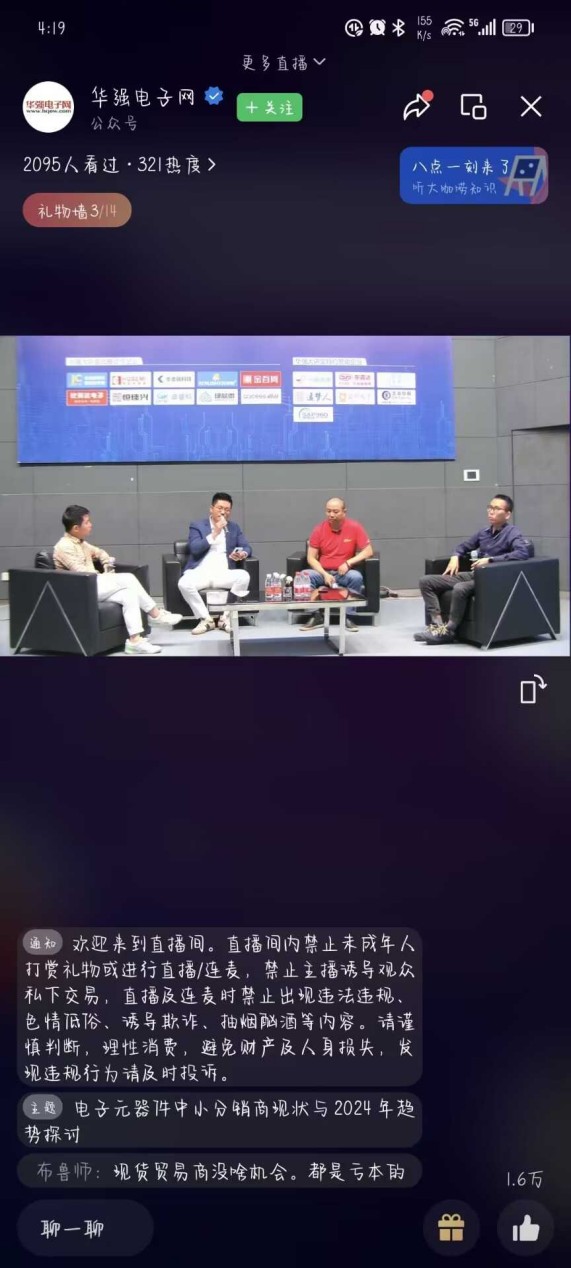
The round-table discussion in live stream
Standardisation comes first. Whether the sale is at home or abroad, these parts meet what most customers need, so they substitute easily and compete well. Size matters next: a small component saves warehouse space and travels easily, which cuts logistics cost and lifts efficiency. Keeping them in stock matters just as much. Selling overseas means long transit times and longer storage, and fresh produce, for example, requires cold-chain logistics, adding to storage and transportation costs. Semiconductor components have no such trouble, because they are compact and have a long shelf life under appropriate storage conditions. The last point counts most: these products can serve as alternatives to imported components, as their quality and performance have become increasingly competitive.
Mr. Song Shiqiang, general manager of Slkor, said: “China's semiconductor industry still needs to continue to innovate and make sustained efforts, but the shift made by traders has already become an important force behind the industry's development.” Traders who work with Chinese semiconductor companies to bring Chinese-made alternatives to market create a mutually beneficial relationship. Domestic manufacturers leverage traders' market resources and experience to expand into international markets, while traders benefit from the resulting business opportunities and profits.
China's semiconductor industry is a key part of the global industry, and with traders turning to domestic semiconductor substitution it offers considerable potential for further growth. As technology advances and policy support continues, the quality and performance of Chinese-made alternatives should keep rising, and they will gradually gain wider acceptance among buyers and end users. At Slkor, we look forward to exploring new opportunities, addressing emerging challenges and contributing to the continued development of China's semiconductor industry.
Introduction to Mr. Song Shiqiang
Mr. Song Shiqiang is the general manager of both Slkor and Kinghelm. He is a member of the expert pool of the Chinese Institute of Electronics, an expert on Huaqiangbei's economy and business ecosystem, and writes columns and popular-science articles. Song Shiqiang began his career as a front-line technician and has served as the chief executive of an internationally listed property company. He has wide experience in technical management and business operation, and he combines macroeconomic theory with the practical realities of running a business, leading his companies to rapid growth.
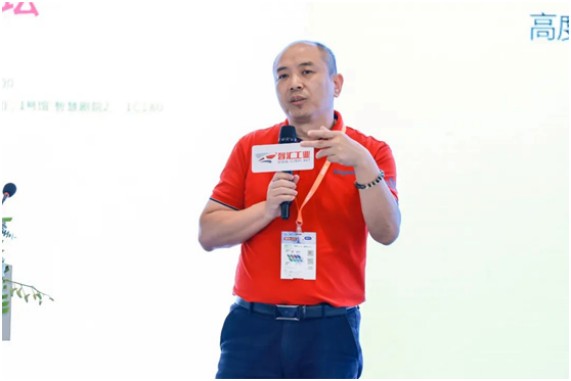
Mr. Song Shiqiang, general manager of Slkor and Kinghelm
Slkor and Kinghelm, the two companies in which Mr. Song Shiqiang has invested, are headquartered in Shenzhen, China, and both are recognised as National High-Tech Enterprises. The Slkor (www.slkoric.com) and Kinghelm (www.kinghelm.net) brands have continued to expand their presence in international markets. Shenzhen Slkor focuses on the development of new materials, new processes and new products; its technical team comes from Yonsei University in South Korea and Tsinghua University, and its silicon carbide MOSFET technology is internationally competitive. Slkor has grown from a fabless semiconductor design company into a business covering design and development, manufacturing, product sales and technical support, and it is a member of the Shenzhen Electronics Chamber of Commerce.
Related Recommendations