






















Service Hotline
News

News
KH-1.27PH180-1X10P-L7.2 Pin Header: Balancing Space Efficiency and Process Reliability
2026-08-17
28
In PCB layout design, connector selection is often overlooked compared with IC selection, yet connectors can have a direct and significant impact on the overall product structure, assembly efficiency, and long-term reliability. This is particularly true when product dimensions are constrained. Choosing the right pin-header pitch becomes a matter of trade-offs: a smaller pitch saves space, but an excessively small pitch can compromise soldering yield and mating-cycle durability. The Kinghelm KH-1.27PH180-1X10P-L7.2 vertical pin header is designed to strike a practical balance between these considerations.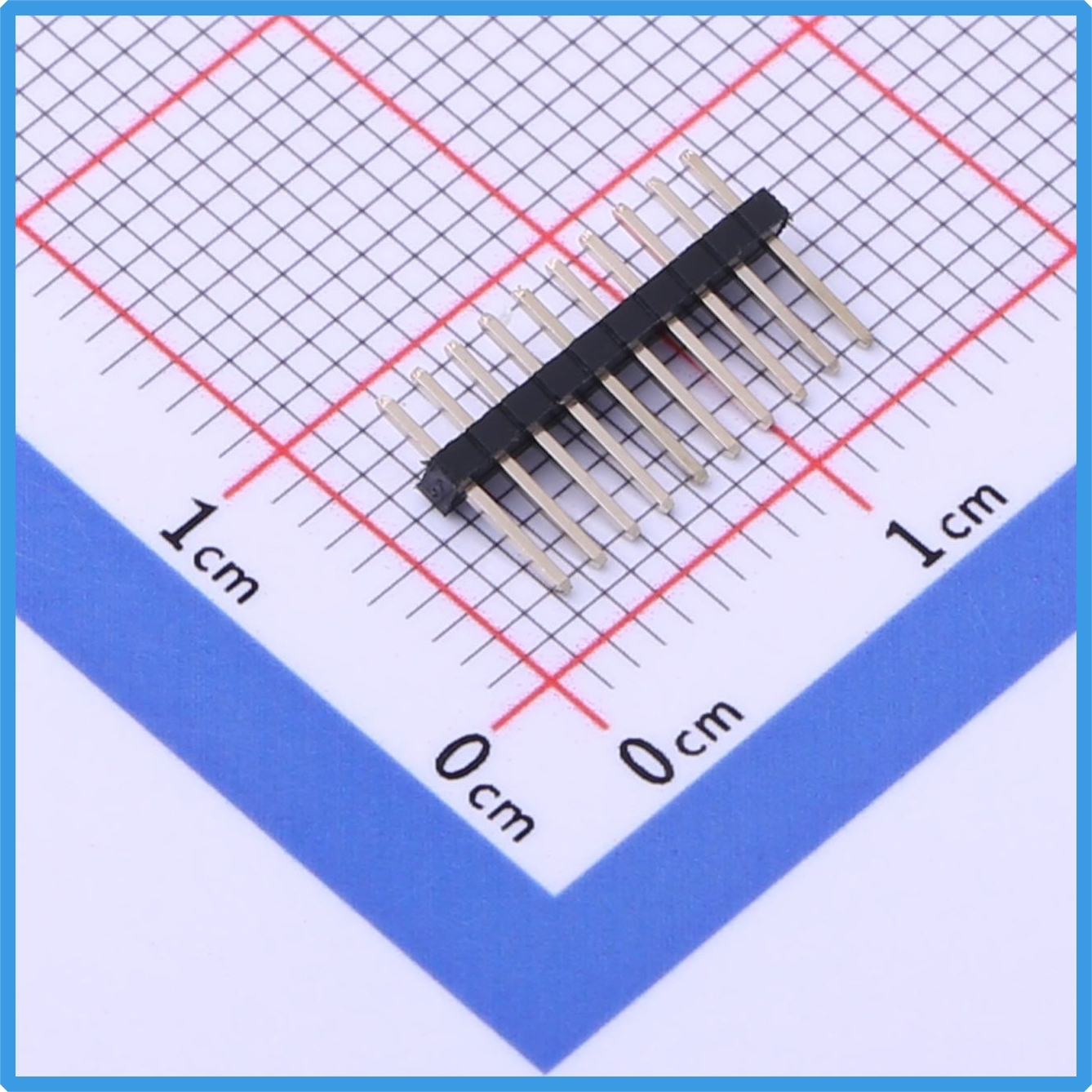
Kinghelm KH-1.27PH180-1X10P-L7.2 Product Image
I. The Practical Constraints of Pin-Header Pitch
Common pin-header pitches include 2.54 mm, 1.27 mm, 1.0 mm, and smaller pitches such as 0.5 mm. The 2.54 mm pitch is the long-established industry standard and offers generous process tolerances, but it takes up considerably more space in applications with many pins or limited PCB area. While 1.0 mm and smaller pitches provide greater compactness, they place higher demands on PCB manufacturing accuracy, assembly equipment, and repair capabilities. Their finer, more delicate pins are also more susceptible to bending during mating and unmating.
At 1.27 mm, the pitch sits between these two extremes. It reduces the linear footprint by approximately half compared with 2.54 mm, while retaining a larger pin cross-section and larger pad size than 1.0 mm headers. This provides a practical balance between space efficiency and process robustness. This is also why 1.27 mm headers are widely used in communication modules, industrial control equipment, portable devices, and other applications: they support compact designs without imposing excessive manufacturing and rework requirements.
II. Design Rationale Behind the Dimensions of the KH-1.27PH180-1X10P-L7.2
The header has an overall length of 7.2 mm, consisting of three sections: a 3.9 mm mating-pin length, a 1.0 mm insulator height, and a 2.3 mm termination-pin length. These dimensions are not arbitrary; they are optimized for typical application requirements.
-
3.9 mm mating-pin length: This is the effective insertion depth into the receptacle. Standard 1.27 mm receptacles on the market typically have an insertion depth of around 4.0 mm. A 3.9 mm mating length allows the pin tip to fully enter the working area of the receptacle's spring contact, ensuring reliable electrical contact while avoiding excessive insertion depth.
-
1.0 mm insulator height: The low-profile insulator helps minimize the height of the header above the PCB, making it advantageous in applications requiring close board-to-board stacking. However, the low-profile construction also means that the base has limited resistance to lateral forces, so excessive bending or prying should be avoided during installation.
-
2.3 mm termination-pin length: This length is suitable for PCBs approximately 1.0–1.6 mm thick. After soldering, an appropriate amount of pin remains exposed around the solder joint, making visual inspection and rework easier.
Together, these dimensions determine the compatible PCB thickness range and overall stacking height. During component selection, the specifications of the mating receptacle should therefore be considered together with the pin-header dimensions.
III. Electrical and Environmental Performance
With a rated current of 1 A, the header is suitable for most digital signal applications, such as I²C, UART, GPIO, and low-speed SPI, as well as low-power analog signals. When multiple pins are carrying current simultaneously, appropriate derating should be applied based on the actual temperature rise, as is standard practice for connectors.
The operating temperature range of −40°C to +105°C covers commercial and industrial applications. In terms of materials, the insulator should be capable of withstanding the peak temperatures associated with lead-free reflow soldering, typically below 260°C, while gold-plated contacts help improve oxidation resistance and maintain stable contact resistance. These characteristics make the header suitable for conventional indoor equipment, outdoor enclosures, and certain automotive applications outside high-temperature zones.
IV. Assembly and Usage Considerations
As a through-hole component, this vertical pin header is primarily intended for through-hole soldering processes. During automated wave soldering, the flux should be applied uniformly and the preheating temperature properly controlled to minimize issues such as solder balls and insufficient solder joints. For hand soldering, a temperature-controlled soldering iron is recommended, with the temperature set to approximately 330–350°C and the soldering time limited to 2–3 seconds.
It is worth noting that the insulator height is only 1 mm, resulting in a relatively thin base. When mating or unmating the receptacle, excessive rocking or lateral force should therefore be avoided, as it may cause the insulator to crack or the pins to loosen from the plastic body. For applications involving frequent mating cycles or significant vibration, additional mechanical support may be considered, such as adding alignment posts on both sides of the header or using a locking receptacle.
V. Application Suitability
The single-row, 10-pin design of the KH-1.27PH180-1X10P-L7.2 makes it suitable for module interfaces, debugging/programming ports, and board-to-board signal connections. Typical applications include vertical connections between wireless communication modules—such as NB-IoT, LoRa, and Wi-Fi modules—and their carrier boards, as well as external expansion interfaces on industrial sensor acquisition boards.
With 10 pins, the header can carry a group of parallel signals, such as 8 data lines plus 2 control lines, or serve as a convenient connection point for multiple independent signals.
Where a higher pin count is required, multiple headers of the same model can be installed side by side. However, consistent pitch alignment must be maintained to prevent accumulated tolerances from making mating difficult.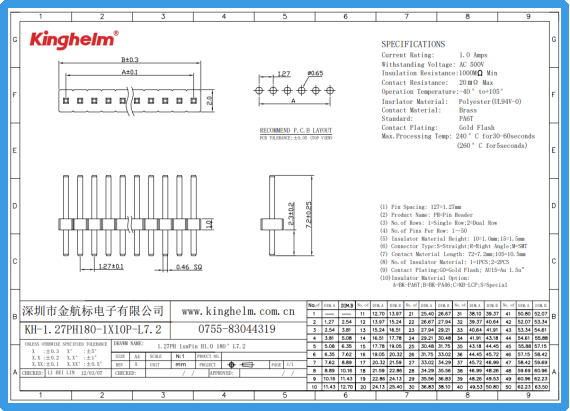
Kinghelm KH-1.27PH180-1X10P-L7.2 Specification
VI. Conclusion
The value of the Kinghelm KH-1.27PH180-1X10P-L7.2 pin header lies in its ability to strike a practical balance between miniaturization and manufacturability. A 1.27 mm pitch is neither the most compact nor the most spacious option, but it is precisely this middle ground that makes it an attractive choice for many electronic design projects seeking a good balance of cost, reliability, and space efficiency. Its dimensional specifications, electrical characteristics, and environmental performance are all oriented toward meeting mainstream engineering requirements rather than pursuing extreme specifications.
When selecting this header, engineers should evaluate the actual PCB thickness, mating-receptacle specifications, mating frequency, and operating temperature as a complete system. If the application conditions are consistent with the typical scenarios described above, this product can provide a stable and cost-effective interconnection solution.
About Kinghelm
Shenzhen Kinghelm Electronics Co., Ltd.(www.kinghelm.net)has technical backbones from Tsinghua University and UESTC, and has introduced overseas returnee professionals. Kinghelm is able to develop highly reliable and high-performance antenna and connector products.KH series products of "Kinghelm" brand include Beidou/GPS antennas, RF adapter connectors, plug connector, electrical data connectors, terminals, and customized vehicle harnesses, industrial / medical connectors, and special antenna connectors."Kinghelm connects world", Kinghelm has grown with the development of China's Beidou industry. Starting from supplying Beidou/GPS dual mode antennas, IPEX terminals, and RF adapter cables for automotive manufacturers, Kinghelm has continuously developed products. Currently, it has a series of WiFi, Bluetooth, NB-loT, LoRa, Zigbee, UWB, and GSM antennas, RFID tags, RF adapter cables, standard microwave antennas, vehicle grade SMA, SMB, FAKRA holders, coaxial cables, and can customize non-standard antenna connectors based on customer drawings or samples.
Related Recommendations