Service Hotline
Resources

Resources
What Are the Types of Communication Antennas? A Comprehensive Overview from Classification to Application
2025-07-17
1330
Communication antennas act as the “bridge” of wireless communication. Different scenarios require varying coverage ranges, transmission distances, and anti-interference capabilities, which has led to the development of multiple types of communication antennas. This article systematically reviews antenna classifications and characteristics from the perspectives of radiation direction, operating frequency, application scenarios, and more—helping you quickly identify the right antenna for your needs.
1. Classification by Radiation Direction: Key Differences Between Omnidirectional and Directional Antennas
This is the most basic way to classify antennas, based on the directional characteristics of signal coverage:
(1) Omnidirectional Communication Antennas
Features: Uniformly radiate signals in a 360° horizontal plane, with vertical coverage angles typically ±30°–±60°. Gain is relatively low (usually 3–8 dBi), and they don’t require precise alignment.
Typical structure: Often cylindrical (e.g., fiberglass omnidirectional antennas) or whip-shaped (e.g., walkie-talkie antennas), using spiral or vertical radiating elements inside.
Typical applications:
Scenarios that need to transmit signals in multiple directions, such as outdoor base stations covering nearby devices, IoT gateways connecting multiple sensors.
Mobile devices (e.g., vehicle antennas), where the position changes dynamically and omnidirectional coverage avoids signal interruptions.
Representative models:
433 MHz fiberglass omnidirectional antenna (gain 5 dBi)
2.4 GHz whip omnidirectional antenna
(2) Directional Communication Antennas
Features: Focus signals in a specific direction (horizontal beamwidth usually 30°–120°), with higher gain (8–40 dBi). They require precise alignment with the communication target and support longer transmission distances.
Typical structures:
Yagi antennas (composed of reflector, driven element, and directors; gain 8–15 dBi)
Parabolic antennas (dish-shaped reflectors focusing signals; gain 15–40 dBi)
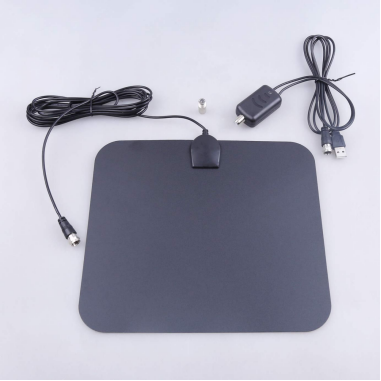
Flat panel directional antennas (flat design; gain 10–20 dBi; ideal where space is limited)
Typical applications:
Point-to-point long-distance communication, such as backhaul links between mountain base stations, or drone video transmission (which requires directional HD video links).
Scenarios with high anti-interference demands (focused beams reduce interference), such as industrial equipment monitoring networks.
Representative models:
5.8 GHz flat panel directional antenna (gain 14 dBi)
12 GHz parabolic directional antenna (gain 30 dBi)
2. Classification by Operating Frequency: Matching Different Band Requirements
Communication antennas need to match the signal frequency to operate efficiently. By frequency, they can be categorized as follows:
(1) Low-Frequency Communication Antennas (30 kHz–300 MHz)
Features: Longer wavelengths (1–1000 meters) provide strong diffraction (signals bend around obstacles), but they have lower gain and slower data rates, making them suitable for long-range, low-speed communication.
Typical applications:
Broadcasting (e.g., AM radio at 535–1605 kHz)
Shortwave communication (3–30 MHz, for maritime and aviation long-distance communication)
Low-speed IoT devices (e.g., 433 MHz sensors with 1–3 km range and low power consumption)
Representative models: Shortwave whip antennas, 433 MHz directional Yagi antennas
(2) Radio Frequency (RF) Communication Antennas (300 MHz–300 GHz)
Features: Cover mainstream wireless communication bands, with shorter wavelengths (1 mm–1 m), higher gain, and faster data rates. They generally require line-of-sight transmission because of weaker diffraction.
Subtypes:
Ultra-high frequency (UHF, 300 MHz–3 GHz): e.g., 2.4 GHz WiFi antennas, 1.8 GHz mobile communication antennas
Millimeter wave (above 24 GHz): e.g., 28 GHz 5G base station antennas, 77 GHz automotive radar antennas for high-speed, low-latency applications
Typical applications:
Smartphones, routers, drone video transmission (2.4/5 GHz)
5G backhaul links (28 GHz), satellite communications (Ka band, 20–30 GHz)
(3) High-Frequency Communication Antennas (above 300 GHz)
Features: Extremely short wavelengths (sub-millimeter), very wide bandwidth (high data rates), but signals attenuate quickly (affected by rain and fog), with effective distances of just a few meters to tens of meters.
Typical applications: Lab-level high-speed communications, short-range millimeter-wave radars (e.g., security screening equipment)
3. Classification by Structure and Shape: Identifying Functions by Appearance
Different designs meet specific application needs; by observing the structure, you can often tell what type of antenna it is:
(1) Linear / Rod Antennas
Features: Simple structures, usually a single metal rod or wire-like radiator, cost-effective, easy to install, lower gain (1–5 dBi).
Typical applications:
Short-distance communication like walkie-talkies (UHF/VHF bands)
Remote controllers (315 MHz)
Bluetooth devices (2.4 GHz)
Representative models: Telescopic rod antennas on FM radios, antennas on children’s toy remotes
(2) Planar Antennas
Features: Use flat or curved reflectors to focus or radiate signals, with higher gain and stronger directionality. Suitable for long-distance directional communication.
Subtypes:
Flat panel directional antennas (10–20 dBi gain, e.g., Massive MIMO antennas for 5G)
Parabolic antennas (dish reflectors, 20–40 dBi gain, e.g., satellite receivers, microwave relays)
Typical applications: Satellite communication (tracking geostationary satellites), long-distance monitoring (5–50 km)
(3) Array Antennas
Features: Made up of multiple radiating elements, with phase control enabling beamforming (dynamically adjusting beam direction). High gain (10–30 dBi) and support for multi-user communication.
Typical applications: Large-scale MIMO antennas in 5G base stations (e.g., 64T64R systems serving dozens of users simultaneously, boosting capacity by 3–5x)
(4) Microstrip (Patch) Antennas
Features: Use metal patches printed on PCB boards as radiating elements; very compact (millimeter scale) and lightweight—ideal for integration into small devices.
Typical applications: Smartphones, smartwatches, drones, supporting 2.4 GHz WiFi, Bluetooth, GPS, etc.
4. Classification by Application Scenario: Purpose-Built Specialized Antennas
Different environments require antennas with different durability, size, and performance characteristics, leading to specialized designs:
(1) Base Station Antennas
Features: Wide frequency bands (supporting multiple standards like 2G/3G/4G/5G), high gain (8–18 dBi), multi-beam design, with lightning protection and weather resistance (-40°C to 85°C).
Typical installation: Mounted on towers or rooftops, using directional sector antennas (for specific coverage areas) or omnidirectional antennas (for smaller coverage areas)
(2) Satellite Communication Antennas
Features: Extremely high gain (20–40 dBi), narrow beams (within ~1°), require precise tracking (alignment accuracy of ~0.1°), and strong interference rejection (built-in filters).
Subtypes:
Fixed satellite antennas (e.g., home satellite TV dishes receiving geostationary satellite signals)
On-the-move satellite antennas (vehicle/ship-mounted, auto-tracking satellites to keep connections stable in motion)
(3) IoT Communication Antennas
Features: Low power consumption, compact size, support for LPWAN protocols (LoRa, NB-IoT) at 433 MHz, 868 MHz, 915 MHz.
Typical applications: Smart meters (water, electricity), agricultural sensors (soil moisture), with ranges of 1–10 km
(4) Vehicle-Mounted Communication Antennas
Features: Shock-resistant (withstand up to 100G), waterproof (IP67), mostly omnidirectional or wide-beam directional designs, supporting GPS, 4G/5G, and V2X (vehicle-to-everything) bands.
Typical installation: Car roofs (e.g., shark fin antennas), side mirrors (hidden antennas)
(5) Industrial Communication Antennas
Features: Anti-interference (shielded metal casing), corrosion-resistant (stainless steel or fiberglass), suitable for factories, oil fields, mines, supporting industrial IoT (IIoT) communication.
5. Core Parameter Comparison of Different Communication Antennas
Category | Antenna Type | Gain Range | Coverage Direction | Typical Frequency | Representative Application |
Radiation Direction | Omnidirectional | 3–8 dBi | 360° omnidirectional | 2.4 GHz | Wireless bridges |
Radiation Direction | Directional | 8–40 dBi | 30°–120° directional | 5.8 GHz | Satellite communication |
Frequency | Low-frequency | 1–5 dBi | Mainly omnidirectional | 433 MHz | Sensors |
Frequency | RF antennas | 5–20 dBi | Omnidirectional/Directional | 28 GHz | 5G base stations |
Application | Base station | 8–18 dBi | Directional sector | Multi-band | Mobile network coverage |
Application | Microstrip | 2–5 dBi | Omnidirectional/Directional | 2.4 GHz | Smartphones |
6. How to Quickly Choose the Right Communication Antenna
(1) Check coverage needs: For multi-direction coverage, choose omnidirectional; for point-to-point long distance, choose directional antennas.
(2) Match the frequency: Ensure the antenna band matches your device (e.g., WiFi devices need 2.4/5 GHz antennas).
(3) Consider the environment: Outdoor use? Choose fiberglass housings (corrosion-resistant). Industrial use? Choose anti-interference array antennas.
(4) Check installation conditions: Limited space? Use microstrip antennas. Need to move? Use whip omnidirectional antennas.
7. Summary
Communication antennas come in many forms, but the core classification is clear:
By radiation direction: omnidirectional vs. directional
By frequency: from low frequency to millimeter wave
By scenario: base station, satellite, IoT, and more
Understanding these features and applications helps you avoid “poor signal” problems caused by choosing the wrong antenna.
Related Recommendations