






















Service Hotline
Resources

Resources

What reliability tests can your in-house laboratory perform independently, including high/low temperature, 120-hour salt spray, and repeated mating life tests?
2026-09-19
53
Kinghelm has its own RF reliability laboratory in Dongguan Tangxia, capable of performing the following tests independently:
Environmental tests: High/low temperature cycling, high/low temperature storage, 120-hour salt spray, and damp heat aging.
Mechanical tests: Repeated mating life, vibration testing, mechanical shock, and cable bend/swing tests.
Electrical/RF tests: Insulation resistance, dielectric withstand voltage, contact resistance; VSWR and insertion loss RF performance testing using a network analyzer.
For certain stringent third-party certification requirements, we can also cooperate with external accredited laboratories.
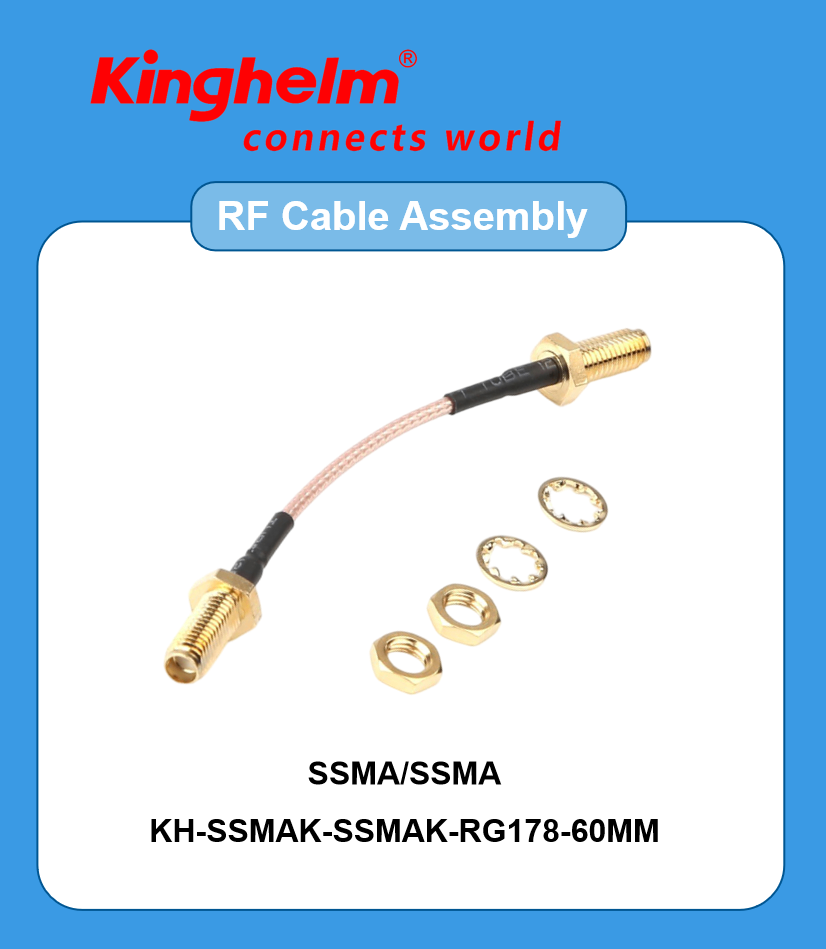
KH-SSMAK-SSMAK-RG178-60MM RF Cable Assembly: Compact and Flexible for Short-Distance, High-Frequency Signal Connections
2026-09-19
60
In wireless communication, RF testing, electronic equipment, and high-frequency module applications, the available installation space inside a device is often limited. Conventional RF cable assemblies may be difficult to install in compact equipment due to their size and routing requirements. To meet the connection needs of compact electronic devices, Kinghelm offers the KH-SSMAK-SSMAK-RG178-60MM RF Cable Assembly. This assembly features SSMA female connectors on both ends and flexible RG178 coaxial cable with a total cable length of 60mm. Its compact construction and flexible routing make it suitable for short-distance, high-frequency signal connections in space-constrained equipment.
Product Description: SSMA female to SSMA female RF Cable Assembly, using brown RG178 coaxial cable with a cable length of 60mm.
Brand Name: Kinghelm
Part Number: KH-SSMAK-SSMAK-RG178-60MM
Packaging: Bag
Gross Weight: 7.3g
The overall RF Cable Assembly is compact and easy to install and route inside equipment with limited space. It can be used for RF modules, communication modules, testing equipment, and other applications requiring short-distance high-frequency signal connections.
Kinghelm KH-SSMAK-SSMAK-RG178-60MM Product Image
SSMA Female Connectors for Compact RF Connections
The KH-SSMAK-SSMAK-RG178-60MM RF Cable Assembly features SSMA female connectors with female contacts on both ends. Both connectors are straight-type and gold-plated, providing a compact connection solution for compatible SSMA RF interfaces.
SSMA connectors are suitable for applications where a small form factor and reliable RF connection are required. Their compact design makes them suitable for wireless communication equipment, RF modules, high-frequency electronic devices, test instruments, and other space-constrained systems.
With SSMA female connectors on both ends, this RF Cable Assembly can be used to connect compatible SSMA interfaces directly. The integrated cable assembly can simplify connections between RF modules and reduce the need for additional adapters in suitable applications.
Flexible RG178 Coaxial Cable for Easy Installation
The RF Cable Assembly uses brown RG178 coaxial cable with an approximate outer diameter of 1.8mm. The slim and flexible cable construction makes it suitable for internal wiring and short-distance RF signal connections in electronic equipment.
The 60mm cable length is designed for applications where two RF interfaces are located relatively close to each other. Compared with longer cable assemblies, the short cable length helps reduce excess wiring inside compact equipment and allows a cleaner internal layout.
The flexible RG178 coaxial cable can also be routed according to the internal structure of the device, making the assembly convenient for connections between PCBs, RF modules, wireless communication modules, and other high-frequency components.
Black Heat-Shrink Tubing for Added Protection
The KH-SSMAK-SSMAK-RG178-60MM RF Cable Assembly is equipped with black heat-shrink tubing measuring approximately OD 2.5 × 1.5mm. The heat-shrink tubing covers the corresponding connection area, helping protect the cable assembly while providing a neat and organized appearance.
In compact electronic equipment, proper cable routing and connection protection are important during installation and assembly. The heat-shrink tubing helps keep the connection section compact and organized, making the RF Cable Assembly convenient for equipment installation, testing, and production.
300V Withstand Voltage
The KH-SSMAK-SSMAK-RG178-60MM RF Cable Assembly has a withstand voltage of 300V and can be used in electronic equipment and RF connection applications that meet the corresponding electrical requirements.
When selecting an RF Cable Assembly for a specific application, users should consider the operating voltage, operating frequency, impedance, connector specifications, installation conditions, and other system requirements.
For applications with specific RF performance requirements, the complete system specifications should be evaluated before use. Factors such as operating frequency, cable length, connector matching, installation method, and operating environment may affect the actual performance of an RF Cable Assembly.
Designed for Short-Distance High-Frequency Signal Connections
With its compact SSMA connectors, flexible RG178 coaxial cable, and 60mm cable length, the KH-SSMAK-SSMAK-RG178-60MM RF Cable Assembly can be used in a variety of short-distance RF signal connection applications.
Typical applications include wireless communication equipment, RF modules, high-frequency electronic modules, RF testing equipment, test fixtures, PCB-to-module connections, and other electronic devices requiring compact RF interconnections.
For compact communication equipment and electronic instruments where internal installation space is limited, this RF Cable Assembly provides a practical way to connect compatible SSMA interfaces while keeping the internal wiring short and organized.
Compact Construction for Space-Constrained Equipment
One of the key features of this RF Cable Assembly is its compact overall construction. The combination of small SSMA connectors and slim RG178 coaxial cable allows the assembly to occupy relatively little space compared with larger RF cable solutions.
The 60mm cable length is particularly suitable for short-distance connections between closely positioned components. In equipment where internal space is limited, a properly sized RF Cable Assembly can help simplify cable routing and reduce unnecessary cable loops.
This makes the product suitable for applications where both connector compatibility and installation flexibility are important considerations.
Kinghelm KH-SSMAK-SSMAK-RG178-60MM Specification
Bag Packaging for Convenient Storage and Use
The KH-SSMAK-SSMAK-RG178-60MM RF Cable Assembly is supplied in bag packaging, with a gross weight of approximately 7.3g. The clearly defined part number and product specifications make it convenient for identification, storage, research and development, testing, assembly, and production applications.
Overall, the Kinghelm KH-SSMAK-SSMAK-RG178-60MM is a compact SSMA Female to SSMA Female RF Cable Assembly designed for short-distance, high-frequency signal connections. It features SSMA female connectors with female contacts on both ends, straight gold-plated connectors, and flexible brown RG178 coaxial cable.
With a 60mm cable length, approximately 1.8mm cable outer diameter, OD 2.5 × 1.5mm black heat-shrink tubing, and 300V withstand voltage, this RF Cable Assembly is suitable for compact electronic equipment where space, cable routing, and connector compatibility are important considerations.
Depending on the specific interface and technical requirements, the KH-SSMAK-SSMAK-RG178-60MM can be considered for wireless communication modules, RF testing equipment, high-frequency electronic modules, PCB-to-module connections, test fixtures, and other short-distance RF signal interconnection applications.
About Kinghelm
According to Song Shiqiang, Kinghelm’s top 20 best-selling products cover Type-C and HDMI connectors, automotive wiring harnesses, adapter cables, pin headers, terminals, and other categories. The company also has strong capabilities in RF coaxial connectors such as SMA, IPEX, and MCX, as well as RF cables and antennas, including GPS antennas.
Among them, KH-IPEX-K501-29 has sold more than 200,000 units and has been featured on the LCSC homepage, while KH-SMA-K513-G has appeared on the homepage best-selling list multiple times. KH-TYPE-C-16P is one of Kinghelm’s top-five best-selling Type-C horizontal SMT female connectors. Other consistently popular products include KH-SMA-KE-Z, KH-SMA-KWE17-G, KH-MMCX-Z, KH-3216-A35, KH-IPEX4-2020, KH-RJ45-58-8P8C, and KH-RCH56-8P8C-D.
These products are widely used in communications, consumer electronics, automotive electronics, and IoT applications. Leveraging its strengths in R&D, quality, and supply chain management, Kinghelm focuses on independent innovation and domestic alternatives, continuously expanding its product portfolio and earning market recognition with a diverse range of best-selling products.
KH-SSMAK-SSMAK-RG178-60MMView Product Details
What length options are available for RF cables?
2026-09-18
164
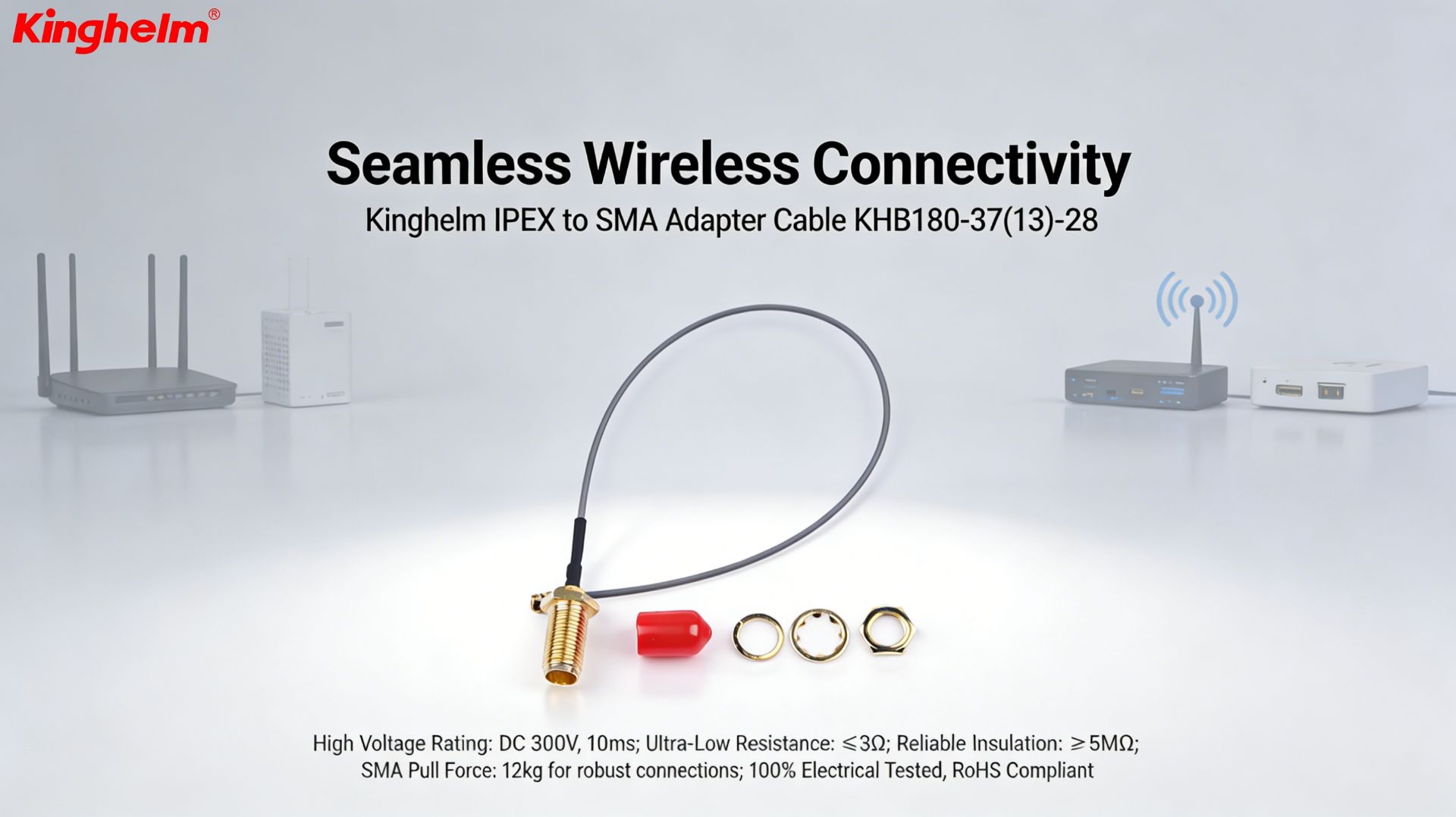
The length of RF cables can be customized according to the customer’s specific application requirements. Standard cable lengths typically range from a few centimeters to several meters. For applications with limited installation space or short distances between modules, ultra-short RF cable assemblies with lengths of around 10 mm or more can be provided. These compact cables are suitable for applications such as internal module connections, board-to-board connections, and connections between RF modules and antennas, helping minimize cable space while meeting installation and assembly requirements.
For longer RF cables, especially those measuring several meters, the cable length needs to be evaluated together with the operating frequency, cable type, physical dimensions, impedance requirements, and allowable signal loss. As cable length increases, insertion loss during RF signal transmission also increases. Therefore, for long-distance or high-frequency applications, low-loss RF cables are generally recommended to help maintain signal integrity, transmission quality, and overall system performance.
RF cable lengths are not limited to standard specifications and can be cut and customized based on the customer’s equipment structure, installation distance, and application requirements. Whether you need millimeter-level ultra-short cables, conventional cables ranging from several centimeters to hundreds of centimeters, or meter-level long cables, customized solutions can be evaluated according to the specific project requirements.
For cable lengths beyond the standard range, we can further evaluate the appropriate cable type and assembly solution based on the operating frequency, maximum allowable insertion loss, installation environment, bending requirements, and other application conditions, ensuring that the selected RF cable meets the electrical and mechanical requirements of the system.
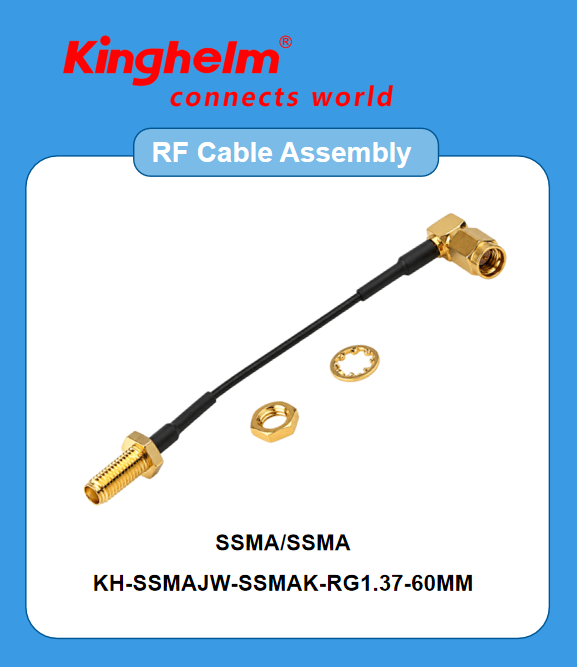
KH-SSMAJW-SSMAK-RG1.37-60MM RF Cable Assembly: Ideal for High-Frequency Connections in Tight Spaces
2026-09-18
208
In high-frequency electronic equipment, wireless communication modules, and various RF systems, cables may be relatively small components, but they play an important role in stable signal transmission and efficient internal device layout. This is especially true for compact electronic devices, where conventional RF cables with larger dimensions can be limited by installation space, bending radius, and connector orientation.
For applications that require short-distance, high-frequency signal transmission within a confined space, a compact RF coaxial cable with flexible connector configurations can make equipment design and assembly more convenient.
Kinghelm KH-SSMAJW-SSMAK-RG1.37-60MM Product Image
1. Product Specifications
Brand: Kinghelm
Model: KH-SSMAJW-SSMAK-RG1.37-60MM
Product Type: RF Coaxial Cable
Cable Length: 60 mm
Coaxial Cable: RG1.37 black coaxial cable
Cable Outer Diameter: Approx. 1.3 mm
One-End Connector: SSMA female, female contact (socket), straight type, gold-plated
Other-End Connector: SSMA male, male contact (pin), right-angle type, gold-plated
Heat-Shrink Tubing: OD 2.5 × 1.5 mm
Tubing Color: Black
Rated Voltage: 300 V
Packaging: Bag
2. 60 mm Compact Design for Space-Constrained Connections
The Kinghelm KH-SSMAJW-SSMAK-RG1.37-60MM RF coaxial cable is designed for compact connection applications. With an overall length of only 60 mm, it uses RG1.37 black coaxial cable and features an SSMA right-angle male connector on one end and an SSMA female straight connector on the other, resulting in a compact and space-efficient assembly.
In wireless communication equipment, RF modules, test modules, embedded electronic devices, and similar products, internal installation space is often limited, while the distance between interfaces may be relatively short. Excessively long cables can make routing more difficult and may require additional looping, securing, or cable management.
The 60 mm cable length is well suited to short-distance connections and allows interfaces within a device to be connected directly according to their physical positions, helping simplify assembly and cable routing.
For electronic equipment designed with miniaturization and modularity in mind, a compact cable assembly can also reduce interference with surrounding components and occupy less valuable internal space.
3. SSMA Right-Angle Male and Straight Female Connectors for Flexible Installation
One of the key features of this product is its combination of two different SSMA connector configurations. One end is an SSMA male right-angle connector with a male pin, while the other end is an SSMA female straight connector with a female contact. Both connectors feature gold-plated contacts.
The right-angle design changes the direction in which the cable exits the connector. When space around an interface is limited, or when the cable needs to be routed along the edge of a device or parallel to a PCB, a right-angle connector can help reduce the space required for cable routing and provide greater installation flexibility.
The other end uses a straight SSMA female connector for connection to a corresponding SSMA male interface. The male-to-female configuration allows the cable to be used for specific RF interconnection requirements between compatible interfaces.
For R&D engineers, electronics engineers, and production technicians, selecting an appropriate connector configuration can help simplify internal RF cable routing and facilitate connections between modules.
4. RG1.37 Coaxial Cable for Compact High-Frequency Connections
The cable assembly uses RG1.37 black coaxial cable with an outer diameter of approximately 1.3 mm. Compared with larger-diameter coaxial cables, the RG1.37 format provides a more compact solution for applications where internal installation space is limited.
A coaxial cable typically consists of an inner conductor, dielectric insulation, and an outer shielding structure, forming a controlled transmission path for RF and high-frequency signals. Coaxial interconnection is widely used in RF modules, wireless communication equipment, and other high-frequency electronic systems.
For a short 60 mm connection, the small-diameter RG1.37 cable helps minimize the physical footprint of the cable assembly while providing a practical solution for internal RF interconnection.
5. Gold-Plated Connectors for RF Interconnection Applications
Both connectors are gold-plated. The SSMA female connector features a straight configuration with a socket contact, while the SSMA male connector features a right-angle configuration with a male pin.
As important components in an RF signal path, connectors must provide reliable mechanical mating and stable electrical contact. Gold-plated contact surfaces are commonly used in electronic connectors to support reliable contact performance and durability in appropriate applications.
The combination of SSMA connectors, RG1.37 coaxial cable, and a 60 mm overall length gives this cable assembly a compact form factor that is well suited to short-distance RF interconnections in space-constrained electronic equipment.
6. Black Heat-Shrink Tubing for Added Protection
The cable assembly is fitted with OD 2.5 × 1.5 mm black heat-shrink tubing.
The heat-shrink tubing is primarily applied around the transition area between the cable and connector, providing additional protection and helping reinforce the cable-to-connector interface.
For electronic equipment that requires installation, adjustment, or maintenance, maintaining the structural integrity of the transition area between the coaxial cable and connector is important for reliable cable management.
The black heat-shrink tubing matches the black RG1.37 coaxial cable, giving the assembly a clean and consistent appearance. Its compact size and black finish also make it convenient for organized internal cable routing.
7. 300 V Rated Voltage for Applicable Equipment Connections
This model is specified with a rated voltage of 300 V. When selecting a cable for a particular application, the actual operating voltage, frequency, power level, interface specifications, and other system requirements should be considered together. The rated voltage alone should not be used to determine whether the cable is suitable for a specific RF system.
For RF equipment, connector type, cable specification, connector configuration, installation dimensions, and other mechanical and electrical parameters are also important considerations. Engineers should therefore evaluate the complete system requirements when designing an RF interconnection solution.
Kinghelm KH-SSMAJW-SSMAK-RG1.37-60MM Datasheet
8. Suitable for Short-Distance Connections Inside Electronic Equipment
With its 60 mm cable length, approximately 1.3 mm cable diameter, and right-angle male connector, the KH-SSMAJW-SSMAK-RG1.37-60MM is particularly suited to RF interconnection applications where installation space is limited.
Potential applications include wireless communication equipment, RF modules, communication terminals, test and measurement equipment, embedded electronic devices, and other products that use compatible SSMA interfaces. Depending on the specific interface layout, the cable can be used for short-distance RF connections between modules or between RF interfaces inside a device.
For designs with limited PCB space or closely positioned interfaces, the 60 mm cable length can help reduce excess cable while the right-angle male connector provides greater flexibility in cable routing and allows the assembly to better conform to the internal mechanical structure of the equipment.
9. Conclusion
As modern electronic equipment continues to become smaller and more highly integrated, connectors and cable assemblies must also adapt to increasingly compact internal layouts.
The Kinghelm KH-SSMAJW-SSMAK-RG1.37-60MM RF coaxial cable features a compact 60 mm length, an SSMA right-angle male connector on one end, and an SSMA straight female connector on the other. It uses RG1.37 black coaxial cable to create a compact and flexible RF interconnection solution.
With its combination of compact dimensions, practical connector configuration, and small-diameter coaxial cable, this cable assembly is designed with space-constrained, short-distance, high-frequency signal interconnection applications in mind.
For equipment requiring internal RF cable routing, module-to-module interconnection, or short-distance RF connections between compatible SSMA interfaces, the KH-SSMAJW-SSMAK-RG1.37-60MM can be considered based on the specific interface requirements, electrical specifications, and available installation space.
As electronic equipment moves toward greater miniaturization, modularization, and integration, a properly sized and appropriately configured RF cable can also contribute to more efficient internal layouts. For engineers looking for a compact SSMA interconnection solution, the KH-SSMAJW-SSMAK-RG1.37-60MM provides one option for space-constrained RF applications.
About Kinghelm
Kinghelm (www.kinghelm.net), has been specializing in electronic interconnection and RF products for nearly 20 years.
The company offers a broad portfolio of popular and high-demand products, with key models including KH-IPEX-K501-29, KH-SMA-K513-G, KH-TYPE-C-16P, KH-IPEX4-2020, KH-RJ45-58-8P8C, KH-RCH56-8P8C-D, KH-PJ-209-SMT, KH-TYPE-C-W-16P-T, and KH-BNC50-3511.
Its product portfolio covers major categories such as RF coaxial connectors, USB connectors, Ethernet connectors, and audio connectors, while also extending to Type-C, SMA, IPEX, MCX, HDMI connectors, automotive wiring harnesses, adapter cables, pin headers, terminals, RF cables, antennas, GPS antennas, Wi-Fi antennas, BeiDou antennas, internal antennas, 4G antennas, ceramic antennas, RF connectors, electronic components, sensors, DC sockets, FPC connectors, waterproof USB connectors, and more than 20 additional product categories.
With a focus on stable performance and cost-effective solutions, Kinghelm's products have earned the long-term trust of more than 20,000 customers worldwide and are widely used across communications, automotive applications, industrial IoT, and other advanced technology sectors.
KH-SSMAJW-SSMAK-RG1.37-60MMView Product Details
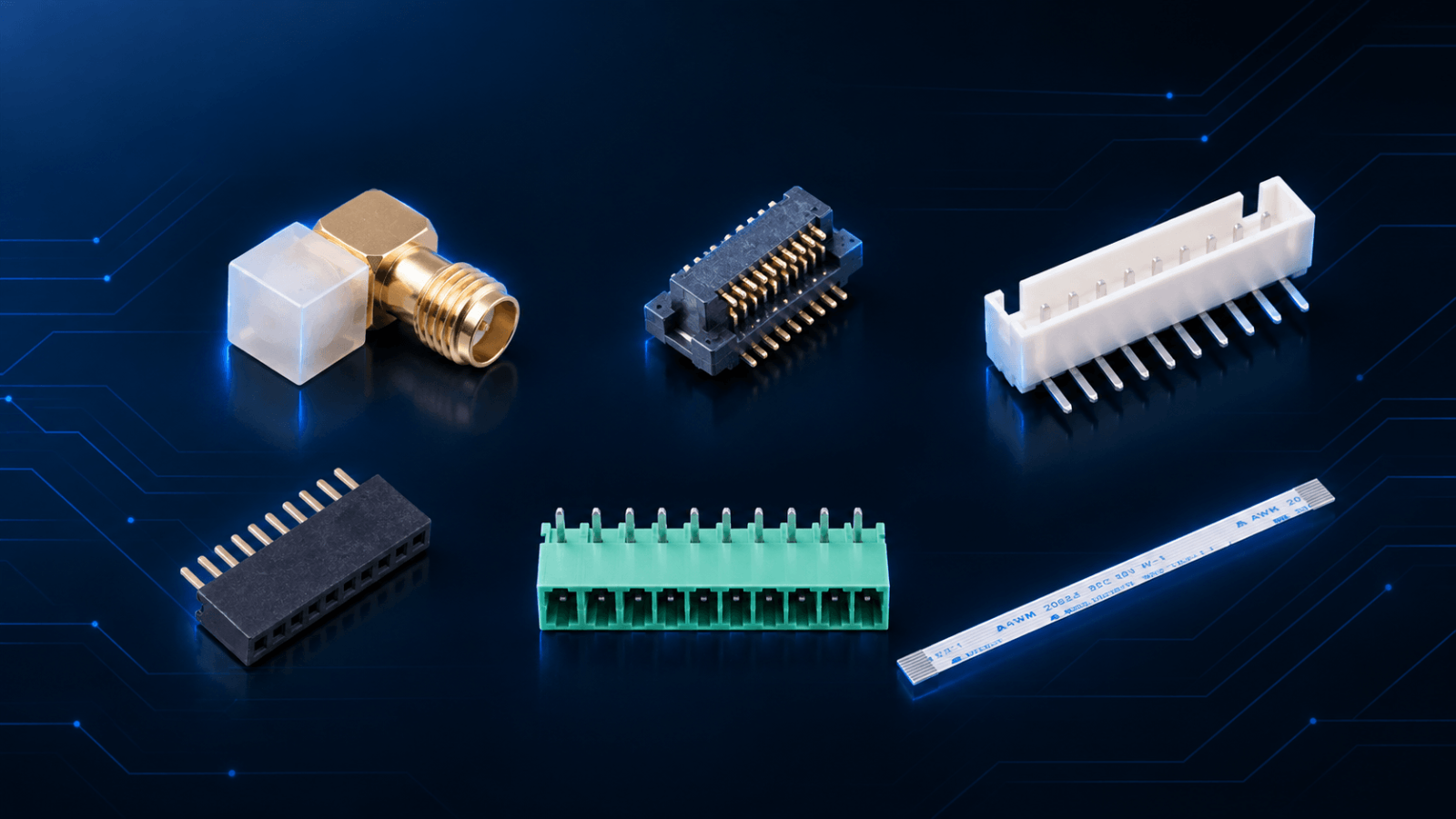
Connector Selection Checklist: Matching RF, Board-to-Board and Wire-to-Board Families to Your Design
2026-09-17
226
Most of the work in how to choose a connector for PCB design is finished before anyone opens a connector catalogue, which is why a connector selection checklist starts with the design rather than with a part number. Three things are usually already settled by the time the layout is frozen: the impedance and frequency the RF path has to carry, the stack height and board outline the enclosure allows, and whether anyone will need to open the unit after it ships.
Treat those three as inputs rather than options. A 50 Ω path running from DC to 6 GHz points at coaxial interfaces and quietly removes ribbon, header and terminal-block families from the shortlist, whatever their unit price looks like. A 1.2 mm gap between two parallel boards is not a preference; it decides which board-to-board pitches stay realistic. If the assembly has to be serviced in the field, a permanently soldered board-to-board pair drops out long before cost is discussed.
Keeping those answers in one place is what makes the checklist worth reusing. It records what the design has already decided, which leaves a candidate list small enough to compare properly.
Connector Selection Criteria That Eliminate Families, In Order
Once those inputs are fixed, connector selection criteria narrow the field in sequence. Running the three questions below out of order is what creates the awkward cases: a part that meets the electrical requirement, cannot be written into a purchase order cleanly, and arrives with drawings that disagree with the footprint.
Signal, power, or both. The first question is what actually travels through the contact. Signal-only paths with controlled impedance lead toward coaxial families; power-only paths lead toward terminal blocks and heavier headers; mixed paths usually force a compromise on pin count or plating. This single answer typically removes half the candidates.
Board-to-board, or board-to-cable. A connection that stays fixed between two boards for the life of the product belongs to the board-to-board and FFC/FPC families. One that has to route around a hinge, pass through a chassis wall, or unplug for service belongs to wire-to-board or cable-assembly territory. Leaving this question until late is expensive, because a design that assumes a pluggable harness but specifies a soldered joint is reworked on the production line rather than on paper.
Current, and how often it is mated. Current sets the minimum contact size and, indirectly, the pitch. Mating frequency sets the contact geometry. A connector mated once during assembly and one mated every time a technician swaps a module are different products, even when they share a 1.27 mm pitch and the same footprint.
The order matters because each answer narrows the next one. Choosing pitch first and working backwards to current is how a 0.5 mm part ends up specified for a load it cannot carry.
What Survives: Connector Selection By Application
After those three questions, what usually remains is one family, occasionally two. The table below is the comparison sheet worth carrying into connector selection by application. The last column is the item to have in writing before an order is raised.
Family
Typical pitch / interface
Current
Typical mating life
Confirm before ordering
RF / coaxial
50 Ω interface (SMA, SMB, IPEX, FAKRA), DC to 6 GHz
Signal path, up to 1 A
~500 cycles (typical)
Impedance, upper frequency and contact plating. KH-SMA-K513-G
Board-to-board
0.5 mm (2.5 mm XH also counted here)
~0.5 A per contact
~20 to 30 cycles (typical)
Stack height and alignment tolerance. KH-WB105-F20E-04L, KH-XH-11A-Z
Wire-to-board
2.54 mm
3 A / 250 V
~30 cycles (typical)
Wire gauge and lock retention. KH-A2504-10AW
FFC / FPC
0.5 mm / 1.0 mm
~0.5 A per contact
~20 to 30 cycles (typical)
Insertion direction and bend radius. KH-FFC-A0.5-10P, KH-FFC-V0.5-10P
Pin and female header
1.27 mm (2.0 / 2.54 mm in the same family)
1.0 A / AC 500 V
~50 cycles (typical)
Stack height and selective gold plating. KH-1.27FH-1X10P-H4.3
Terminal block / industrial
3.81 mm
8 A / 300 V, AC 2000 V/min
~50 cycles (typical)
Creepage distance and terminal torque. KH-15EDGRC-3.81-10PG
Pitch, current, withstand voltage, temperature range, and contact and insulation resistance figures above come from published Kinghelm datasheets. Mating life is an industry-typical reference range rather than a guaranteed specification, and is worth confirming per part number.
The Connector Selection Checklist Before Samples or a PO Go Out
A shortlist is not an order. The connector selection checklist below is what a purchasing file should be able to answer from supplier documents rather than from a conversation, so that incoming inspection has something to check against.
Check
Evidence worth filing
Pitch, position count and land pattern
Datasheet drawing plus a 3D or footprint file matched against your layout
Stack height and alignment tolerance
Dimensional drawing with tolerances, and a mated sample pair where the stack is critical
Current derating
Contact current rating at your operating ambient, not at 25 °C
Contact resistance, insulation resistance, withstand voltage
Rated values from the datasheet or a test report
Plating and contact material
Plating thickness and base metal stated in writing
Operating temperature and reflow profile
Rated range plus the recommended reflow curve
Mating life and keying
Rated cycles and the anti-mis-mating feature for your position count
Retention and vibration
Insertion and withdrawal force, plus any latch or lock detail
RoHS and REACH
A current declaration rather than a general statement
Sample and batch consistency
A sample from the production process, and the incoming inspection criteria
If Board-to-Board Is What Survived
Board-to-board deserves one extra step, because it is the family where the electrical and mechanical answers are decided together. The number that causes most late changes is not pitch. It is stack height tolerance. A 0.5 mm connector designed for a fixed 0.9 mm stack will not absorb 0.3 mm of accumulated PCB thickness and solder-mask variation across a panel. Alignment follows the same rule: at 20 to 40 positions on 0.5 mm pitch, a fraction of a millimetre of misalignment is enough to bend contacts on the first insertion.
If board-to-board is what survived your shortlist, the guide on how to choose the right board-to-board connector covers stack height, coplanar and right-angle options in more detail.
If a shortlist needs a second opinion before the layout is frozen, our engineers will review stack height, current derating and mating life against your drawing. Samples for any of the families above can be requested through the sample application page, and technical questions reach us fastest through the contact form.
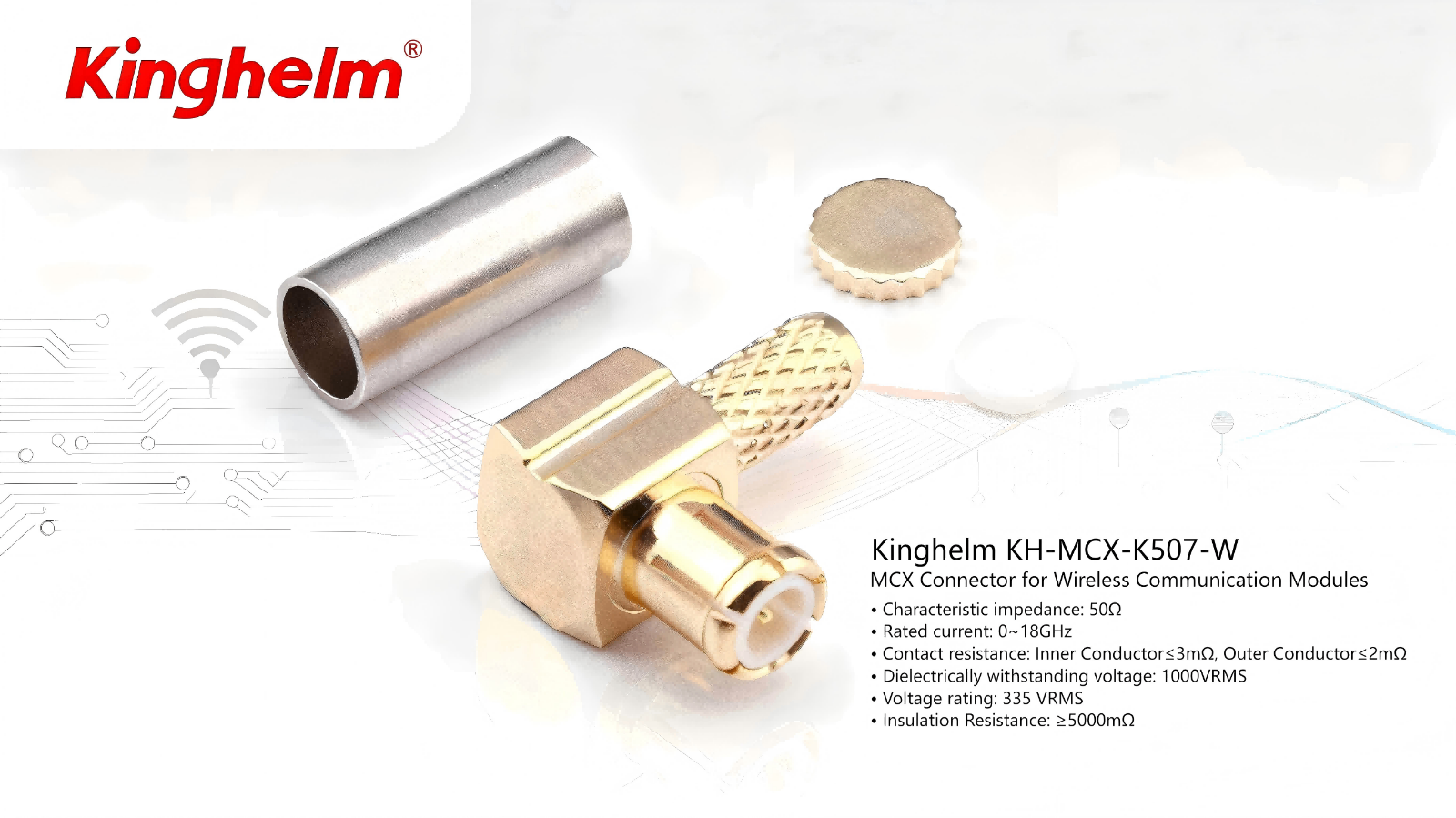
What waterproof rating can the connectors achieve?
2026-09-17
342
Standard board-level RF connectors, such as SMA and IPEX, are generally not waterproof by themselves. They are mainly designed for applications where the connector is installed inside the equipment or is not directly exposed to water and moisture. If waterproof and dustproof performance is required, waterproof RF connectors, sealed cable connectors, or other sealing components can be selected according to the application requirements.
With proper sealing structures, such as sealing rings, gaskets, and sealants, waterproof RF connectors can typically achieve IP65 to IP67 protection ratings. IP65 provides protection against dust and water jets, while IP66 offers enhanced protection against powerful water jets. IP67 can provide protection against temporary immersion in water, making it suitable for many outdoor communication devices, vehicle-mounted equipment, industrial equipment, security systems, and other applications requiring a higher level of environmental protection.
For applications requiring an even higher level of protection, IP68 can also be developed and customized according to the customer's specific requirements, drawings, samples, or application conditions. The final IP68 rating will depend on the overall product structure and the applicable test conditions.
It is important to note that the waterproof rating does not depend solely on the connector itself. It is also closely related to the overall structural design, sealing ring material and dimensions, connector-to-housing fit, cable exit design, assembly process, and installation method. Therefore, the connector should be designed and verified together with the equipment housing, panel, cable, and sealing structure to ensure that the required protection level can be achieved.
The final waterproof rating should be confirmed based on the actual product structure and verified through the corresponding standardized testing.
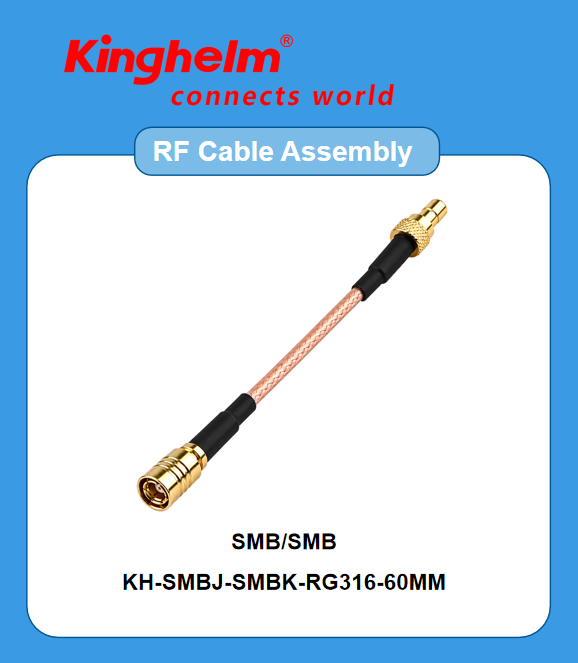
KH-SMBJ-SMBK-RG316-60MM SMB RF Cable for Short-Distance Connections
2026-09-17
378
In RF communication systems, wireless devices, test equipment, and various electronic products, RF cables play an important role in signal transmission and interconnection between components. A reliable and easy-to-install RF cable designed for space-constrained applications can simplify signal connections between internal modules.
The Kinghelm KH-SMBJ-SMBK-RG316-60MM is an SMB male-to-SMB female RF cable assembly featuring straight SMB connectors on both ends. It uses a brown RG316 coaxial cable with a cable length of 60 mm, making it suitable for short-distance connections inside various RF devices and electronic equipment.
Kinghelm KH-SMBJ-SMBK-RG316-60MM Product Image
2. Product Specifications
Brand: Kinghelm
Part Number: KH-SMBJ-SMBK-RG316-60MM
Product Type: SMB straight male-to-SMB straight female RF cable assembly
Cable Type: RG316 coaxial cable
Cable Color: Brown
Cable Outer Diameter: 2.5 mm
Cable Length: 60 mm
Rated Voltage: 300 V
Male Connector: Straight SMB male connector with male pin, gold-plated
Female Connector: Straight SMB female connector with female contact, gold-plated
Protective Sleeve: OD 3.5 × 15 mm
The KH-SMBJ-SMBK-RG316-60MM features an SMB male-to-female configuration, with straight connectors on both ends and gold-plated contacts. The cable is made of RG316 coaxial cable with an approximate outer diameter of 2.5 mm.
With its compact design and 60 mm cable length, this RF cable assembly is well suited for short-distance connections between interfaces inside electronic equipment. The assembly also includes an OD 3.5 × 15 mm protective sleeve to provide additional protection around the connection area.
3. SMB Connector Design for Convenient Equipment Interconnection
SMB is a compact RF coaxial connector designed for applications where space efficiency and convenient connection are important. SMB connectors are widely used in wireless communication equipment, RF modules, test instruments, electronic measuring equipment, and other compact electronic systems.
The KH-SMBJ-SMBK-RG316-60MM features an SMB male connector with a male pin on one end and an SMB female connector with a female contact on the other, allowing direct connection between compatible SMB interfaces.
Both connectors feature a straight configuration, providing a clean and straightforward orientation for internal cable routing. For PCB-mounted RF interfaces, wireless communication modules, and other compact electronic assemblies, a pre-assembled RF cable can simplify installation and eliminate the need for on-site cable termination.
4. RG316 Coaxial Cable for Short-Distance RF Connections
The cable assembly uses brown RG316 coaxial cable with an outer diameter of approximately 2.5 mm. RG316 coaxial cable is commonly used for RF signal interconnection and is valued for its relatively small diameter, light weight, and flexibility.
With a 60 mm cable length, this assembly is suitable for connecting RF interfaces located relatively close to each other inside a device.
In equipment assembly, a short cable length can help minimize excess cable and keep internal wiring neat and organized. The relatively small cable diameter also makes the cable easier to route around other components in space-constrained electronic equipment.
5. Gold-Plated Connectors for Reliable Connections
Both the SMB male and SMB female connectors of the KH-SMBJ-SMBK-RG316-60MM feature gold-plated contacts. Gold plating can help improve resistance to oxidation and corrosion while supporting stable electrical contact during operation.
For applications involving equipment testing, debugging, maintenance, and repeated connection and disconnection, standardized SMB interfaces can make installation and servicing more convenient.
The male-to-female configuration also allows the cable assembly to connect directly to compatible SMB interfaces, reducing the need for additional adapters in suitable applications.
Kinghelm KH-SMBJ-SMBK-RG316-60MM Datasheet
6. Suitable for a Variety of Electronic Applications
With its SMB male-to-female configuration, RG316 coaxial cable, and compact 60 mm length, the KH-SMBJ-SMBK-RG316-60MM can be used in a variety of applications, including:
Wireless communication equipment
RF modules
Test and measurement instruments
Electronic measuring equipment
Signal transmission assemblies
RF equipment
Electronic devices with compatible SMB interfaces
During research and development and testing, pre-assembled RF cable assemblies can provide a convenient way to establish connections between modules. During equipment manufacturing and assembly, engineers can select suitable cable lengths and connector configurations according to the product's mechanical layout, helping simplify installation and improve assembly efficiency.
When selecting an RF cable assembly, engineers should consider factors such as connector type, cable length, operating frequency, electrical specifications, installation space, and operating environment.
The KH-SMBJ-SMBK-RG316-60MM combines SMB male and female connectors with RG316 coaxial cable to provide a convenient pre-assembled solution for short-distance RF interconnection applications.
7. Selection and Installation Recommendations
When using the KH-SMBJ-SMBK-RG316-60MM, the cable should be selected according to the equipment's interface type, operating environment, and specific electrical requirements.
During installation, avoid excessive bending, pulling, or mechanical stress on the cable. The connector interfaces should also be kept clean to help minimize connection issues caused by mechanical damage or poor contact.
For applications where two SMB interfaces are positioned relatively close to each other, the 60 mm cable length can be considered for short-distance interconnection. If the actual installation distance differs, a cable with an appropriate length should be selected according to the equipment's internal layout.
Proper cable routing can help prevent unnecessary mechanical stress on the cable and connectors while keeping the internal assembly neat and organized.
Overall, the Kinghelm KH-SMBJ-SMBK-RG316-60MM is an SMB straight male-to-SMB straight female RF cable assembly designed for short-distance connections. It features a 60 mm RG316 brown coaxial cable with an approximate outer diameter of 2.5 mm, gold-plated straight SMB connectors on both ends, and an OD 3.5 × 15 mm protective sleeve.
With its compact design and straightforward male-to-female connection configuration, the cable assembly can be used for short-distance interconnection between RF modules, electronic components, and compatible interfaces in a variety of electronic and RF applications.
About Kinghelm
According to Song Shiqiang, Kinghelm’s key products include the KH-TYPE-C-16P USB connector, KH-IPEX-K501-29 RF coaxial connector, KH-RJ45-58-8P8C Ethernet connector (RJ45/RJ11), and KH-SMA-KE-Z RF coaxial connector. These products are widely used across communication, automotive, industrial control, consumer electronics, and other industries, delivering reliable performance for diverse applications.
Leveraging Shenzhen’s well-established Huaqiangbei electronics ecosystem, Kinghelm has served tens of thousands of customers worldwide, providing efficient and reliable one-stop electronic interconnection solutions.
Kinghelm also offers a comprehensive product portfolio covering RF connectors, electronic components, sensors, millimeter-wave components, tactile switches, detection switches, toggle switches, push-button switches, micro switches, multifunction switches, illuminated switches, DIP switches, rocker switches, headphone jacks, DC jacks, FPC connectors, waterproof USB connectors, limit switches, encoder switches, tactile push buttons, USB receptacles, and USB Type-C connectors.
With flexible customization capabilities, Kinghelm provides tailored solutions for different applications and supports a wide range of precision interconnection requirements.
KH-SMBJ-SMBK-RG316-60MMView Product Details
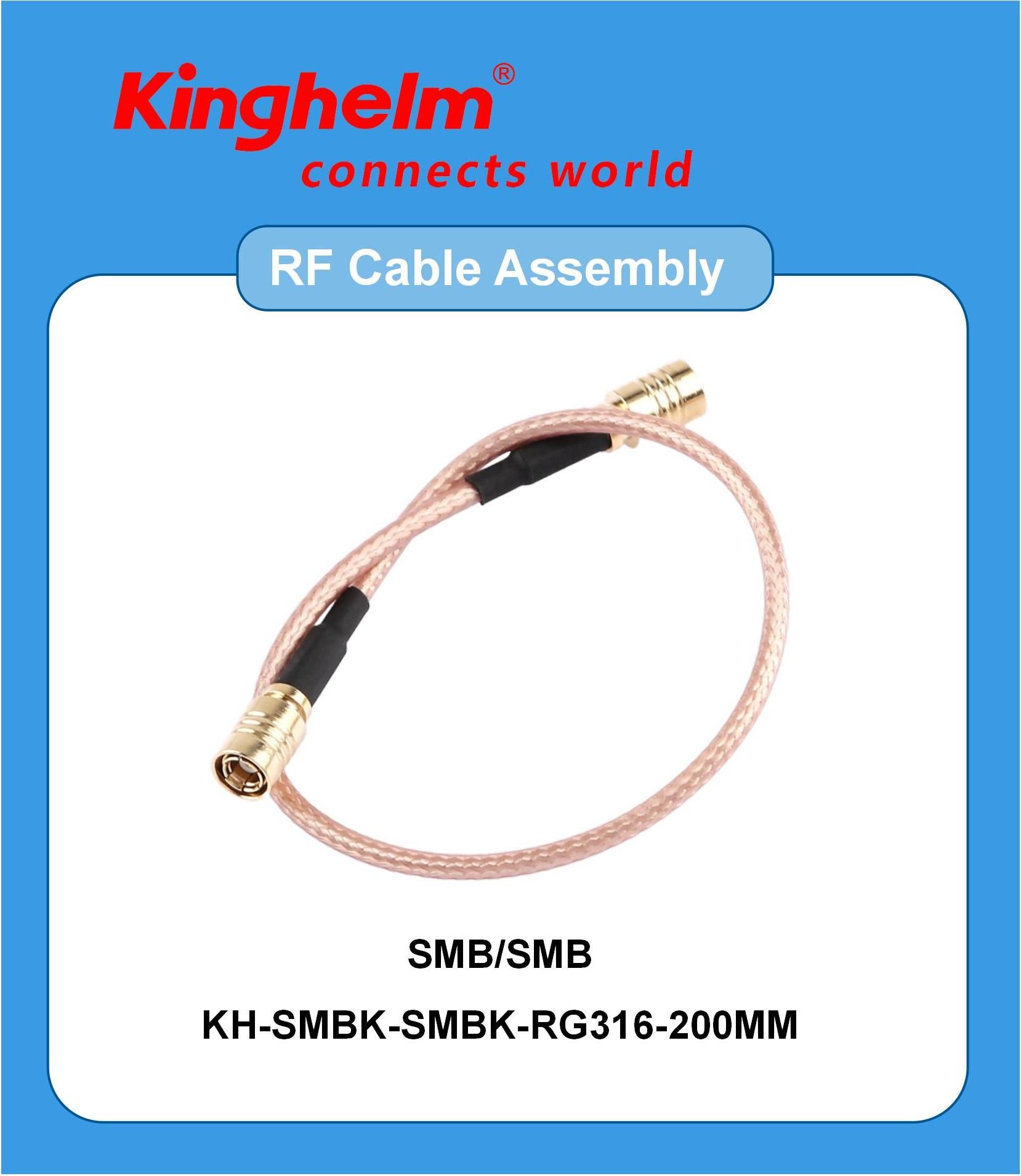
KH-SMBK-SMBK-RG316-200MM RF Cable Assembly: SMB Straight Female-to-Female for Stable RF Signal Connection
2026-09-16
459
In wireless communication equipment, RF modules, test instruments, and various electronic devices, RF signals often need to be transmitted reliably between different modules and interfaces. For applications where internal space is limited and the connection distance is relatively short, a suitable pre-assembled RF cable assembly can make installation easier while keeping the overall wiring clean and organized.
The Kinghelm KH-SMBK-SMBK-RG316-200MM is a pre-assembled RF cable assembly designed for these applications. It features straight SMB female connectors on both ends, RG316 coaxial cable, and a finished length of 200 mm, making it suitable for short-distance RF signal connections.
Kinghelm KH-SMBK-SMBK-RG316-200MM Product Image
Product Specifications
Brand: Kinghelm
Model: KH-SMBK-SMBK-RG316-200MM
Product Type: SMB-K to SMB-K RF Cable Assembly
Cable Length: 200 mm
Rated Voltage: 300 V
Protective Sleeve: OD 3.5 × 15 mm
Connectors: Straight SMB female, gold-plated
Connector Configuration: SMB female-to-female
Coaxial Cable: RG316, brown
Cable Outer Diameter: Approx. 2.5 mm
SMB Straight Female-to-Female for Direct RF Connection
The most notable feature of this product is its SMB straight female-to-female configuration, also known as SMB-K to SMB-K.
When the equipment provides compatible SMB interfaces, this RF cable assembly can be connected directly without additional adapters. SMB connectors are compact and widely used in electronic equipment where installation space is limited.
The straight connector design also provides a clear connection direction, making it convenient for internal module connections and equipment wiring. Compared with cutting and assembling coaxial cable on site, a pre-assembled RF cable assembly can be installed directly, saving processing time during equipment assembly and maintenance.
200mm Length for Short-Distance RF Interconnection
The 200 mm finished length is designed for short-distance connections between RF modules, communication modules, PCB interfaces, and other electronic components.
A suitable cable length is particularly important inside compact equipment. An excessively long cable may create unnecessary slack and make internal wiring difficult to organize, while a cable that is too short may limit installation flexibility.
The 200 mm length provides a practical option for many short-distance RF interconnection applications. During installation, the cable can be routed along the structure of the equipment, helping reduce cable clutter and making future maintenance and module replacement easier.
RG316 Coaxial Cable for Flexible Routing
The cable section uses RG316 brown coaxial cable with an outer diameter of approximately 2.5 mm.
Compared with larger coaxial cables, RG316 is relatively compact and flexible, making it suitable for equipment with limited internal space. Electronic devices often contain multiple PCBs, RF modules, power cables, and other components within a confined enclosure. A smaller-diameter RF cable can make routing and installation more convenient.
The brown cable jacket also provides easy visual identification when multiple types of cables are used inside the same device.
Gold-Plated SMB Connectors
Both ends of the cable assembly feature straight SMB female connectors with gold-plated female contacts.
The gold-plated contact surface provides good corrosion resistance and helps maintain reliable electrical contact during use. Connector quality is particularly important in RF applications, where stable connections are essential for signal transmission.
Since both ends use the same SMB female connector configuration, the cable provides a simple and standardized connection solution for compatible interfaces. Users should confirm connector type and interface compatibility before installation.
Protective Sleeve for Added Cable-End Protection
The cable-to-connector transition area is equipped with an OD 3.5 × 15 mm protective sleeve.
During equipment assembly, movement, and cable routing, the connector tail and cable junction may experience bending or mechanical stress. The protective sleeve provides additional support and protection around this area while also giving the finished cable assembly a cleaner appearance.
This type of cable-end protection can be especially useful for RF cable assemblies installed inside compact electronic equipment.
Kinghelm KH-SMBK-SMBK-RG316-200MM Specification
Pre-Assembled RF Cable Assembly for Easier Installation
One of the main advantages of a finished RF cable assembly is that it reduces the need for on-site cable processing.
When using bulk coaxial cable, manufacturers may need to cut the cable, strip it, install connectors, and perform additional assembly and inspection. With the KH-SMBK-SMBK-RG316-200MM, the cable length, cable type, and connector configuration are already defined and assembled.
This makes the cable convenient for prototype development, laboratory testing, equipment assembly, and production applications. For batch production, standardized RF cable assemblies can also simplify material management and make replacement and maintenance more efficient.
Typical Applications
The KH-SMBK-SMBK-RG316-200MM is designed for short-distance RF connection applications requiring an SMB female-to-female configuration.
Typical applications may include:
Wireless communication equipment
RF modules
Communication modules
RF test equipment
Electronic test instruments
RF laboratory equipment
PCB and module interconnection
Internal equipment wiring
IoT and other RF-enabled devices
Before selecting an RF cable assembly, users should confirm the connector type, operating frequency, impedance, cable length, voltage, and installation environment according to the specific application requirements.
If the equipment interfaces are compatible with the SMB female connectors and the 200 mm length meets the routing requirements, this pre-assembled RF cable assembly can provide a convenient solution for short-distance RF interconnection.
Compact and Practical RF Cable Assembly for Electronic Equipment
An RF cable assembly may look like a simple component, but connector type, cable specification, length, contact finish, and cable-end protection can all affect the installation experience.
The Kinghelm KH-SMBK-SMBK-RG316-200MM RF Cable Assembly combines a straight SMB female-to-female configuration with RG316 coaxial cable in a compact 200 mm assembly. Both ends feature gold-plated SMB female connectors, while the cable uses a small-diameter RG316 coaxial cable with an OD 3.5 × 15 mm protective sleeve at the connector transition.
For applications requiring RF module interconnection, internal equipment wiring, or short-distance signal connections, a standardized pre-assembled RF cable assembly can reduce on-site processing and simplify installation.
With clear specifications and a ready-to-use design, the KH-SMBK-SMBK-RG316-200MM is a practical solution for compact RF interconnection applications.
About Kinghelm
Kinghelm(www.kinghelm.net) specializes in RF passive components, antennas, connectors, RF cable assemblies, and electronic interconnection solutions. With more than a decade of industry experience, Kinghelm serves over 20,000 customers worldwide and offers more than 8,000 SKUs for applications in communications, automotive, industrial control, IoT, and other fields.The company holds certifications including ISO 9001, ISO 14001, RoHS, and REACH, and provides both standard products and customized antenna and connector solutions, supporting customers from product development and prototyping to mass production.
KH-SMBK-SMBK-RG316-200MMView Product Details
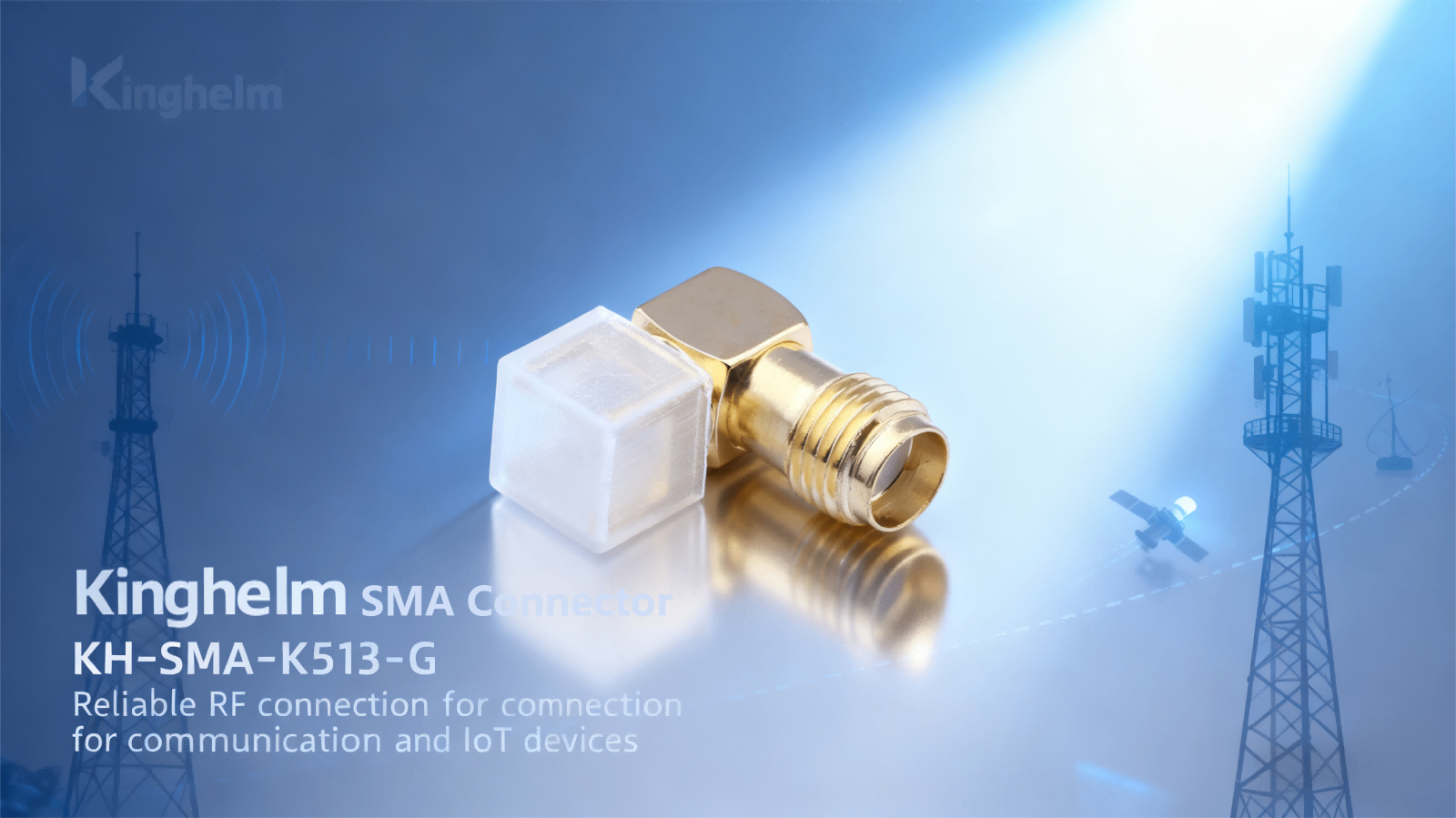
What are the impedance, frequency range, and operating temperature of SMA connectors?
2026-09-15
477
SMA connectors are small coaxial connectors widely used in RF and microwave systems. They feature a compact size, high mechanical strength, and reliable connections. Their impedance, frequency range, and operating temperature are as follows:
Impedance: Standard SMA connectors are 50 Ω and can match well with most RF transmission systems, test instruments, antennas, and coaxial cables. Although 75 Ω versions also exist on the market, they are mainly used in special applications such as video and broadcasting, and generally cannot be directly mated with 50 Ω SMA connectors. Otherwise, impedance mismatch, degraded VSWR, and signal reflection may occur.
Frequency range: Conventional SMA connectors operate from DC to 18 GHz, which can meet the needs of most wireless communications, radar, test and measurement, and microwave component applications. Precision SMA versions using precision machining, high-quality insulating dielectrics, and strict tolerances can extend the frequency range to 26.5 GHz. Higher frequencies usually require 3.5 mm, 2.92 mm, 2.4 mm, or other connectors. The actual usable frequency is also affected by the cable assembly, PCB transition, soldering quality, and mounting method.
Operating temperature: The general range is -65°C to +165°C, depending on the insulating dielectric, housing and contact materials, plating, and sealing structure. Commonly used PTFE dielectrics, stainless steel or brass housings, and gold- or nickel-plated contacts can support a wide temperature range. Different material and plating versions may vary slightly, and the upper limit of some low-cost versions or versions with plastic accessories may be lower. When used for soldering cables, the solder melting point, cable jacket, and strain relief can also limit the overall temperature performance.
Therefore, when selecting a connector, the datasheet of the specific model should be used as the basis, and environmental and electrical factors such as thermal cycling, vibration, humidity, and frequency matching should also be considered comprehensively.
About Kinghelm
Shenzhen Kinghelm Electronics Co., Ltd.(www.kinghelm.net)has technical backbones from Tsinghua University and UESTC, and has introduced overseas returnee professionals. Kinghelm is able to develop highly reliable and high-performance antenna and connector products.KH series products of "Kinghelm" brand include Beidou/GPS antennas, RF adapter connectors, plug connector, electrical data connectors, terminals, and customized vehicle harnesses, industrial / medical connectors, and special antenna connectors."Kinghelm connects world", Kinghelm has grown with the development of China's Beidou industry. Starting from supplying Beidou/GPS dual mode antennas, IPEX terminals, and RF adapter cables for automotive manufacturers, Kinghelm has continuously developed products. Currently, it has a series of WiFi, Bluetooth, NB-loT, LoRa, Zigbee, UWB, and GSM antennas, RFID tags, RF adapter cables, standard microwave antennas, vehicle grade SMA, SMB, FAKRA holders, coaxial cables, and can customize non-standard antenna connectors based on customer drawings or samples.
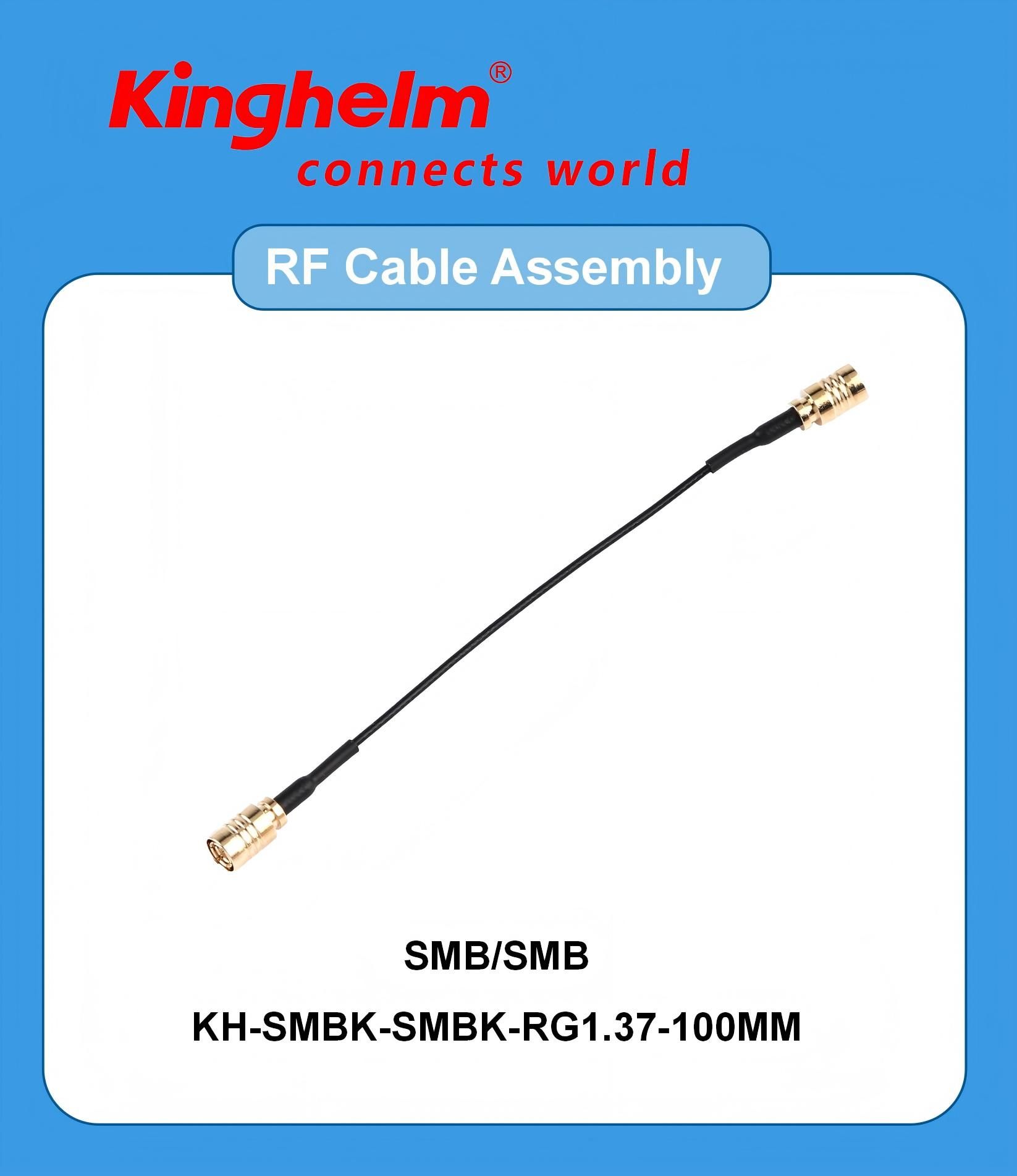
KH-SMBK-SMBK-RG1.37-100MM Compact SMB RF Cable Assembly for Space-Constrained Applications
2026-09-15
534
The Kinghelm KH-SMBK-SMBK-RG1.37-100MM is a finished SMB RF cable assembly, pre-assembled with SMB female connectors on both ends and a 100 mm RG1.37 coaxial cable in between. It is supplied as a ready-to-use cable assembly, eliminating the need for customers to perform connector crimping, cable cutting, or cable assembly on site.
Designed for short-distance RF signal connections, this finished cable assembly combines two straight gold-plated SMB female connectors, RG1.37 black coaxial cable, and protective sleeves into one complete product. With its compact 1.37 mm cable diameter and 100 mm finished length, it is suitable for internal connections between RF modules, PCBs, communication equipment, test equipment, and other compact electronic devices.
Kinghelm KH-SMBK-SMBK-RG1.37-100MM Product Image
Product Specifications
Brand: KinghelmModel: KH-SMBK-SMBK-RG1.37-100MMProduct Type: Finished SMB-K to SMB-K RF Cable AssemblyCable Length: 100 mmCable: RG1.37 black coaxial cableCable Outer Diameter: 1.37 mmConnector: SMB female, female contact, straight typeConnector Finish: Gold-platedRated Voltage: 300 VSleeve: OD 2.5 × 15 mmPackaging: BaggedGross Weight: Approx. 5.35 g
Ready-to-Use Finished Cable Assembly
Unlike loose RF connectors or bulk coaxial cable, the KH-SMBK-SMBK-RG1.37-100MM is supplied as a complete finished cable assembly. The connectors have already been assembled onto the RG1.37 coaxial cable according to the specified cable length.
This finished design saves users the additional work of cable cutting, stripping, connector termination, and assembly. For equipment manufacturers, engineers, and production teams, using pre-assembled RF cable assemblies can simplify the wiring process and improve installation efficiency.
The 100 mm finished length also provides a convenient solution for connecting RF interfaces located close to each other without requiring users to process the cable themselves.
SMB Female-to-Female Configuration
Both ends of the finished cable are equipped with straight SMB female connectors with gold-plated contacts. The two identical connectors form an SMB-K to SMB-K connection configuration.
This design is suitable for connecting compatible SMB male interfaces in RF modules, circuit boards, communication equipment, and testing systems. Because the connectors are already installed, the cable can be directly used after delivery, making it convenient for equipment assembly and maintenance.
Compact RG1.37 Coaxial Cable
The cable assembly uses RG1.37 black coaxial cable with an outer diameter of approximately 1.37 mm. Its slim profile is particularly suitable for compact electronic equipment where internal installation space is limited.
The 1.37 mm cable diameter allows the finished assembly to be routed flexibly around components and PCB layouts. Combined with the 100 mm finished length, it is well suited for short-distance internal RF connections.
Suitable for Equipment Assembly and RF Applications
As a ready-made RF cable assembly, the KH-SMBK-SMBK-RG1.37-100MM can be used in various applications, including:
RF module-to-module connections
PCB and RF module connections
Internal wiring of communication equipment
Wireless communication devices
RF testing equipment
Laboratory test setups
Compact electronic equipment
Short-distance RF signal connections
For manufacturers purchasing RF cable assemblies in volume, a finished and standardized cable can also help simplify production processes and reduce the need for in-house cable termination.
Kinghelm KH-SMBK-SMBK-RG1.37-100MM Specification
Conclusion
The Kinghelm KH-SMBK-SMBK-RG1.37-100MM is a compact finished SMB RF cable assembly, rather than a loose cable or individual connector. It is factory-assembled with two straight gold-plated SMB female connectors and a 100 mm RG1.37 black coaxial cable, providing a ready-to-use solution for short-distance RF connections.
With its compact cable diameter, standardized 100 mm length, pre-installed SMB connectors, and lightweight construction, this finished RF cable assembly is a practical choice for electronic equipment manufacturers, RF module developers, testing applications, and other applications requiring convenient and space-efficient SMB connections.
About Kinghelm
Kinghelm (www.kinghelm.net) was founded by Shi-Qiang Song in Shenzhen and has been deeply engaged in the electronic components industry for many years. The company has developed a comprehensive interconnect product portfolio covering Type-C, SMA, IPEX, MCX, HDMI connectors, automotive wiring harnesses, adapter cables, pin headers, terminals, RF cables, and other interconnect products. In addition, Kinghelm offers a complete range of antenna products, including GPS antennas, Wi-Fi antennas, BeiDou antennas, embedded antennas, 4G antennas, and ceramic antennas, supported by an extensive portfolio of RF coaxial connectors and RF connector solutions.
Leveraging Shenzhen's well-established electronics supply chain, Shi-Qiang Song and his team have developed and optimized a wide range of products to meet the diverse requirements of applications such as communications, automotive electronics, and the Internet of Things (IoT). From board-to-board connections in space-constrained environments, to stable signal transmission in automotive applications, and antenna solutions for various wireless terminals, Kinghelm provides practical, highly compatible product options designed to meet real-world engineering requirements.
With a focus on product compatibility, connection reliability, and application-specific optimization, Kinghelm provides dependable interconnect solutions that support engineers throughout system design, wiring, assembly, testing, and debugging.
KH-SMBK-SMBK-RG1.37-100MMView Product Details
BNC vs SMA: The Key Differences Every RF Engineer Should Know
2026-09-14
601
Introduction
Have you ever had a link that measured clean on the bench, then showed extra insertion loss or an unstable trace the moment it went into the rack? In most cases the connector is not faulty. The interface is simply wrong for the job.
Core answer: BNC is the right choice for fast mating and 75Ω video or low-GHz RF paths, while SMA is the right choice for compact 50Ω designs that run higher in frequency or face vibration. Both are standardized interfaces, so the decision is settled by impedance, frequency, space, and environment, not by brand.
Who this is for: design engineers and procurement specialists selecting a coax interface for video, broadcast, test, or RF products, including anyone comparing a 75Ω BNC against a 50Ω SMA for a specific system.
If your path runs above 4 GHz: skip the BNC column below and go straight to the SMA sections. Above that frequency you are really choosing between SMA and a precision interface, not between BNC and SMA.
BNC vs SMA Connector: A Detailed Comparison
The two interfaces were designed for different jobs. BNC was designed for repeated fast connections; SMA was designed for compact, high-frequency 50Ω work. Neither is a general upgrade over the other.
BNC Connector: Fast Connection and Easy Handling
A quarter turn of the bayonet lock and you are connected, which is why BNC still sits on oscilloscopes, broadcast racks and CCTV gear. BNC exists in 50Ω and 75Ω: the 75Ω version is the normal choice for video and broadcast and pairs with RG-59 or RG-6, while the 50Ω version covers general RF test and instrumentation. Bayonet parts are commonly specified at around 500 mating cycles, and Kinghelm's BNC series, 50Ω and 75Ω alike, is specified from DC to 3 GHz.
Broadcast and video signal paths, where 75Ω is the system standard
Test benches and lab instruments, where cables are swapped constantly
Surveillance and CCTV, where field service speed decides downtime
Communication test equipment
If the cable gets changed more often than the design does, BNC is the right answer.
75Ω BNC connector with bayonet coupling.
SMA Connector: Compact and Secure for RF Systems
SMA is threaded, and it takes longer to mate on purpose. Done up to the correct torque, the joint shrugs off sustained vibration in a way a bayonet joint cannot. Standard SMA runs 50Ω and is commonly rated from DC to 18 GHz, with precision versions reaching 26.5 GHz. Torque is usually specified between 0.79 and 1.13 N·m (7–10 in·lb), and under-torquing is behind most of the intermittent contacts that only show up after the unit ships.
Wireless modules and RF front ends on space-constrained PCBs
Antennas and antenna feeds, including GNSS and cellular
Microwave assemblies and instrumentation above 4 GHz
Any joint that has to survive vibration
When space, frequency or vibration is the binding constraint, SMA is the better fit.
50Ω SMA connector with threaded coupling.
BNC vs SMA: Key Differences at a Glance
Feature
BNC
SMA
Practical takeaway
Coupling
Quarter-turn bayonet
Threaded, torqued
BNC for speed, SMA for certainty
Interface standard
IEC 60169 series
MIL-STD-348 / IEC 61169 series
Standardized parts intermating across suppliers
Typical frequency rating
Commonly 3–4 GHz depending on part; Kinghelm BNC series DC–3 GHz
18 GHz; precision to 26.5 GHz
Above 4 GHz, stop considering BNC
Impedance
50Ω and 75Ω
50Ω standard; 75Ω available
Fix impedance before anything else
Mating cycles (typical)
Around 500
A few hundred to 1000, torque-dependent
Match the cycle count to your service plan
Cable pairing
RG-59 / RG-6 (75Ω), RG-58 (50Ω)
RG-58, RG-316, 0.085" semi-rigid
Choose cable and connector together
Size
Larger, easier to grip
Compact
SMA for dense boards, BNC for gloved hands
Vibration
Moderate retention
High retention
Threaded for anything that moves
For the full connector taxonomy and for BNC sourcing criteria, see our RF connector guide and BNC procurement guide.
BNC vs SMA Connector: Factors to Consider Before Choosing
Start with impedance, frequency, space and environment. Price is the last line of the comparison, not the first.
Impedance and Compatibility
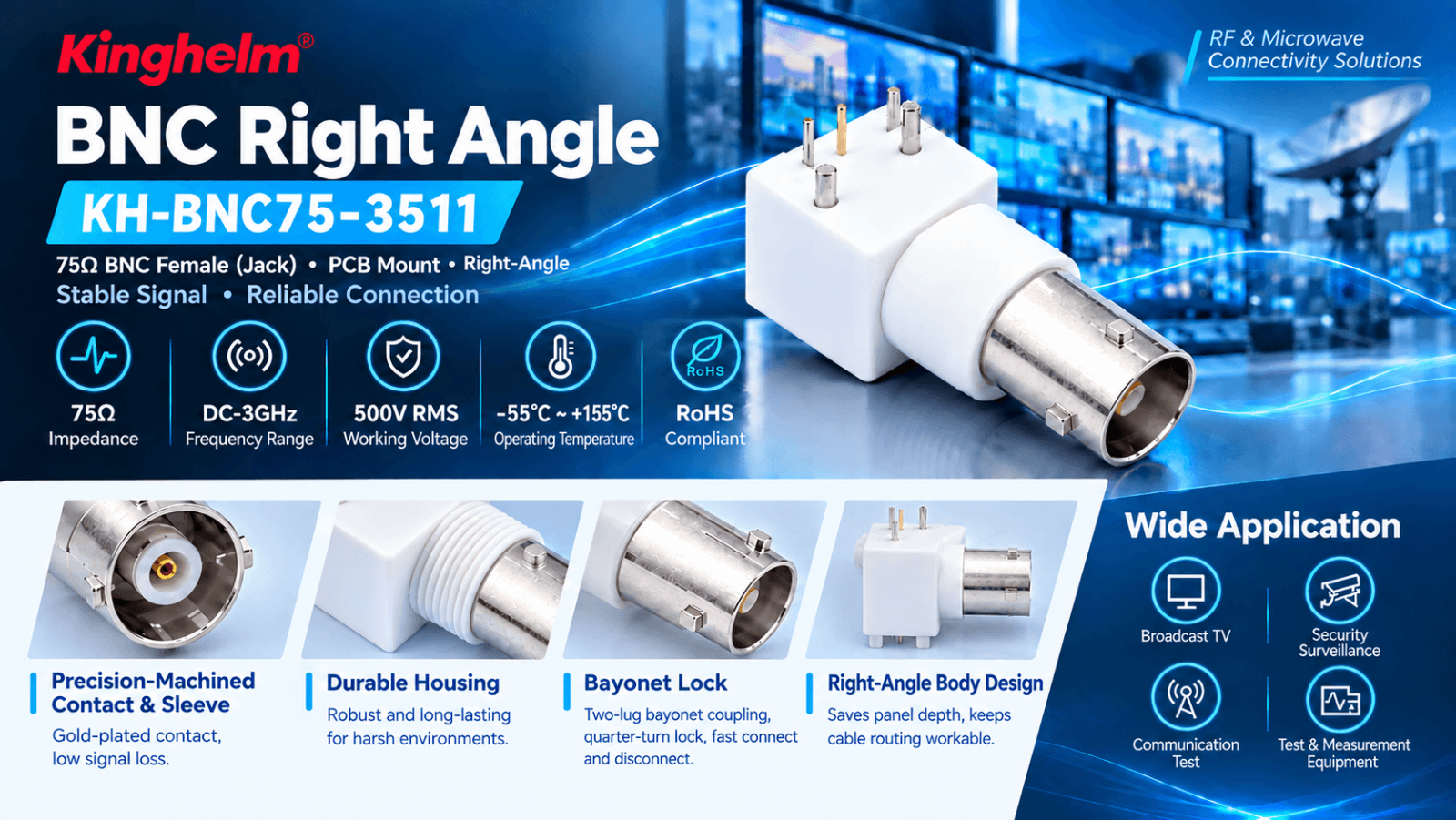
Match impedance along the whole path: connector, cable, and equipment interface. A 75Ω BNC on a 50Ω port does not fail on contact. It raises return loss, and in video that shows up as ghosting or ringing long before the part fails. This is the mismatch we get asked about most often.BNC covers both impedances in one mechanical family, so video and RF test can share a panel design. Standard SMA is 50Ω. 75Ω SMA exists but is not the default, and availability is worth checking before it goes into a layout. Confirm connector, cable and equipment impedance together, and check gender before you order. Kinghelm's 75Ω part in this family, KH-BNC75-3511, is covered in detail below.
Power Handling Capability
BNC and SMA differ in geometry more than in ratings. The larger BNC body is commonly specified with higher working voltage. SMA's small dielectric and centre contact suit high frequency, but they carry less current and dissipate less heat. KH-BNC75-3511, for example, is rated 500 V RMS over DC to 3 GHz.Power handling falls as frequency rises, so ask for the derating curve at your operating frequency and rate the finished assembly rather than the connector alone.
Environmental and Outdoor Suitability
Indoor benches reward connection speed. Outdoor hardware rewards protection. Check the seal at the mating interface, the plating and the strain relief, not just the temperature figure.KH-BNC75-3511 is specified from −55°C to +155°C, and its housing, inner conductor and insulation are chosen to hold that range. A connector that measures well on the bench can still be the wrong part for a pole-mounted enclosure.
How to Verify Before You Commit
A datasheet tells you what a part should do. These four checks tell you what the assembly in front of you actually does.
Impedance continuity: sweep the finished path with a TDR and confirm there is no impedance step at the connector or the termination.
Insertion loss and return loss: measure S21 and S11 on the assembled cable at your highest operating frequency. The cable and termination usually dominate the result, not the connector alone.
Torque: set SMA joints to the specified 0.79–1.13 N·m. A torque wrench costs less than the field failure it prevents.
Mechanical retention: pull-test the crimp or solder joint, and count mating cycles if the part is serviceable in the field.
Ask for S-parameter data or a test report before you release volume orders.
Common BNC vs SMA Connector Selection Mistakes
Two mistakes cause most of the rework we see, and both are visible before production starts.
Treating 50Ω and 75Ω as interchangeable. The symptom is on screen: ghosting in video, elevated return loss everywhere else.
Paying for frequency you will not use. If the design runs to 3 GHz, an 18 GHz SMA adds cost without adding margin you need.
How to Choose the Right Connector
Work through these in order. The answer usually falls out by the second question.
What impedance does the system run? 75Ω points to BNC; 50Ω leaves both options open.
What is the highest frequency in the path? Above your chosen part's rating (3 GHz for this BNC series, around 4 GHz for the interface in general), move to SMA or a precision interface.
How often will the joint be connected and disconnected? Frequent access favours BNC; a set-and-forget joint favours SMA.
What does the environment do to it? Vibration, moisture and temperature narrow the choice further.
Then compare suppliers on specifications, mechanical construction, environmental ratings and production consistency, rather than on unit price alone.
Where Does the KH-BNC75-3511 Fit?
KH-BNC75-3511 is Kinghelm's 75Ω BNC female right-angle connector. The 75Ω interface keeps the transmission line matched, and the right-angle body keeps cable routing workable where panel depth is limited.
Specifications, from the Kinghelm datasheet:
Impedance: 75Ω
Frequency range: DC–3 GHz
Working voltage: 500 V RMS
Operating temperature: −55°C to +155°C
Locking: bayonet
Compliance: RoHS
Packaging: tray; gross weight 8.5 g
Kinghelm lists four application areas for this part: broadcast and television, security and surveillance, communication testing, and instrumentation. The company runs an ISO 9001 quality management system and states compliance with EU RoHS and REACH; plating thickness, body material and dielectric data are stated on the part datasheet.
The same body is also offered in 50Ω as KH-BNC50-3511, with identical frequency, voltage and temperature ratings. If a product family needs both a 75Ω video path and a 50Ω RF path, one connector outline can cover both, which simplifies panel design and reduces the number of spares you carry.
The datasheet and a 3D model are available for layout review, and samples can be requested through the Kinghelm sample request page.
What to Put in Your RFQ
Six fields are enough to get quotes you can actually compare.
Interface and impedance: BNC, 75Ω, female, right-angle.
Highest operating frequency, plus the insertion loss and VSWR limit the design must stay inside.
Expected mating cycles over the product's service life.
Mounting style, termination type, and the space available behind the panel.
Environment: operating temperature range, moisture, and corrosion exposure.
Documentation and supply: datasheet, 3D model, plating and material statement, RoHS and REACH status, first-article samples, lead time, and whether a qualified second source is required.
Final Thoughts
Two numbers decide this: the impedance your system runs and the highest frequency in the path. Settle those and the connector family usually picks itself.Working on a 75Ω design now? Send us the interface and frequency range, and our engineers will come back with the part, the datasheet and a sample request link.
FAQ
Can I use a 75Ω BNC on a 50Ω port?
Do not. The mismatch raises return loss, and in video it appears as ghosting or ringing. Keep the entire path at one impedance.
Can I choose a connector just because it fits the equipment?
No. Physical compatibility says nothing about impedance or frequency range, and both are on the datasheet. Check them before you approve the part.
What is the frequency limit of a BNC connector?
BNC is commonly specified in the low-GHz range, around 3 to 4 GHz depending on the part. Kinghelm's BNC series is rated DC–3 GHz. Above that, use SMA or another threaded interface.
Can SMA be used in video systems?
75Ω SMA exists and appears in some broadcast and digital video equipment, but it is not the default. Check availability and price before designing one in.
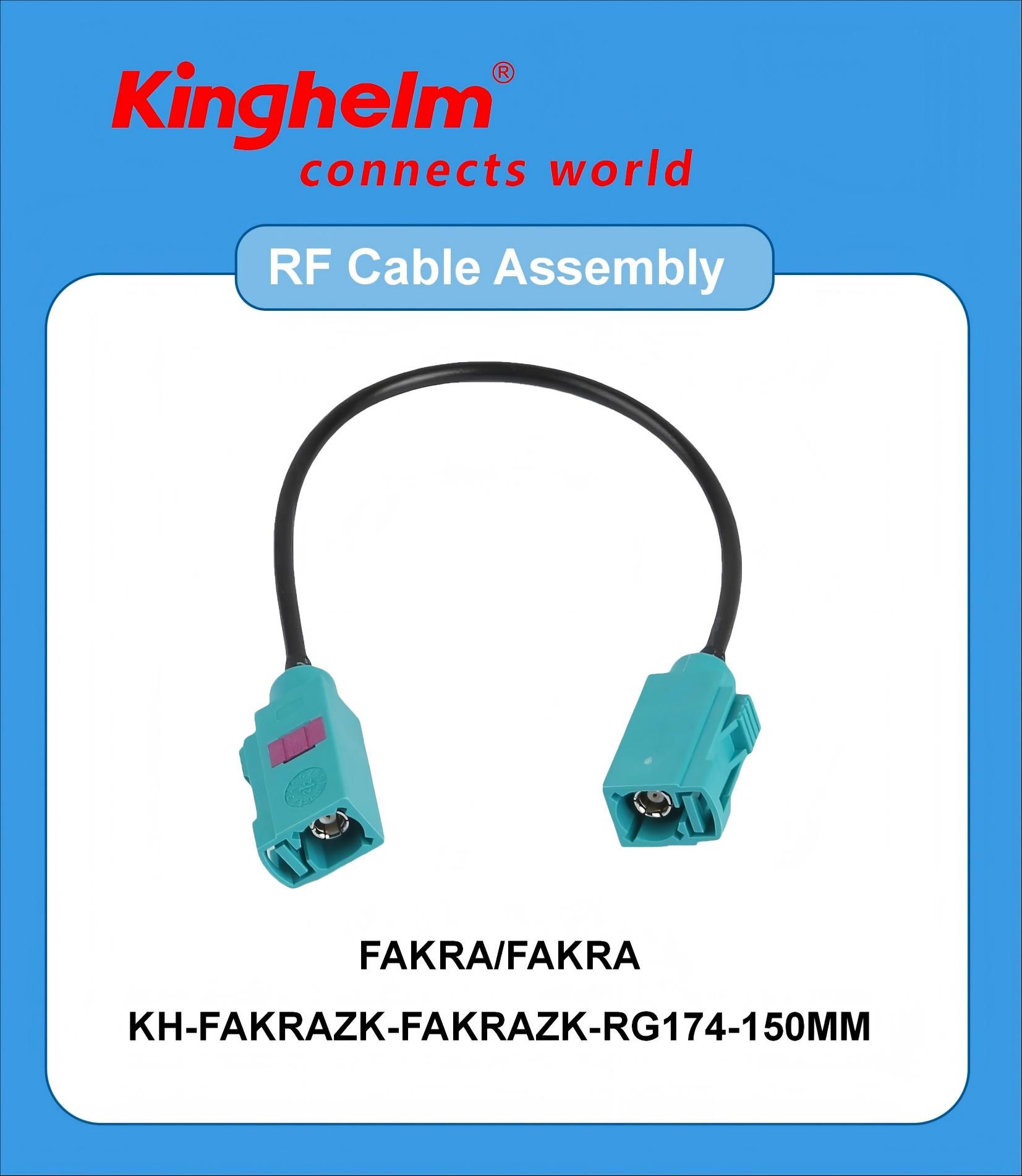
KH-FAKRAZK-FAKRAZK-RG174-150MM Automotive FAKRA Female-to-Female RG174 RF Cable Assembly
2026-09-14
629
With the continuous development of automotive electronics, in-vehicle communication, navigation and positioning, intelligent driving, and in-vehicle entertainment, the number of electronic devices and communication modules inside vehicles continues to increase. This has created higher requirements for RF signal transmission, wiring harness stability, reliability, and installation convenience.
FAKRA connectors are widely used in automotive electronics due to their standardized interfaces, easy identification, and structural characteristics designed for automotive applications. They are commonly used in automotive antenna systems, GPS navigation, wireless communication, and in-vehicle entertainment systems.
The Kinghelm KH-FAKRAZK-FAKRAZK-RG174-150MM is an automotive FAKRA female-to-female RG174 RF cable assembly featuring a blue Z-type FAKRA female connector at each end and a black RG174 coaxial cable in the middle. With a standard cable length of 150 mm and a compact overall structure, it is suitable for a variety of short-distance RF signal connection applications.
Kinghelm KH-FAKRAZK-FAKRAZK-RG174-150MM Product Image
Product Specifications
Brand: Kinghelm
Model: KH-FAKRAZK-FAKRAZK-RG174-150MM
Product Type: RF Cable Assembly
Application: Automotive Electronics / RF Signal Connection
Connector Configuration: FAKRA Blue Z-Type Female to FAKRA Blue Z-Type Female
Connector Type: FAKRA Female-to-Female
Connector Housing Color: Blue
Connector Structure: Z-Type
Coaxial Cable: RG174
Cable Color: Black
Cable Outer Diameter: Approx. 2.8 mm
Cable Length: 150 mm
Sleeving: Black Heat-Shrink Tubing
Heat-Shrink Tubing Size: OD 3.5 × 15 mm
Rated Voltage: 300 V
Packaging: Bag
Product Weight: Approx. 11.05 g
1. Blue Z-Type FAKRA Design for Automotive RF Connections
Both ends of this RF cable assembly are equipped with blue Z-type FAKRA female connectors. The connectors feature a female contact configuration and blue housings, providing clear visual identification during wiring harness assembly, equipment installation, and maintenance.
FAKRA connectors are commonly used in automotive electronic systems and are suitable for applications such as automotive antennas, navigation and positioning systems, wireless communication, satellite positioning, and in-vehicle entertainment.
Automotive interiors typically have limited installation space and complex electronic module layouts. A properly designed connector structure can help optimize cable routing and simplify installation.
The Z-type connector design is suitable for applications where a specific connection direction is required. When the equipment interface and cable routing are positioned at an angle, the Z-type structure can help reduce excessive bending near the connector and contribute to a more organized wiring layout.
The blue FAKRA housing also makes it easier to distinguish different interfaces within automotive wiring harnesses, which can help improve efficiency during assembly, inspection, and maintenance.
2. RG174 Coaxial Cable for Compact and Flexible Wiring
The coaxial cable is an essential part of an RF cable assembly and is responsible for RF signal transmission. This product uses RG174 coaxial cable, featuring a black outer jacket and an outer diameter of approximately 2.8 mm.
RG174 is a commonly used small-diameter coaxial cable specification. Its relatively compact size and flexibility make it suitable for electronic equipment and wiring harness applications where installation space is limited.
Automotive interiors contain numerous control modules, communication modules, and antenna interfaces. RF cable assemblies therefore need to be routed according to the equipment layout and available installation space.
The relatively small outer diameter of RG174 helps reduce the space occupied by the cable assembly while facilitating bending, routing, and installation.
By combining FAKRA connectors with RG174 coaxial cable, this product provides a ready-to-use RF cable assembly for short-distance RF signal connections between compatible devices.
3. 150 mm Standard Cable Length for Short-Distance Connections
This RF cable assembly features a standard cable length of 150 mm, making it suitable for compact, short-distance connection applications.
During electronic equipment assembly, the distance between different modules can vary. An excessively long cable may create unnecessary cable slack and make wiring organization more difficult, while a cable that is too short may not reach the required connection point.
The 150 mm cable length can meet the connection requirements of certain compact electronic devices and modules while facilitating standardized procurement and assembly.
For applications such as R&D testing, equipment assembly, automotive wiring harness processing, and mass production, a standardized RF cable assembly can reduce the need for additional cable cutting, connector crimping, and assembly operations.
4. Black Heat-Shrink Tubing for a More Integrated Cable Assembly
The connection area between the FAKRA connector and the coaxial cable is covered with black heat-shrink tubing, with a specification of OD 3.5 × 15 mm.
The heat-shrink tubing covers the cable termination area and helps provide a cleaner and more organized overall appearance. During electronic equipment and automotive wiring harness assembly, the rear section of the connector generally requires appropriate protection and cable organization.
The heat-shrink tubing helps create a more integrated transition between the connector and cable, contributing to the overall structure of the RF cable assembly.
The black tubing matches the black RG174 coaxial cable, providing a consistent appearance suitable for automotive wiring harnesses and other black cable systems.
5. 300 V Rated Voltage and Clearly Defined Specifications
According to the product specifications, this FAKRA RF cable assembly has a rated voltage of 300 V.
For actual applications, the RF cable assembly should be selected according to the equipment's operating voltage, operating frequency, impedance requirements, and installation environment.
RF cable assembly selection should not be based solely on connector type and cable length. It is also important to confirm the equipment interface specification, RF frequency range, impedance requirements, installation direction, and available space.
Before bulk procurement or deployment, users are advised to verify the connector model and cable specifications according to the requirements of the actual application.
6. Applications in Automotive Electronics, Navigation, and Communication
Featuring FAKRA connectors, this product is particularly suitable for automotive electronics and in-vehicle RF connection applications.
Depending on the equipment interface specifications, potential applications include:
Automotive antenna systems
GPS navigation systems
Navigation and positioning equipment
In-vehicle communication modules
Wireless communication equipment
In-vehicle entertainment systems
Automotive electronic modules
Intelligent vehicle electronics
RF connection and testing equipment
As vehicles become increasingly intelligent and connected, the demand for communication and data transmission within vehicles continues to grow. RF cable assemblies serve as an important link between antennas, communication modules, and electronic equipment.
The Kinghelm KH-FAKRAZK-FAKRAZK-RG174-150MM combines standard FAKRA connectors with RG174 coaxial cable in a compact 150 mm configuration, making it suitable for short-distance RF connections.
It can also be used in electronic product R&D, testing, prototyping, and wiring harness processing, provided that the connector and electrical specifications meet the requirements of the application.
Kinghelm KH-FAKRAZK-FAKRAZK-RG174-150MM Specification
7. Compact RF Cable Assembly for Easy Wiring Harness Installation
The product adopts a simple and compact FAKRA connector + RG174 coaxial cable + heat-shrink tubing construction, providing a ready-to-use RF cable assembly with clearly defined specifications.
Both ends use the same type of blue Z-type FAKRA female connector, allowing connection to compatible FAKRA interfaces. The 150 mm cable length helps minimize excess cable, while the approximately 2.8 mm outer diameter of the RG174 coaxial cable makes the assembly suitable for space-constrained installation environments.
For electronic equipment manufacturers, automotive electronics companies, and wiring harness manufacturers, using a standardized finished RF cable assembly can reduce processes such as cable cutting, stripping, crimping, and connector assembly.
This can help simplify assembly operations, improve production efficiency, and facilitate standardized production management.
Conclusion
Overall, the Kinghelm KH-FAKRAZK-FAKRAZK-RG174-150MM Automotive FAKRA Female-to-Female RG174 RF Cable Assembly is a compact, ready-to-use RF connection solution designed for short-distance RF signal transmission.
The assembly features blue Z-type FAKRA female connectors at both ends, a black RG174 coaxial cable, a standard 150 mm cable length, and black heat-shrink tubing at the cable termination area.
With its FAKRA connector configuration, compact RG174 coaxial cable, and standardized 150 mm length, this RF cable assembly is well suited for automotive electronics, in-vehicle communication, navigation and positioning, automotive antenna systems, wireless communication modules, and other related electronic equipment.
Depending on the actual interface and electrical requirements, it may also be used for electronic equipment R&D, testing, prototyping, and wiring harness processing.
When selecting an RF cable assembly, users are advised to consider the equipment interface type, operating frequency, impedance, operating voltage, connection direction, cable length, and installation environment to ensure compatibility with the specific application.
About Kinghelm
Kinghelm(www.kinghelm.net) has been deeply engaged in the RF and interconnect industry for many years. Its product portfolio covers a wide range of connectors and interconnect components, including Type-C, SMA, IPEX, MCX, HDMI, as well as automotive wiring harnesses, adapter cables, pin headers, terminals, RF cables, and other interconnect products.
Kinghelm offers a comprehensive antenna portfolio, including GPS antennas, Wi-Fi antennas, BeiDou antennas, internal antennas, 4G antennas, ceramic antennas, and various other antenna products.
Combined with RF coaxial connectors and RF connectors, these products provide complete signal transmission solutions for different applications.
Kinghelm also offers a wide range of electronic components, including sensors, millimeter-wave products, tactile switches, detection switches, and band switches.
Leveraging Shenzhen's mature electronics supply chain, Kinghelm supports diverse application areas such as in-vehicle communication, navigation and positioning, intelligent driving, industrial connectivity, and IoT equipment.
The company provides reliable product support for engineers in component selection, bulk procurement, and customized wiring harness processing, helping deliver stable and efficient signal connectivity for a wide range of electronic applications.
KH-FAKRAZK-FAKRAZK-RG174-150MMView Product Details
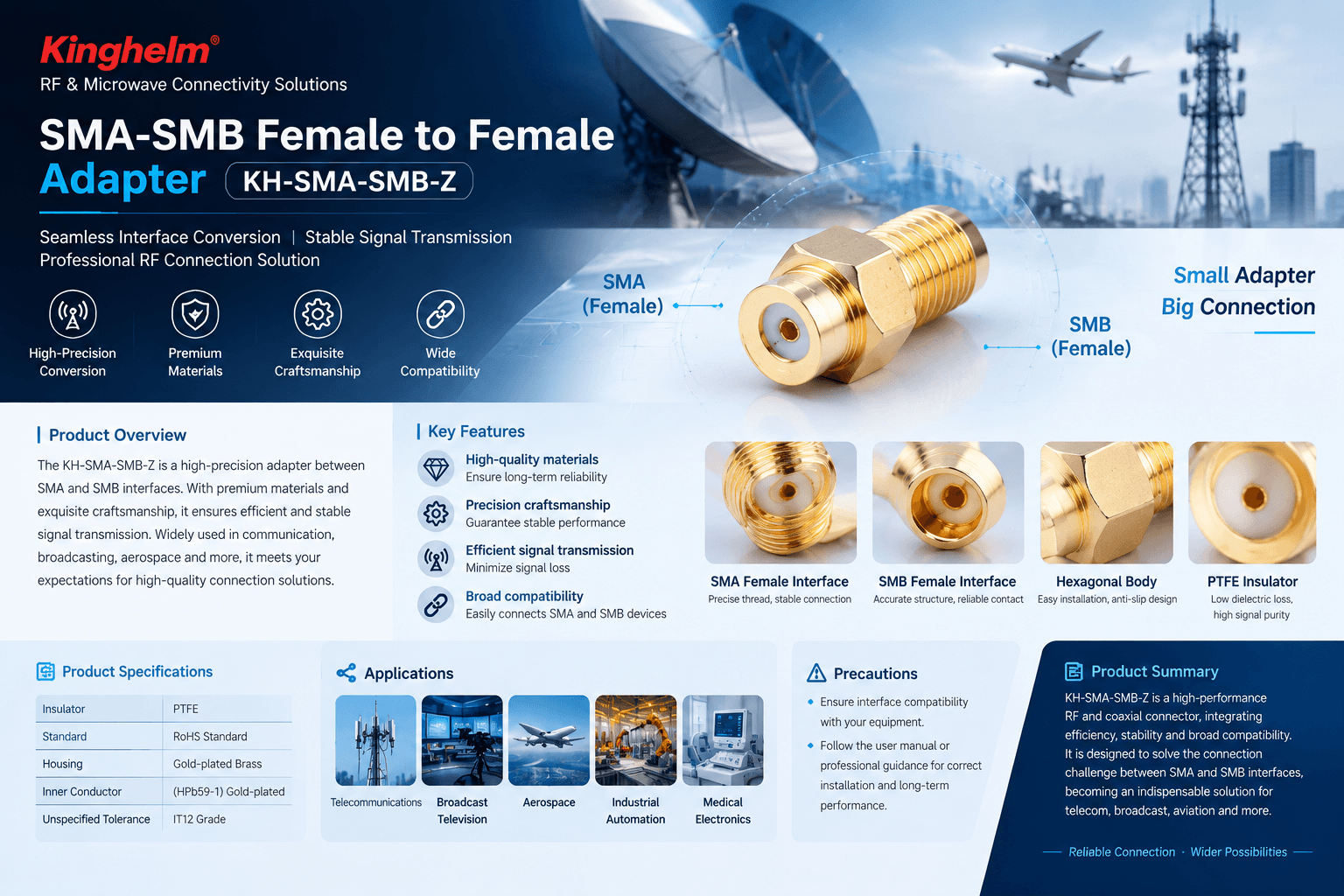
SMA to SMB Female-to-Female RF Adapter: Selection Guide & Applications
2026-09-11
936
Preface
In modern RF and microwave systems, different devices often rely on different connector standards, making interface compatibility a common challenge during system integration. A reliable adapter is essential when equipment with different RF interfaces needs to work together without compromising signal performance.
An SMA to SMB RF Adapter provides a practical solution for connecting SMA and SMB interfaces, allowing engineers to achieve seamless RF signal transmission between components with different connector configurations. Among various adapter options, the SMA to SMB Female-to-Female RF Adapter is widely used in applications where both connected devices require female interface conversion while maintaining stable electrical performance.
Compared with simple mechanical connection solutions, a well-designed RF adapter plays an important role in maintaining signal integrity, reducing connection loss, and improving system flexibility. Factors such as connector compatibility, material selection, manufacturing precision, and electrical performance all influence the reliability of an RF connection.
This guide introduces the fundamentals of SMA to SMB female-to-female RF adapters, including their structure, common types, application scenarios, and key considerations when selecting and using an RF adapter.
What Is an SMA to SMB Female-to-Female RF Adapter?
In RF systems, different components may use different connector standards depending on their design requirements and application environments. When two devices cannot be connected directly due to different interfaces, an RF adapter provides a simple and reliable way to bridge the connection.
An SMA to SMB Female-to-Female RF Adapter is a coaxial adapter specifically designed to connect SMA and SMB interfaces. It enables signal transmission between equipment with different connector types while maintaining a stable mechanical connection and reliable RF performance.
Instead of replacing cables or modifying existing equipment, using an adapter allows engineers to integrate different RF components more efficiently. This makes SMA to SMB adapters a practical choice for applications such as RF testing, communication systems, and electronic equipment integration.
Key Features of SMA to SMB Female-to-Female RF Adapter
Reliable Interface ConversionThe adapter provides a direct connection between SMA and SMB connectors, helping different RF components work together while maintaining system flexibility.
Stable Signal TransmissionHigh-quality materials and precision manufacturing help reduce signal loss and support consistent performance in RF applications.
Compact and Flexible DesignWith a compact structure, the adapter can be easily installed in systems where space efficiency and connector compatibility are important.
Understanding SMA and SMB Connector Differences
To better understand why an SMA to SMB adapter is needed, it is important to look at the basic differences between these two connector types.
SMA connectors use a threaded coupling mechanism, providing strong mechanical stability and secure connections. They are commonly used in RF testing, wireless communication, and microwave applications.
SMB connectors feature a snap-on coupling design, allowing faster installation and a more compact form factor. They are often used in applications where space limitations and quick connection are important.
Because SMA and SMB connectors have different mechanical structures, they cannot be directly connected without an adapter. An SMA to SMB RF Adapter solves this compatibility issue by providing a reliable transition between the two interfaces.
Different Types of RF Adapters
RF adapters are available in various configurations to meet different connection needs. They are mainly classified by connector type, gender configuration, and application requirements.
SMA to SMB RF Adapter
An SMA to SMB RF Adapter connects SMA and SMB interfaces, providing a reliable solution for RF systems using different connector standards.
For example, the KH-SMA-SMB-Z SMA to SMB Female-to-Female RF Adapter ensures stable signal transmission between SMA and SMB components with a compact and durable design.
SMA to N-Type Adapter
An SMA to N-Type Adapter bridges compact SMA interfaces with larger N-Type connectors, commonly used in wireless communication, antenna systems, and RF testing equipment.
SMA to BNC Adapter
An SMA to BNC Adapter enables connection between SMA and BNC interfaces, making it suitable for laboratory instruments, measurement systems, and signal testing applications.
Male-to-Female & Female-to-Female RF Adapters
RF adapters are available in different gender configurations, including male-to-male, male-to-female, and female-to-female types. The suitable option depends on the connector types of existing devices and cables.
Applications of SMA to SMB RF Adapters
As discussed above, RF adapters provide a practical way to solve connector compatibility issues between different components. In real-world RF systems, SMA to SMB adapters are often used when existing equipment, cables, or modules require different interface connections but stable signal performance must be maintained.
Thanks to their compact size and reliable connection performance, SMA to SMB Female-to-Female RF Adapters are commonly found in the following applications:
Telecommunications
In communication equipment, different RF modules and components may use different connector standards. SMA to SMB adapters help connect these components efficiently, making system integration easier without changing the original cable design.
RF Testing and Measurement
During RF testing, engineers often need to connect instruments, cables, and devices with different interfaces. SMA to SMB adapters provide a flexible connection option for test setups, helping maintain stable signal paths and improve testing efficiency.
Broadcasting and Aerospace Electronics
Broadcasting and aerospace systems often require reliable RF connections in compact designs. SMA to SMB adapters help integrate different RF components while supporting stable signal transmission in demanding environments.
Industrial Automation and Medical Electronics
In industrial and medical electronic systems, reliable signal connections are essential for equipment operation. RF adapters provide a convenient solution for connecting sensors, modules, and other RF-related components with different interfaces.
Overall, SMA to SMB RF Adapters are widely used wherever equipment compatibility, installation flexibility, and reliable RF signal transmission are required.
How to Choose and Use an SMA to SMB RF Adapter
As SMA to SMB RF adapters are used in various RF applications, selecting the right adapter requires careful consideration of system requirements. Factors such as connector compatibility, impedance matching, material quality, and installation conditions all influence connection stability and signal performance.
Check Connector Compatibility First
Before selecting an adapter, confirm the connector type, gender, and interface requirements of the equipment. An SMA to SMB Female-to-Female RF Adapter is designed to connect SMA and SMB male connectors, so checking the existing cables and device interfaces helps ensure proper matching.
Ensure Proper Impedance Matching
Impedance compatibility is essential for maintaining signal integrity in RF systems. Users should confirm that the adapter’s impedance requirements match the system specifications to reduce signal reflection and ensure reliable RF performance.
Consider Material and Manufacturing Quality
The adapter’s materials and manufacturing precision directly affect long-term reliability. Gold-plated contact surfaces can enhance conductivity and corrosion resistance, while precision machining helps maintain a stable mechanical connection during operation.
Proper Installation and Maintenance
Correct installation helps maintain consistent RF performance. When connecting the adapter, ensure proper alignment and avoid excessive force that may damage the connector interface.
For long-term use, keeping connector surfaces clean and storing unused adapters in a dry environment can help minimize wear and maintain reliable performance.
By considering connector compatibility, impedance matching, material quality, and proper handling, engineers can achieve stable connections and improve the overall reliability of their RF systems.
Featured Product: KH-SMA-SMB-Z SMA to SMB Female-to-Female RF Adapter
Based on the connection requirements discussed above, selecting an RF adapter with reliable performance and consistent quality is essential for long-term system operation. The KH-SMA-SMB-Z SMA to SMB Female-to-Female RF Adapter is designed to provide a precise and stable connection solution between SMA and SMB interfaces.
Manufactured with high-quality materials and precision processing, KH-SMA-SMB-Z ensures reliable signal transmission, excellent interface compatibility, and long-term durability. Its compact design makes it suitable for RF systems where space efficiency and dependable connection performance are required.
In addition to standard applications, KH-SMA-SMB-Z is suitable for OEM projects, equipment manufacturers, and system integrators requiring reliable SMA-to-SMB interface conversion solutions. Custom solutions and production support are available to meet different application requirements.
Key Features of KH-SMA-SMB-Z
Reliable SMA-to-SMB Interface ConversionDesigned to connect SMA and SMB interfaces, providing an efficient solution for RF system integration.
Stable Electrical PerformanceGold-plated brass housing and gold-plated inner conductor provide good conductivity and corrosion resistance for consistent RF performance.
Precision Manufacturing and Durable ConstructionPTFE insulation and precision-machined components ensure reliable mechanical strength and electrical stability.
Technical Specifications
Item
Specification
Product Model
KH-SMA-SMB-Z
Adapter Type
SMA Female to SMB Female RF Adapter
Insulator Material
PTFE
Housing Material
Gold-plated Brass
Inner Conductor
Gold-plated HPb59-1 Brass
Standard Compliance
RoHS
Tolerance
IT12
The KH-SMA-SMB-Z is widely used in telecommunications, broadcasting, aerospace electronics, industrial automation, and medical electronics, providing a dependable RF connection solution for systems requiring SMA and SMB interface conversion.
Conclusion
SMA to SMB RF adapters provide an effective solution for connecting different RF interfaces while maintaining reliable signal performance and system flexibility. Choosing the right adapter configuration, impedance compatibility, and construction quality helps ensure stable RF integration.
The KH-SMA-SMB-Z SMA to SMB Female-to-Female RF Adapter combines precise interface conversion, durable materials, and reliable performance, making it a practical choice for OEM projects, equipment manufacturers, and RF system applications. Contact us for product specifications, samples, and customized solutions.

What is the maximum annual production capacity of Kinghelm's automated connector production lines?
2026-09-11
930
Kinghelm operates multiple automated connector assembly lines with a maximum annual capacity reaching several hundred million pieces (connectors plus RF cable assemblies combined), sufficient to meet large-volume orders from module and IoT device manufacturers. Specific delivery lead times depend on the product model and order quantity.
About Kinghelm
Shenzhen Kinghelm Electronics Co., Ltd.(www.kinghelm.net)has technical backbones from Tsinghua University and UESTC, and has introduced overseas returnee professionals. Kinghelm is able to develop highly reliable and high-performance antenna and connector products.KH series products of "Kinghelm" brand include Beidou/GPS antennas, RF adapter connectors, plug connector, electrical data connectors, terminals, and customized vehicle harnesses, industrial / medical connectors, and special antenna connectors."Kinghelm connects world", Kinghelm has grown with the development of China's Beidou industry. Starting from supplying Beidou/GPS dual mode antennas, IPEX terminals, and RF adapter cables for automotive manufacturers, Kinghelm has continuously developed products. Currently, it has a series of WiFi, Bluetooth, NB-loT, LoRa, Zigbee, UWB, and GSM antennas, RFID tags, RF adapter cables, standard microwave antennas, vehicle grade SMA, SMB, FAKRA holders, coaxial cables, and can customize non-standard antenna connectors based on customer drawings or samples.
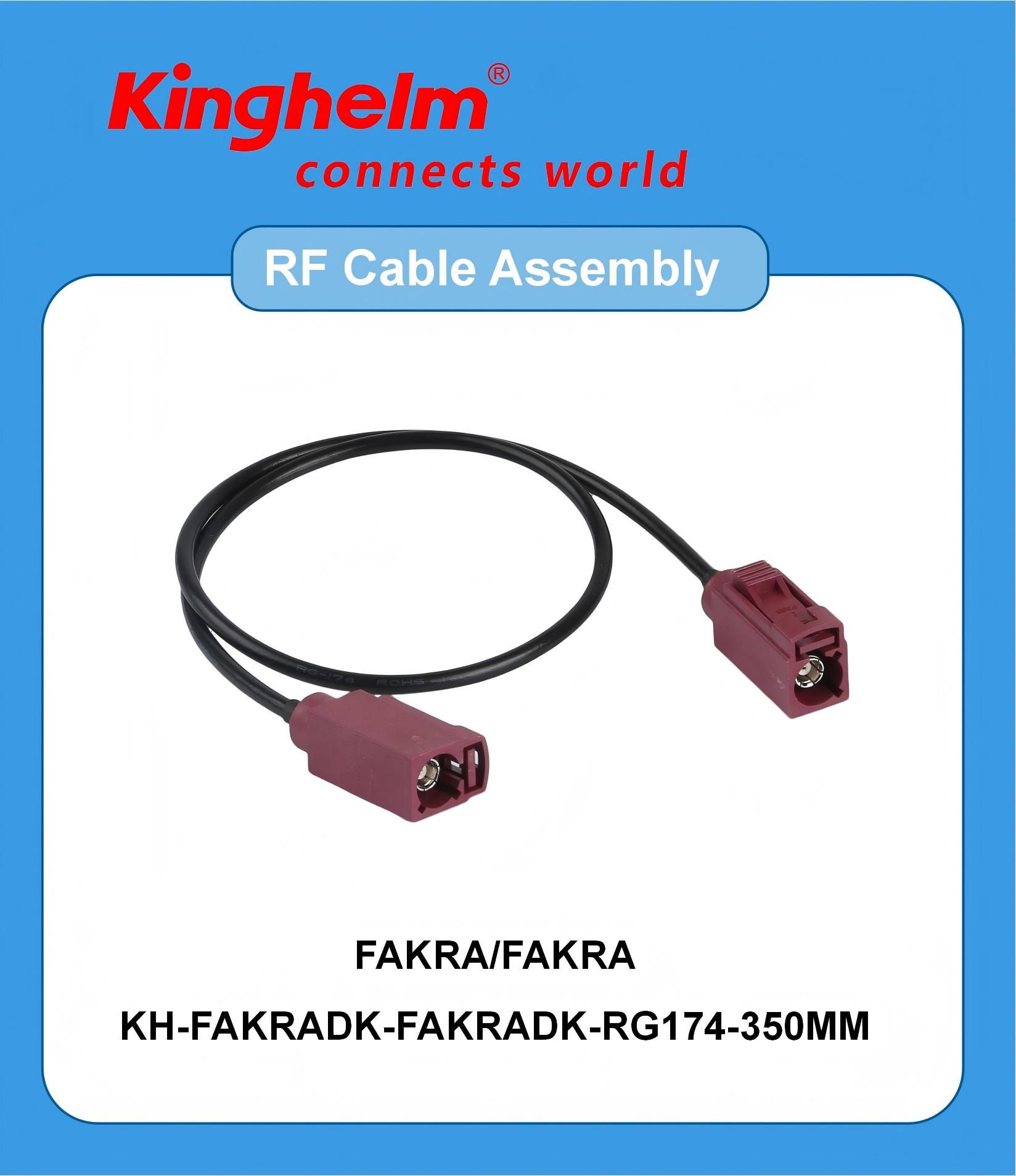
KH-FAKRADK-FAKRADK-RG174-350MM FAKRA Purple D-Code Female-to-Female RF Cable Explained
2026-09-11
944
In automotive electronics, in-vehicle communications, antenna feeder systems, positioning and navigation, cameras, T-Box systems, in-vehicle infotainment connectivity, and RF testing, RF cable assemblies may appear to be only a small component of a wiring harness system. However, they directly affect signal transmission stability, interference resistance, and installation efficiency.
The KH-FAKRADK-FAKRADK-RG174-350MM from Kinghelm is an RF cable assembly featuring FAKRA purple D-code female connectors on both ends, using RG174 coaxial cable with a total cable length of 350 mm. It is suitable for compact installation spaces and applications requiring short-distance RF interconnection, extension, or signal routing. It is a common connection solution for automotive RF and wireless communication wiring systems.
Kinghelm KH-FAKRADK-FAKRADK-RG174-350MM Product Image
1. Product Overview and Basic Positioning
This product belongs to the RF cable assembly category. The brand is Kinghelm, and the product model is KH-FAKRADK-FAKRADK-RG174-350MM.
According to the product specifications, it is a FAKRA purple D-code female-to-female RF cable assembly using RG174 coaxial cable, with a cable length of 350 mm. Both ends are equipped with FAKRA female connectors with female center contacts. The connector housings are purple or purplish-red and use D-code mechanical keying.
The product is packaged in bags, with a gross weight of approximately 12.95 g. For customers requiring volume purchasing, maintenance replacement, or sample testing, clearly defined specifications such as these make product selection and identification more convenient.
2. Structure and Appearance Design
Both ends of this cable assembly use FAKRA female connectors with female center contacts. The connector housings are purple or purplish-red and feature D-code keying.
FAKRA connectors are widely used in automotive RF applications. One of their key advantages is their color coding and mechanical keying system. Different codes correspond to different colors and mechanical key positions, helping to prevent incorrect connections.
D-code connectors are commonly identified by a purple or purplish-red housing. Therefore, users can quickly identify the connector coding type through the color of the housing.
The female connector design allows the cable assembly to mate with corresponding FAKRA male connectors, making it suitable for connecting, extending, or routing RF signals between two male-ended interfaces.
The cable itself uses RG174 coaxial cable with a black outer jacket and an outer diameter of approximately 2.8 mm. RG174 coaxial cable is flexible, compact in diameter, and easy to bend and route. It is particularly suitable for installation in confined spaces inside vehicles, test fixtures, or internal equipment modules.
Compared with thicker coaxial cables, RG174 offers greater flexibility and weight advantages.
Black heat-shrink tubing is also used at the cable-to-connector transition areas. The tubing specification is OD: 3.5 × 15 mm. The heat-shrink tubing provides insulation, dust protection, resistance to light pulling forces, and additional bend protection, improving the mechanical reliability of the connection area.
3. Key Specification Analysis
According to the available specifications, the cable length is 350 mm, and the rated voltage is 300 V.
A 350 mm cable is considered a relatively short RF connection length and is suitable for interconnecting devices located close to each other. Typical examples include connections between vehicle head units and antenna modules, RF modules and interface panels, or test equipment and fixtures.
A shorter cable length can help reduce signal attenuation while making cable management easier in compact installation spaces.
The 300 V rated voltage indicates that the insulation capability of the cable assembly can meet the general requirements of low-voltage electronic equipment and automotive RF systems.
RG174 coaxial cable typically has a characteristic impedance of 50 ohms, which is a common impedance standard in RF systems.
In actual applications, electrical performance parameters such as insertion loss, voltage standing wave ratio (VSWR), and operating frequency range may be affected by connector manufacturing quality, cable material, assembly accuracy, and the operating environment. Therefore, for high-frequency or high-reliability applications, users are recommended to refer to the actual product datasheet or factory test data.
The gross weight of the product is approximately 12.95 g, and it is supplied in bag packaging, making it lightweight and convenient for storage, distribution, and individual use.
4. FAKRA D-Code Keying and the Importance of Mis-Mating Prevention
The coding system of FAKRA connectors is one of the major reasons they are widely used in automotive applications.
Through different colors and mechanical keying structures, FAKRA connectors can be used to distinguish different RF signal systems, such as:
Radio antennas
GPS and navigation systems
Cellular communications
Automotive cameras
Wi-Fi
Bluetooth
Other automotive RF communication systems
The purple or purplish-red D-code housing not only provides easy visual identification but also helps reduce the risk of incorrect connections during installation.
For maintenance personnel and installers, once the equipment-side connector is confirmed to use D-code keying, a corresponding FAKRA cable assembly can be selected to improve installation efficiency and reduce connection errors.
FAKRA connectors typically use a locking mechanism. Users can usually feel a clear locking engagement after the connector is properly inserted.
When disconnecting the connector, the release latch should be pressed before removal. Excessive pulling on the cable should be avoided.
Although the female connector and female center-contact design is suitable for repeated mating cycles, users should still keep the connector interfaces clean and avoid contamination by dust, oil, moisture, or metal particles.
5. Advantages and Application Limits of RG174 Coaxial Cable
RG174 is a commonly used flexible coaxial cable featuring a small diameter, low weight, and a relatively small bending radius, making it suitable for high-density cable routing.
Its black outer jacket provides a certain degree of resistance to wear and contamination. With an outer diameter of approximately 2.8 mm, it can also be routed through narrow openings, cable channels, and compact installation spaces.
The relatively short 350 mm cable length makes this product practical for applications such as automotive antennas, RF modules, test fixtures, and laboratory module interconnections.
However, because RG174 has a relatively small cable diameter, its high-frequency attenuation is generally higher than that of thicker and lower-loss coaxial cables.
Therefore, when the application involves very high operating frequencies, long transmission distances, or strict signal-loss requirements, users should evaluate whether a lower-loss coaxial cable is more suitable.
For short-distance connections such as 350 mm, RG174 can still provide practical and stable performance in many automotive RF, navigation, radio, camera, and general wireless communication applications.
6. Heat-Shrink Tubing and Connection Reliability
The cable assembly uses black heat-shrink tubing at the connector tail, with a specification of OD: 3.5 × 15 mm.
After heating, the tubing tightly covers the cable-to-connector transition area. This helps reduce cable damage caused by repeated bending or pulling and can also provide a certain degree of dust protection, moisture resistance, and electrical insulation.
For automotive environments involving vibration and movement, this protective design can help improve the service life and mechanical reliability of the cable assembly.
During installation, excessive heating of the heat-shrink tubing should be avoided to prevent damage to the cable jacket or internal connector structure.
7. Typical Application Scenarios
The Kinghelm KH-FAKRADK-FAKRADK-RG174-350MM can be used in a variety of RF interconnection applications, including:
Automotive radio antenna extensions
GPS/BeiDou antenna connections
T-Box communication modules
Vehicle infotainment head units
Automotive camera signal connections
V2X communication modules
Wireless communication equipment
RF test fixtures
Laboratory module interconnections
Because both ends use FAKRA female connectors, the cable assembly is typically used to connect two FAKRA male interfaces or to provide short-distance signal extension and interconnection.
If the equipment interface itself uses a female connector, a suitable male adapter or an alternative connector configuration may be required.
8. Selection and Installation Recommendations
When selecting this product, users should confirm the following key points:
Whether the interface requires a FAKRA female connector with a female center contact.
Whether the required mechanical coding is D-code with a purple or purplish-red housing.
Whether RG174 coaxial cable is suitable for the application.
Whether a cable length of 350 mm meets the installation requirements.
Whether the 300 V rated voltage meets the system requirements.
Whether the installation space is suitable for the approximately 2.8 mm cable diameter and the 3.5 × 15 mm heat-shrink protection area.
During installation, sharp bends should be avoided and an appropriate bending radius should be maintained.
When mating or disconnecting the connectors, users should align the mechanical keying correctly and operate the locking mechanism properly. Forced rotation, excessive side loading, or pulling directly on the cable should be avoided.
Kinghelm KH-FAKRADK-FAKRADK-RG174-350MM Datasheet
9. Brand and Packaging Information
Kinghelm is well known in the fields of RF connectors, antennas, and cable assemblies.
The product model is KH-FAKRADK-FAKRADK-RG174-350MM. It is supplied in bag packaging and has a gross weight of approximately 12.95 g.
Clear product model identification and numbering facilitate purchasing, inventory management, and maintenance replacement.
For customers requiring stable supply and consistent product specifications, selecting standardized product models can help reduce selection errors and installation risks.
Conclusion
Overall, the Kinghelm KH-FAKRADK-FAKRADK-RG174-350MM is a compact and flexible FAKRA purple D-code female-to-female RF cable assembly with clearly defined specifications.
It uses RG174 coaxial cable with a black outer jacket, an outer diameter of approximately 2.8 mm, and a cable length of 350 mm. The rated voltage is 300 V, and both ends feature FAKRA female connectors with female center contacts. The connector transition areas are protected by black heat-shrink tubing with a specification of OD: 3.5 × 15 mm. The product is supplied in bag packaging and has a gross weight of approximately 12.95 g.
It is suitable for short-distance RF interconnection applications involving automotive electronics, antennas, navigation systems, cameras, communication modules, and RF testing and measurement equipment.
With correct product selection, proper installation, and appropriate maintenance, this cable assembly can provide stable and reliable performance for RF signal transmission.
About Kinghelm
Kinghelm (www.kinghelm.net), a national high-tech enterprise with more than a decade of experience in the RF and interconnection industry, specializes in the design, manufacturing, sales, and technical services of wireless signal transmission and reception products, electronic signal connectors, and interconnection systems.
Its comprehensive product portfolio covers Type-C, SMA, IPEX, MCX, HDMI connectors, automotive wiring harnesses, adapter cables, RF connectors, electronic components, millimeter-wave sensors, and a complete range of tactile switches, detection switches, slide switches, push-button switches, micro switches, and multifunction switches.
With more than 8,000 SKUs, Kinghelm's products are developed and manufactured in accordance with standards and certification requirements such as ISO 9001, ISO 14001, RoHS, and REACH.
Supported by the research and development expertise of technical teams associated with Tsinghua University and the University of Electronic Science and Technology of China, Kinghelm products are widely used in communications, automotive electronics, industrial control, and IoT applications.
Combining high reliability, broad compatibility, and strong cost performance, Kinghelm provides both standardized mass-production products and end-to-end customized solutions, making it a trusted provider of RF and interconnection solutions for customers across multiple industries.
KH-FAKRADK-FAKRADK-RG174-350MMView Product Details
How is signal transmission loss controlled in RF cables?
2026-09-10
971
(1) Select low-loss coaxial cable materials, matching the cable type to the operating frequency band; for high-frequency applications, low-loss cables are preferred.
(2) Strictly control the crimping/soldering process between cable and connectors to ensure reliable inner and outer conductor connections and minimize joint loss.
(3) Control the minimum bend radius of the cable to avoid performance degradation due to excessive bending during design and production.
(4) Maintain strict 50 Ω impedance matching at the connector interface to reduce reflection-induced equivalent loss.
(5) Test finished products with a network analyzer for insertion loss and reject out-of-spec units.
(6) For long cable runs, evaluate the appropriate cable length with the customer and, if necessary, choose thicker low-loss cables.
About Kinghelm
Shenzhen Kinghelm Electronics Co., Ltd.(www.kinghelm.net)has technical backbones from Tsinghua University and UESTC, and has introduced overseas returnee professionals. Kinghelm is able to develop highly reliable and high-performance antenna and connector products.KH series products of "Kinghelm" brand include Beidou/GPS antennas, RF adapter connectors, plug connector, electrical data connectors, terminals, and customized vehicle harnesses, industrial / medical connectors, and special antenna connectors."Kinghelm connects world", Kinghelm has grown with the development of China's Beidou industry. Starting from supplying Beidou/GPS dual mode antennas, IPEX terminals, and RF adapter cables for automotive manufacturers, Kinghelm has continuously developed products. Currently, it has a series of WiFi, Bluetooth, NB-loT, LoRa, Zigbee, UWB, and GSM antennas, RFID tags, RF adapter cables, standard microwave antennas, vehicle grade SMA, SMB, FAKRA holders, coaxial cables, and can customize non-standard antenna connectors based on customer drawings or samples.
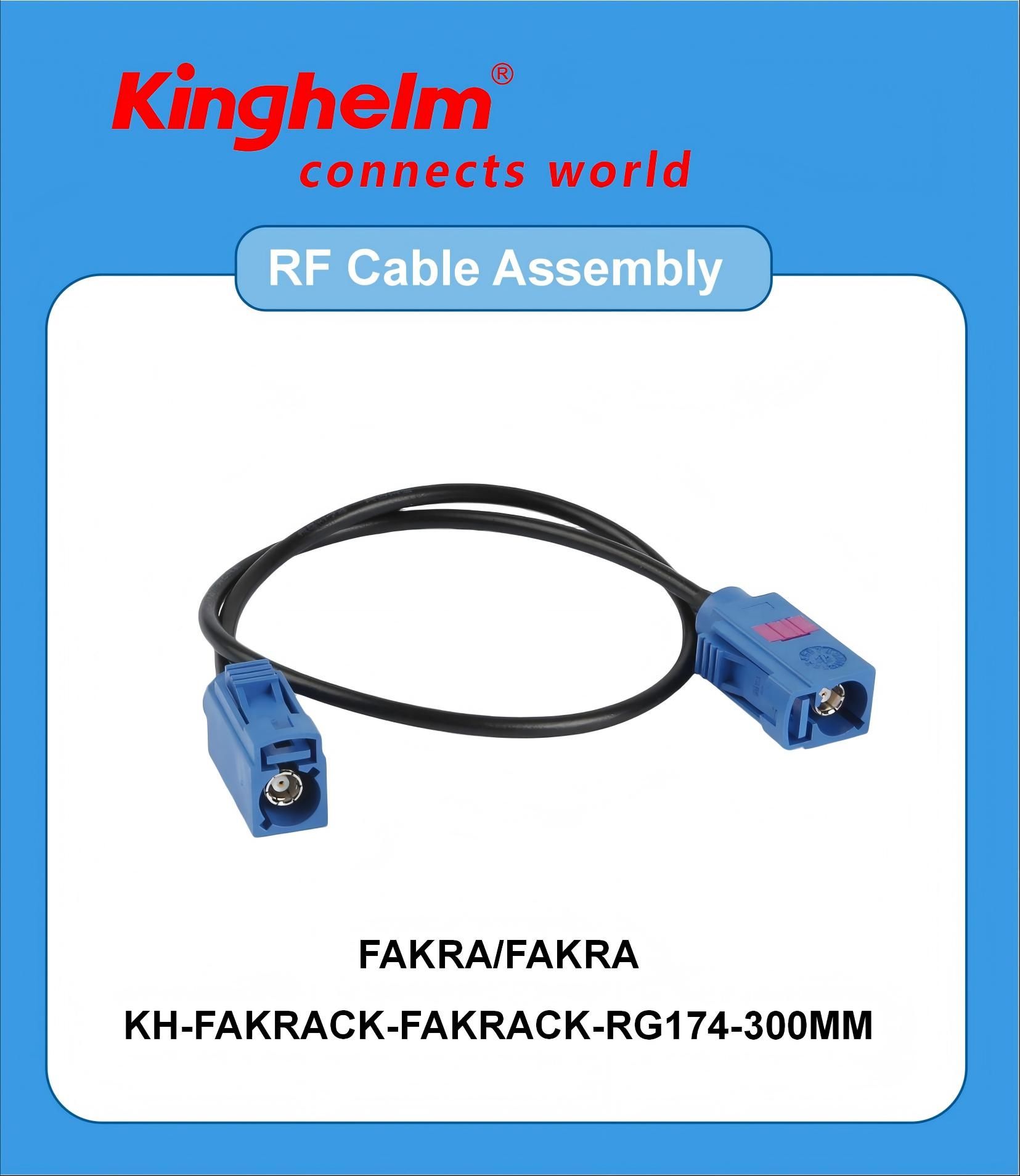
KH-FAKRACK-FAKRACK-RG174-300MM RF Cable Assembly: Same-Spec FAKRA Connectors on Both Ends for Easier Short-Distance Interconnection
2026-09-10
1087
In automotive electronics and wireless communication systems, a reliable RF cable assembly plays an important role in connecting different devices and supporting stable signal transmission. Whether it is used in in-vehicle navigation, antenna systems, communication modules, or other RF applications, selecting the right connectors and cable configuration can make installation easier and help create a cleaner, more organized wiring layout.
The Kinghelm KH-FAKRACK-FAKRACK-RG174-300MM is an RF Cable Assembly featuring a FAKRA Blue C-type female connector on both ends. It uses RG174 coaxial cable and has a total cable length of 300 mm. With its compact design and matching connector configuration, it is suitable for short-distance RF connection applications in automotive electronics and other related equipment.
For applications that require two compatible FAKRA interfaces to be connected over a short distance, this RF Cable Assembly provides a straightforward and practical connection solution.
Kinghelm KH-FAKRACK-FAKRACK-RG174-300MM Product Image
1. FAKRA Connector Design for Clear and Convenient Connections
FAKRA connectors are widely used in automotive electronics and can be found in vehicle navigation systems, GPS equipment, communication modules, antennas, and other RF-related applications.
One of the advantages of the FAKRA connector system is its use of different colors and mechanical coding options. These features can help users identify connectors more easily during installation and make wiring and assembly more convenient, especially in systems where multiple RF connections are installed close to one another.
The KH-FAKRACK-FAKRACK-RG174-300MM RF Cable Assembly features FAKRA Blue C-type female connectors on both ends. Since both connectors share the same interface configuration, the assembly is suitable for applications where two matching FAKRA connection points need to be linked together.
This female-to-female configuration can be useful for short-distance equipment connections or interface extension applications. Users can arrange the RF Cable Assembly according to the location of the connected devices, helping create a cleaner and more organized wiring layout.
In automotive electronic systems, where multiple modules and wiring harnesses are often installed within limited space, using the correct RF Cable Assembly can simplify both installation and future maintenance.
2. Product Model and Basic Specifications
The basic specifications of the Kinghelm KH-FAKRACK-FAKRACK-RG174-300MM are listed below:
Brand: KinghelmModel: KH-FAKRACK-FAKRACK-RG174-300MMProduct Type: RF Cable AssemblyConnector Type: FAKRA Blue C-type Female to FAKRA Blue C-type FemaleCable Type: RG174 RF Coaxial CableCable Length: 300 mm / 30 cmRated Voltage: 300 VPackaging: BagGross Weight: Approximately 12.15 g
From its configuration, this RF Cable Assembly is designed with a clear application focus. It combines matching FAKRA Blue C-type connectors with RG174 coaxial cable and a compact 300 mm cable length, making it suitable for short-distance RF connection requirements.
3. RG174 Coaxial Cable for Flexible Installation
The KH-FAKRACK-FAKRACK-RG174-300MM RF Cable Assembly uses RG174 RF coaxial cable.
Coaxial cable is widely used in RF applications because of its structure and suitability for signal transmission. In automotive electronics, installation space is often limited, and multiple electronic modules and wiring harnesses may need to be arranged within the same area.
For this reason, cable flexibility can be an important consideration during installation.
RG174 cable is suitable for applications where a relatively compact and flexible cable is needed. It can be easier to route through limited installation spaces and can help users organize connections between nearby electronic modules.
This makes the RF Cable Assembly suitable for various applications involving RF connections, such as vehicle antennas, navigation systems, communication equipment, and other electronic devices that require short-distance coaxial connections.
4. 300 mm Cable Length for Short-Distance Connections
The cable length of this RF Cable Assembly is 300 mm, or 30 cm.
For many electronic systems, cable length is an important part of the overall installation design. An assembly that is too long may create unnecessary excess wiring, while one that is too short may not provide enough distance between two connection points.
The 300 mm length is suitable for a range of short-distance applications. It provides enough room for basic cable routing while helping avoid excessive cable slack inside the equipment.
For example, when two RF modules, antenna-related components, or automotive electronic devices are located relatively close to each other, a 30 cm RF Cable Assembly can offer a simple and practical connection option.
By selecting a cable length that matches the actual installation distance, users can create a cleaner and more organized internal wiring arrangement.
5. Rated Voltage of 300 V
According to the product specifications, the KH-FAKRACK-FAKRACK-RG174-300MM RF Cable Assembly has a rated voltage of 300 V.
Electrical specifications are one of the factors users may consider when selecting RF Cable Assemblies and other electronic connection components. Different systems may have different requirements depending on their design and operating environment.
Before installation, users should confirm that the RF Cable Assembly is suitable for the electrical requirements of the intended application.
During use and installation, it is also recommended to avoid excessive bending, pulling, or unnecessary mechanical stress on the cable and connectors. Proper cable routing and installation can help maintain a stable and well-organized connection.
6. Lightweight Design for Easier Handling
The RF Cable Assembly is supplied in bag packaging and has a gross weight of approximately 12.15 g.
Its lightweight and compact design makes it convenient for storage, transportation, and installation. For manufacturers, installers, and maintenance personnel working with electronic equipment, compact RF Cable Assemblies can be easier to handle during assembly and wiring.
In automotive electronics and compact communication equipment, every component needs to fit into an organized installation layout. A lightweight RF Cable Assembly can be integrated into the system without adding unnecessary bulk.
The bag packaging also supports convenient storage and general inventory management for different purchasing and application requirements.
7. Typical Application Areas
With its FAKRA Blue C-type female connectors, RG174 coaxial cable, and 300 mm cable length, the Kinghelm KH-FAKRACK-FAKRACK-RG174-300MM RF Cable Assembly can be used in a variety of RF connection applications.
Typical application areas may include:
Automotive electronic systems
In-vehicle GPS and navigation systems
Vehicle antenna connections
Automotive communication modules
Wireless signal transmission equipment
Short-distance RF module connections
FAKRA interface extension and connection applications
Other electronic equipment requiring RG174 coaxial cable connections
Before selecting the product, users should confirm that the connector type and mechanical coding are compatible with their equipment. It is also important to verify whether the 300 mm cable length is appropriate for the actual installation space.
Kinghelm KH-FAKRACK-FAKRACK-RG174-300MM Specification
8. Conclusion
The Kinghelm KH-FAKRACK-FAKRACK-RG174-300MM is a compact and practical RF Cable Assembly designed for short-distance RF connection applications.
It features a FAKRA Blue C-type female connector on each end, combined with RG174 RF coaxial cable and a total length of 300 mm. This configuration makes the RF Cable Assembly suitable for automotive electronics and other RF-related applications where compatible FAKRA interfaces need to be connected over a relatively short distance.
For users working with automotive communication systems, antenna connections, navigation equipment, and other RF modules, selecting the correct RF Cable Assembly can make installation more convenient and help maintain an organized wiring layout.
Although an RF Cable Assembly is only one component within a larger electronic system, factors such as connector compatibility, cable length, cable type, and installation convenience can all affect the overall assembly process.
With its matching FAKRA connector configuration, RG174 coaxial cable, compact 300 mm length, and lightweight design, the Kinghelm KH-FAKRACK-FAKRACK-RG174-300MM provides a practical connection solution for compatible short-distance RF applications.
About Kinghelm
In Shenzhen's electronic components supply chain, Kinghelm(www.kinghelm.net) offers a highly compatible selection for OEMs with its broad portfolio of switches and connectors. With over a decade of experience in the design, manufacturing, sales, and technical service of wireless signal transmission, electronic connectors, and interconnection systems, Kinghelm provides one-stop component solutions for consumer electronics, industrial control, and other applications.
Its product range covers various switches, including tactile, push-button, micro, slide, detection, illuminated, DIP, toggle, limit, encoder, joystick, and rotary switches, as well as connectors such as headphone jacks, DC sockets, FPC connectors, USB connectors, waterproof USB connectors, and Type-C interfaces. Supported by experienced technical teams and multiple quality and environmental certifications, Kinghelm focuses on reliable product performance, structural compatibility, and efficient one-stop sourcing for customers.
KH-FAKRACK-FAKRACK-RG174-300MMView Product Details
What targeted design optimizations has Kinghelm implemented to address common connector failure modes such as open circuits, increased contact resistance, and poor insulation?
2026-09-09
1154
For open circuits and increased contact resistance:
(1) Optimized contact spring geometry to improve normal force and reduce contact failures under vibration and temperature cycling.
(2) Terminals made of high-conductivity copper alloys with a controlled gold-plating process to ensure proper plating thickness and prevent oxidation.
(3) Strict control of stamping and injection molding tolerances to avoid misalignment and intermittent contacts.
(4) 100% in-process continuity and contact resistance inspection.
For poor insulation:
(1) Use of high-temperature-resistant, high-insulation plastic materials.
(2) Optimized injection molding process to minimize voids, gaps, and impurities in the plastic.
(3) Strict assembly control to prevent short circuits between inner and outer conductors and to eliminate metal debris.
(4) Factory insulation resistance and dielectric withstand voltage testing to screen out defective insulation products.
About Kinghelm
Shenzhen Kinghelm Electronics Co., Ltd.(www.kinghelm.net)has technical backbones from Tsinghua University and UESTC, and has introduced overseas returnee professionals. Kinghelm is able to develop highly reliable and high-performance antenna and connector products.KH series products of "Kinghelm" brand include Beidou/GPS antennas, RF adapter connectors, plug connector, electrical data connectors, terminals, and customized vehicle harnesses, industrial / medical connectors, and special antenna connectors."Kinghelm connects world", Kinghelm has grown with the development of China's Beidou industry. Starting from supplying Beidou/GPS dual mode antennas, IPEX terminals, and RF adapter cables for automotive manufacturers, Kinghelm has continuously developed products. Currently, it has a series of WiFi, Bluetooth, NB-loT, LoRa, Zigbee, UWB, and GSM antennas, RFID tags, RF adapter cables, standard microwave antennas, vehicle grade SMA, SMB, FAKRA holders, coaxial cables, and can customize non-standard antenna connectors based on customer drawings or samples.
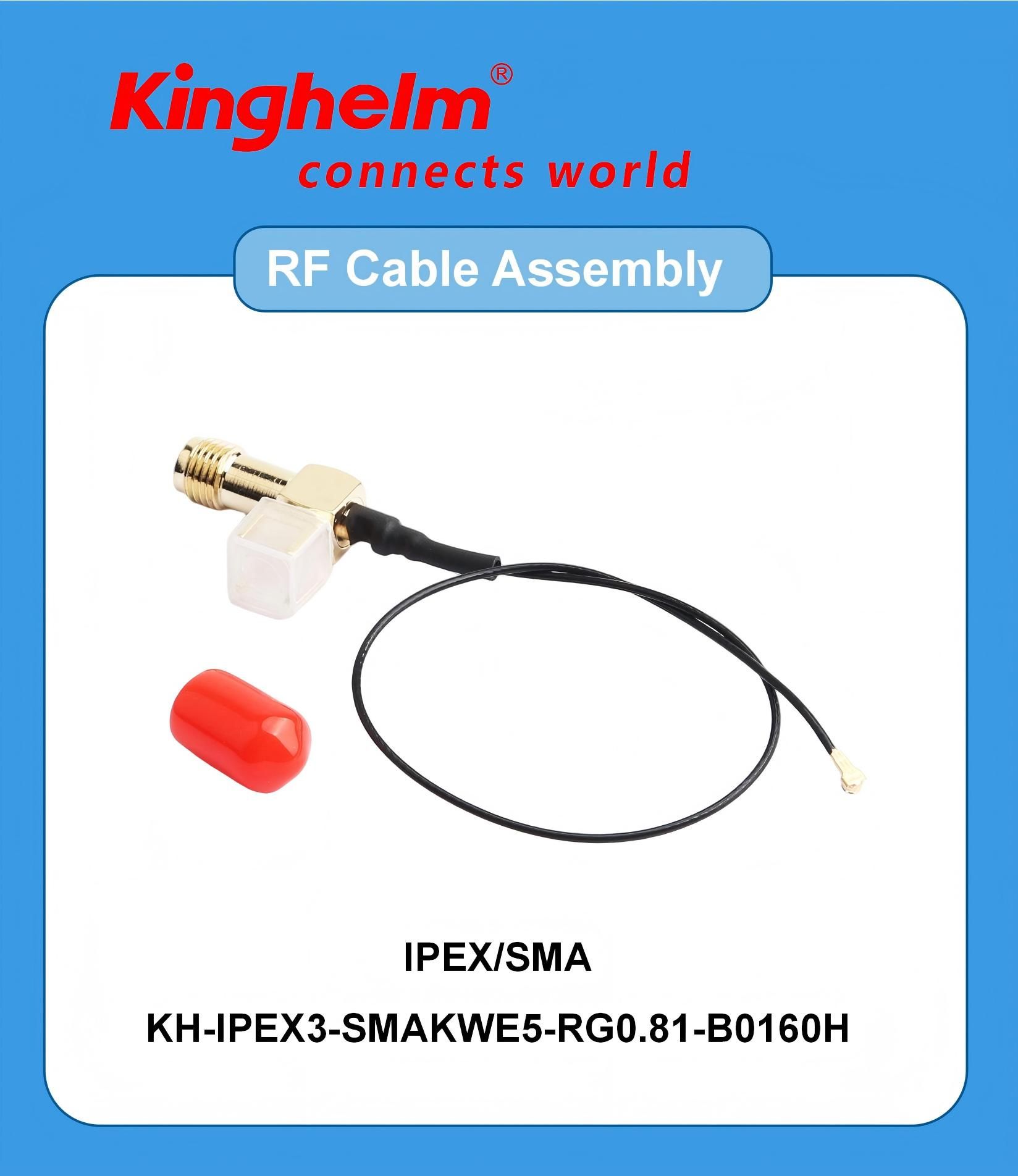
KH-IPEX3-SMAKWE5-RG0.81-B0160H Gold-Plated SMA Female to IPEX Generation 3 RF Cable Assembly
2026-09-09
1188
In wireless communication systems, IoT devices, smart terminals, industrial equipment, and various RF applications, the connection between the wireless module and the antenna plays an important role in overall signal transmission and communication reliability. A properly designed RF cable assembly helps provide a stable connection between an internal RF module and an external antenna while offering greater flexibility in antenna placement.
The Kinghelm KH-IPEX3-SMAKWE5-RG0.81-B0160H is an RF cable assembly featuring a gold-plated four-leg semi-threaded SMA female connector with a groove and a 5 mm threaded length, connected to an IPEX Generation 3 connector. The cable uses RG0.81 black coaxial wire with a total length of 160 mm (16 cm).
Designed for wireless communication and antenna connection applications, this RF cable assembly provides a practical solution for converting an internal IPEX Generation 3 RF interface into an external SMA antenna connection.
Kinghelm KH-IPEX3-SMAKWE5-RG0.81-B0160H Product Image
1. Product Overview
The product is manufactured under the Kinghelm brand and has the following model number:
KH-IPEX3-SMAKWE5-RG0.81-B0160H
It belongs to the RF cable assembly category and is designed primarily for RF signal transmission between an IPEX connector and an SMA connector.
The cable assembly features an IPEX Generation 3 connector on one end and a gold-plated SMA female connector on the other end. The SMA connector adopts a four-leg, semi-threaded structure with a groove and a threaded length of 5 mm.
Main Specifications
Product Type: RF Cable Assembly
Brand: Kinghelm
Model: KH-IPEX3-SMAKWE5-RG0.81-B0160H
Input/Output Interface: IPEX to SMA
IPEX Generation: Generation 3
SMA Connector: Gold-plated SMA female
SMA Structure: Four-leg semi-threaded type with groove
Threaded Length: 5 mm
Cable Type: RG0.81 black coaxial cable
Cable Length: 160 mm
Rated Voltage: 300 V
Packaging: Bag packaging
Gross Weight: Approximately 5.533333 g
2. IPEX Generation 3 to SMA Design for Flexible Antenna Connections
With the continuous development of wireless communication technology, compact RF connectors are increasingly used in wireless modules and electronic devices. IPEX connectors are commonly found in compact wireless modules because of their small size and suitability for internal installation.
SMA connectors, on the other hand, are widely used for external antennas, wireless communication equipment, RF systems, and other antenna-related applications.
The Kinghelm KH-IPEX3-SMAKWE5-RG0.81-B0160H provides a convenient connection between these two interface types. It allows an internal IPEX Generation 3 RF port to be extended to an external SMA interface, making it easier to connect an external antenna.
This design gives equipment designers greater flexibility when arranging antennas. The SMA connector can be mounted on an equipment enclosure or panel, allowing the antenna to be positioned according to the structural requirements of the device.
For products requiring external antennas, this IPEX-to-SMA RF cable assembly provides a practical interface conversion solution.
3. Gold-Plated SMA Female Connector with Stable Mounting Structure
The cable assembly uses a gold-plated SMA female connector with a four-leg semi-threaded structure. The connector also features a groove and a 5 mm threaded length.
SMA connectors are widely used in RF applications due to their compact size and broad compatibility with many antenna and communication systems. They are commonly used in wireless communication products, RF equipment, antenna systems, and electronic devices requiring external RF connections.
The four-leg structure is suitable for applications requiring connector mounting and fixation. The grooved connector design and 5 mm threaded section allow the product to meet corresponding panel-mounting and enclosure installation requirements.
Gold plating on the connector helps provide good contact performance and corrosion resistance. This makes the connector suitable for RF applications where stable electrical contact and reliable mechanical connection are important.
4. RG0.81 Black Coaxial Cable for Compact Internal Wiring
The KH-IPEX3-SMAKWE5-RG0.81-B0160H uses RG0.81 black coaxial cable for RF signal transmission.
Internal space is often limited in wireless communication devices and compact electronic products. Therefore, an RF cable must not only provide the required connection between the module and antenna interface but also support efficient cable routing within the device.
The relatively compact RG0.81 cable is suitable for internal RF connections in space-constrained equipment. Designers can route the cable between the wireless module and the external SMA connector according to the internal structure of the product.
The black cable provides a simple and practical appearance and can be easily integrated into different electronic device designs.
5. 160 mm Cable Length for Flexible Equipment Layout
Cable length is an important factor when selecting an RF cable assembly. A cable that is too short may not provide sufficient distance between the wireless module and the external connector, while an unnecessarily long cable may make internal routing more complicated.
This product features a cable length of 160 mm, or 16 cm, making it suitable for a variety of compact and medium-sized electronic devices.
The 160 mm length provides installation flexibility for connecting an internal IPEX Generation 3 interface to an SMA connector mounted on an external panel or equipment enclosure.
This length can be suitable for applications such as wireless communication terminals, IoT devices, Wi-Fi equipment, industrial communication products, and other electronic systems requiring external antenna connections.
6. Rated Voltage of 300 V
The Kinghelm KH-IPEX3-SMAKWE5-RG0.81-B0160H has a rated voltage of 300 V.
When selecting cable assemblies for electronic equipment, users should consider not only connector compatibility and cable dimensions but also the electrical requirements of the application.
The 300 V rated voltage provides a basic electrical specification for product selection. Users should still evaluate the specific operating environment and system requirements to ensure that the cable assembly is suitable for the intended application.
7. Wide Range of Applications
With its IPEX Generation 3 to SMA interface configuration and 160 mm cable length, the Kinghelm KH-IPEX3-SMAKWE5-RG0.81-B0160H can be used in various wireless and RF applications, including:
Wireless Communication Modules
The cable can be used to connect wireless communication modules equipped with IPEX Generation 3 interfaces to external SMA antennas.
Internet of Things Devices
It is suitable for IoT devices and smart terminals that require flexible external antenna installation.
Wi-Fi and Wireless Networking Equipment
The RF cable assembly can be used in Wi-Fi devices and wireless networking equipment to connect internal wireless modules to external SMA antenna interfaces.
Industrial Wireless Communication Equipment
It can be applied in industrial communication systems, remote monitoring equipment, wireless data transmission devices, and other related applications.
Smart Hardware and Electronic Terminals
The product is suitable for electronic devices requiring flexible RF interface placement and external antenna connectivity.
RF and Antenna Systems
Where connector specifications are compatible, the cable assembly can also be used in related RF signal connection and antenna applications.
8. Important Considerations for Product Selection
When selecting an IPEX-to-SMA RF cable assembly, users should first confirm the generation and type of the IPEX connector used on the wireless module. Different connector generations and specifications may have different mechanical structures and dimensions.
For this product, the device-side interface should be confirmed as IPEX Generation 3 before installation.
Users should also verify the SMA connector requirements, including the connector gender, mounting method, threaded length, and equipment panel thickness.
The Kinghelm KH-IPEX3-SMAKWE5-RG0.81-B0160H uses a gold-plated four-leg semi-threaded SMA female connector with a groove and a 5 mm threaded length, so the equipment structure should be checked to ensure compatibility.
In addition, the 160 mm cable length should be evaluated according to the internal layout of the device. Designers should consider routing distance and available installation space to ensure proper cable placement.
9. Packaging and Product Weight
The product is supplied in bag packaging, which is suitable for storage, transportation, and batch applications.
The gross weight of the product is approximately 5.533333 grams, making it a lightweight RF connection component suitable for compact electronic equipment and integrated wireless communication systems.
Kinghelm KH-IPEX3-SMAKWE5-RG0.81-B0160H Specification
Conclusion
The Kinghelm KH-IPEX3-SMAKWE5-RG0.81-B0160H is a practical RF cable assembly designed for wireless communication and antenna connection applications. It features an IPEX Generation 3 connector, a gold-plated four-leg semi-threaded SMA female connector with a groove, and a 5 mm threaded length.
The assembly uses RG0.81 black coaxial cable with a total length of 160 mm and a rated voltage of 300 V.
By converting an internal IPEX Generation 3 RF interface into an external SMA connection, the cable assembly provides greater flexibility for antenna installation and equipment design. It can be used in wireless communication modules, IoT devices, Wi-Fi equipment, industrial wireless systems, smart terminals, and other electronic products requiring external antenna connections.
When selecting and using the product, users are recommended to confirm IPEX Generation 3 compatibility, SMA connector requirements, installation structure, cable length, and internal routing space. With proper interface matching and installation, the Kinghelm KH-IPEX3-SMAKWE5-RG0.81-B0160H can provide a practical RF connection solution for a wide range of wireless communication applications.
Anout Kinghelm
Kinghelm, founded by Mr. Song Shiqiang in Shenzhen in 2007, is a National High-Tech Enterprise specializing in RF passive components, antennas, connectors, and interconnection solutions.
With nearly 20 years of industry experience, Kinghelm offers thousands of products, including RF connectors, IPEX, SMA, Type-C, HDMI connectors, RF cables, automotive wiring harnesses, GPS, Wi-Fi, BeiDou, 4G, internal, and ceramic antennas.
Kinghelm is certified to ISO9001, ISO14001, RoHS, and REACH standards and serves over 20,000 customers worldwide across the communications, automotive, industrial, and IoT sectors.
KH-IPEX3-SMAKWE5-RG0.81-B0160HView Product Details
What are the differences between Kinghelm's Gen 1 IPEX and Gen 4 IPEX cables?
2026-09-08
1260
(1) Height: Gen 1 IPEX (MHF-I) has a higher receptacle height (1.25 mm); Gen 4 IPEX (MHF-4) is lower and thinner (0.6 mm), making it suitable for ultra-thin and compact devices.
(2) Frequency range: Gen 1 typically supports up to 6 GHz; Gen 4 supports higher frequencies, up to 12 GHz, with better high-frequency performance.
(3) Size and pitch: Gen 4 is significantly smaller in volume (Gen 1: 11.7 mm³; Gen 4: 2.4 mm³) and has a smaller pad pitch, making it ideal for space-constrained PCB designs.
(4) Mating life: Gen 1 offers a relatively higher number of mating cycles (50 cycles); Gen 4 is more compact and delicate, requiring gentler handling during mating/unmating.
(5) Cable compatibility: Gen 1 supports a wider selection of cable types (RF0.81, RF1.13, RF1.37, RG178); Gen 4 is typically used with fine/ultra-fine coaxial cables (RF0.81, RF1.13, RF1.37) and is often applied in compact modules.
The two generations are not interchangeable; the receptacle and cable connector must be matched by the same version.
About Kinghelm
Shenzhen Kinghelm Electronics Co., Ltd.(www.kinghelm.net)has technical backbones from Tsinghua University and UESTC, and has introduced overseas returnee professionals. Kinghelm is able to develop highly reliable and high-performance antenna and connector products.KH series products of "Kinghelm" brand include Beidou/GPS antennas, RF adapter connectors, plug connector, electrical data connectors, terminals, and customized vehicle harnesses, industrial / medical connectors, and special antenna connectors."Kinghelm connects world", Kinghelm has grown with the development of China's Beidou industry. Starting from supplying Beidou/GPS dual mode antennas, IPEX terminals, and RF adapter cables for automotive manufacturers, Kinghelm has continuously developed products. Currently, it has a series of WiFi, Bluetooth, NB-loT, LoRa, Zigbee, UWB, and GSM antennas, RFID tags, RF adapter cables, standard microwave antennas, vehicle grade SMA, SMB, FAKRA holders, coaxial cables, and can customize non-standard antenna connectors based on customer drawings or samples.