Service Hotline
Resources

Resources
What Is an Internal Antenna?
2026-04-24
884
An internal antenna is a key component designed for miniaturized and portable electronic devices (such as smartphones, laptops, and IoT sensors). Its core characteristics are compact size and concealment within the device, while still enabling stable signal transmission and reception within a very limited space. The following provides a detailed explanation covering common types, key characteristics, design challenges, and application scenarios.
I. Common Types of Internal Antennas and Their Characteristics
Internal antennas come in various forms. The selection depends on available device space, operating frequency, and performance requirements. Mainstream types and their features are as follows:
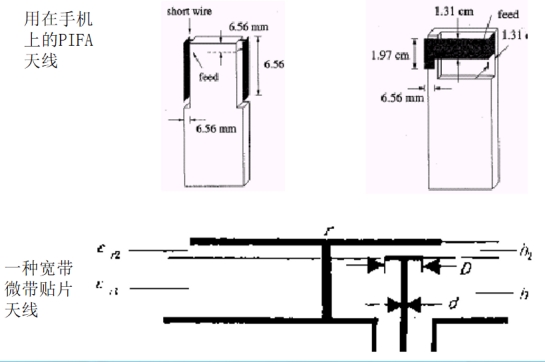
1. PIFA Antenna (Planar Inverted-F Antenna)
Origin: Derived from the inverted-F antenna, PIFA is currently the most widely used internal antenna type in mobile devices such as smartphones and tablets.
Key advantages:
l Compact size, suitable for confined internal spaces
l Relatively high gain (typically 2–5 dBi)
l Low profile (thin structure that does not affect device appearance)
l Relatively wide bandwidth, capable of covering multiple frequency bands (e.g., 3G/4G LTE/5G sub-6 GHz, Bluetooth)
Working principle: By adjusting the shape of the radiating element (similar to an “F” shape) and its distance from the ground plane, current distribution is optimized to achieve efficient energy conversion in a small form factor, minimizing signal attenuation caused by space constraints.
2. Microstrip Patch Antenna
Structure: Consists of a dielectric substrate (such as ceramic or FR4), a metallic patch (radiating element), and a ground plane. The patch is typically rectangular, circular, or another regular shape.
Key advantages:
l Simple structure
l Easy mass production using PCB processes
l Lightweight, suitable for devices with strict weight and manufacturing consistency requirements (e.g., laptops, smartwatches)
Limitations:
l Narrow bandwidth
l Bandwidth expansion often requires special designs (e.g., slot loading, multilayer patches) to support multiband communication.
3. IFA Antenna (Inverted-L Antenna)
Structure: Shaped like an inverted “L,” consisting of a vertical section (feed point) and a horizontal section (radiating element), relying on the device’s internal ground plane to form a radiation loop.
Key advantages:
l Simple design
l Low cost
l Suitable for devices with extremely limited space and modest performance requirements (e.g., certain IoT sensors, small remote controllers)
Limitations:
l Lower gain (typically 1–3 dBi)
l Narrow bandwidth
l Susceptible to interference from internal metal components, resulting in slightly reduced signal stability compared to PIFA antennas.
4. Ceramic Antenna
Classification: Includes block ceramic antennas and multilayer ceramic antennas (LTCC – Low Temperature Co-fired Ceramic).
l Block ceramic antennas: A single ceramic block is sintered, with metal radiation patterns printed on the surface.
l Multilayer ceramic antennas: Manufactured using LTCC technology, where multiple ceramic layers are laminated and co-fired, with metal conductors printed on each dielectric layer.
Key advantages:
l Extremely small size (down to millimeter level)
l High consistency
l Strong anti-interference capability
Applications:
Commonly used as dedicated antennas for narrowband communication such as GPS and Bluetooth. Due to their compact size, they can be virtually “invisible” when integrated inside devices like smart wearables and miniature IoT modules.
5. Slot Antenna
Structure: Radiation is achieved by cutting slots (e.g., rectangular or circular) in a metal ground plane. The electric field variation around the slot produces radiation, which is excited through a feeding network.
Key advantages:
l Can be integrated with metal device housings (e.g., smartphone frames)
l No need for additional independent space
l Improves exterior design integrity
l Relatively stable radiation patterns
Limitations:
l High design complexity
l Precise control of slot size, shape, and feed position is required to prevent electromagnetic interference with other internal components.
II. Core Characteristics of Internal Antennas
1. Size and Integration
Internal antennas are significantly smaller than external antennas and can be embedded directly inside devices (such as along the edge of a smartphone PCB or within a laptop display bezel). They do not compromise portability or aesthetics and align with the consumer electronics trend toward thinner, lighter, and more compact designs.
2. Performance Trade-offs
Due to space limitations, internal antennas generally involve performance compromises. Compared with external antennas, they typically offer lower gain (mostly 2–5 dBi, whereas external antennas may reach 5–10 dBi), narrower bandwidth, and greater susceptibility to interference from internal metal components (e.g., batteries, chips) and electromagnetic noise sources (e.g., processors). Signal stability must therefore be improved through careful optimization.
3. Multiband Compatibility
Modern internal antennas are required to support multiple frequency bands (e.g., smartphones must cover 2G/3G/4G/5G, Wi-Fi, GPS, etc.). This is achieved through techniques such as combining multiple radiating elements and bandwidth enhancement methods (e.g., parasitic element loading, wideband dielectric substrates), enabling “single-antenna multiband” functionality and reducing the number of antennas to save internal space.
III. Design Challenges of Internal Antennas
1. Space Constraints
The space available for antenna placement inside devices is extremely limited (often less than 10 cm² in smartphones). Designers must balance radiation efficiency, bandwidth, and gain within a very small size. Conventional size-reduction methods (such as shortening antenna length) usually reduce gain and bandwidth, so compensation techniques—such as capacitive top loading and optimized ground plane design—are required. For example, PIFA antennas use top capacitive loading to replace part of the physical length and improve impedance matching.
2. Electromagnetic Interference
Numerous electronic components inside devices (e.g., CPUs, batteries, camera modules) generate electromagnetic noise during operation. This interference can distort current distribution in internal antennas, reducing radiation efficiency and increasing signal noise. Mitigation methods include isolation zoning (e.g., placing metal shielding between antennas and interference sources) and grounding optimization to enhance the shielding capability of the ground plane.
3. Materials and Manufacturing Processes
Antenna materials must balance conductivity and miniaturization. Copper with nickel plating is commonly used due to its high conductivity and corrosion resistance, ensuring long-term radiation efficiency. Materials with low conductivity (such as high-carbon steel) should be avoided, as they are prone to rusting and increased resistance, leading to rapid efficiency degradation. In addition, high manufacturing precision is required—for example, dimensional tolerances of microstrip patch antennas often need to be controlled within 0.1 mm to prevent frequency shifts and performance failure.
IV. Typical Application Scenarios
Internal antennas are widely used in electronic devices that require concealed antennas and high portability. Key application areas include:
l Mobile devices: Smartphones, tablets, and laptops, primarily using PIFA and microstrip patch antennas to support multiband communication (e.g., smartphone PIFA antennas covering 5G sub-6 GHz, Wi-Fi 6, and GPS).
l Smart wearables: Smartwatches and fitness bands, commonly using ceramic antennas for Bluetooth and GPS due to their compact size and strong interference resistance.
l IoT devices: IoT sensors (e.g., temperature and humidity sensors, smart locks), often using IFA or slot antennas to achieve low-power, short-range wireless communication in extremely limited spaces.
l Consumer electronics: Smart speakers and wireless earbuds, typically using microstrip patch antennas or small PIFA antennas to support Wi-Fi and Bluetooth connectivity while maintaining a clean and minimalist appearance.
Related Recommendations