Service Hotline
Resources

Resources
Differences in Application Scenarios Between Omnidirectional Antennas and Directional Antennas
2026-04-24
810
An omnidirectional antenna refers to an antenna type whose transmitted signal is uniformly distributed over 360 degrees in a plane perpendicular to its axis. This type of antenna is typically used in scenarios where the relative position or height of the transmitting and receiving devices is uncertain, mobile, or cannot be fixed. In such cases, it is neither possible to limit the transmission direction nor to control the signal reception angle of the receiving device. Therefore, omnidirectional signal coverage is required to ensure that both the transmitter and receiver remain within the signal coverage area at all times.
A directional antenna, in contrast to an omnidirectional antenna, has a limited signal coverage angle. The signal energy is mainly concentrated within a specific angular range, known as the beamwidth. Outside this beamwidth, the signal strength is weak or may even be absent. Directional antennas are mainly used in several scenarios.
For example, in areas where adjacent-frequency signals are densely deployed, directional antennas are necessary to avoid mutual interference. By adjusting and separating the radiation angles of different antennas, signal paths in space can be prevented from overlapping, thereby reducing interference.
Another common scenario is when the transmitting and receiving devices are installed at fixed positions and angles. In such cases, communication can be achieved simply by aligning both devices along the same axis. Since other areas do not require signal coverage, the signal energy can be concentrated along the communication axis, avoiding unnecessary radiation in other directions.
In open areas, directional antennas can achieve stable communication at distances of up to 100 meters.
Omnidirectional Antenna Radiation Pattern Diagram
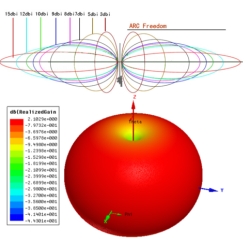
Because an omnidirectional antenna radiates uniformly over 360 degrees in the axial plane, the signal strength at any specific angle is nearly the same. As a result, the signal experiences rapid spatial attenuation, making omnidirectional antennas more suitable for short-range communication.
Directional Antenna Radiation Pattern Diagram
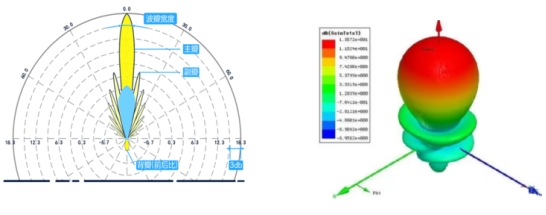
In contrast, a directional antenna radiates within a specific range and angle, concentrating all signal energy into a defined direction. This results in significantly higher signal strength within the beam, which greatly increases the effective communication distance and enables longer-range, stable wireless connections with the corresponding device.
About Kinghelm
Kinghelm is a high-tech enterprise specializing in RF and connectivity solutions. The company offers a wide range of products, including Beidou/GPS antennas, Wi-Fi, Bluetooth, NB-IoT, LORA, Zigbee antennas, RF cables and connectors, board-to-board and plug-in connectors, switches, terminals, and customized automotive and industrial components. With over 17 years of experience, Kinghelm serves industries such as automotive, telecommunications, industrial automation, medical devices, and consumer electronics. Known for durable, reliable components that meet international standards, Kinghelm supports applications ranging from renewable energy to IoT devices.
Related Recommendations