Service Hotline
Resources

Resources
What Are the High-Frequency Technical Challenges for RF Connector PCB and Cable Ends?
2026-05-19
369
High-Frequency Technical Challenges of RF Connector Ends
RF connectors face different high-frequency challenges at the PCB (board) end and the cable (line) end, focusing on signal integrity, mechanical reliability, and loss control.
Impedance Matching Discontinuities:
Transitions at pads, vias, and PCB microstrip lines, combined with dielectric variations, can cause impedance jumps at high frequencies.
Differences in material dielectric constants may induce signal reflections.
High-Density vs. Soldering Conflicts:
Pin pitch ≤0.3 mm makes traditional soldering prone to bridging or cold joints.
Temperature-sensitive substrates complicate thermal control, making it challenging to ensure both solder joint reliability and PCB integrity.
Performance Susceptible to Environmental Factors:
Thermal cycling can cause mismatched coefficients of thermal expansion, leading to solder joint cracks and phase shifts (±15°).
Installation stress may deform structures and disrupt transmission paths.
Shielding Difficulty:
High-frequency signals are prone to leakage and interference.
Improper ground ring design can exacerbate EMI in densely packed PCBs.、
Significant Loss Increase:
Skin effect amplifies conductor loss; dielectric loss increases with frequency.
Above 6 GHz, ordinary materials show severe loss; thinner cables experience even higher attenuation.
Connection Consistency Issues:
Variations in crimping or soldering can cause impedance discontinuities.
Batch-to-batch differences lead to high-frequency performance variability, making large-scale consistency difficult.
Conflict Between Vibration Resistance and Performance:
Deformation of locking mechanisms can affect impedance stability.
Vibration induces fatigue at the connection points; at ultra-high frequencies, small physical changes significantly affect signals.
Plating and Material Compatibility Challenges:
Plating can oxidize, wear, or form tin whiskers.
Poor cable-to-connector material matching can cause impedance mismatch and signal attenuation.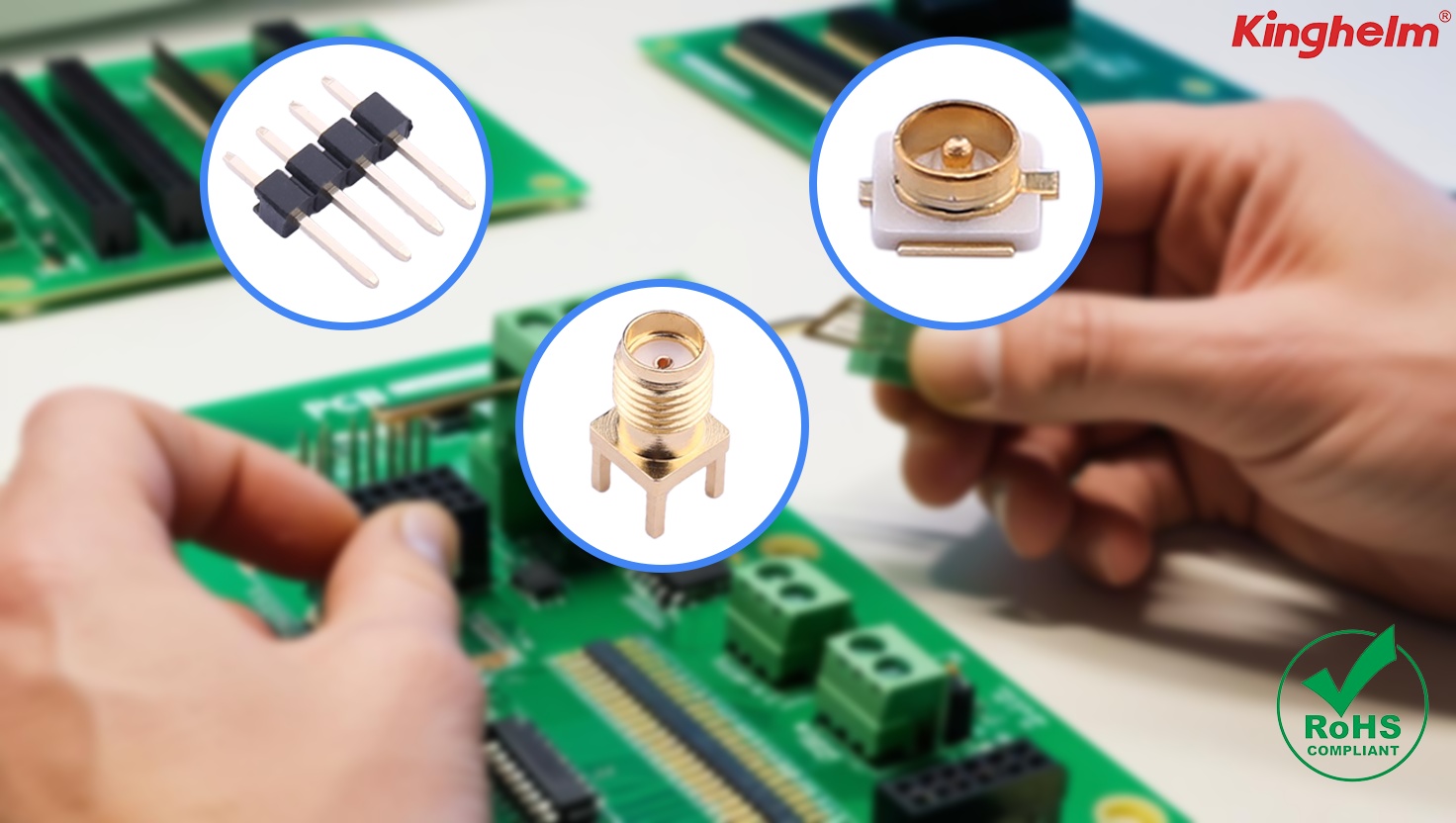
About Kinghelm
Kinghelm is a high-tech enterprise specializing in RF and connectivity solutions. The company offers a wide range of products, including Beidou/GPS antennas, Wi-Fi, Bluetooth, NB-IoT, LORA, Zigbee antennas, RF cables and connectors, board-to-board and plug-in connectors, switches, terminals, and customized automotive and industrial components. With over 17 years of experience, Kinghelm serves industries such as automotive, telecommunications, industrial automation, medical devices, and consumer electronics. Known for durable, reliable components that meet international standards, Kinghelm supports applications ranging from renewable energy to IoT devices.
Related Recommendations