






















Service Hotline
News

News
BNC vs SMA: The Key Differences Every RF Engineer Should Know
2026-09-14
8
Introduction
Have you ever had a link that measured clean on the bench, then showed extra insertion loss or an unstable trace the moment it went into the rack? In most cases the connector is not faulty. The interface is simply wrong for the job.
Core answer: BNC is the right choice for fast mating and 75Ω video or low-GHz RF paths, while SMA is the right choice for compact 50Ω designs that run higher in frequency or face vibration. Both are standardized interfaces, so the decision is settled by impedance, frequency, space, and environment, not by brand.
Who this is for: design engineers and procurement specialists selecting a coax interface for video, broadcast, test, or RF products, including anyone comparing a 75Ω BNC against a 50Ω SMA for a specific system.
If your path runs above 4 GHz: skip the BNC column below and go straight to the SMA sections. Above that frequency you are really choosing between SMA and a precision interface, not between BNC and SMA.
BNC vs SMA Connector: A Detailed Comparison
The two interfaces were designed for different jobs. BNC was designed for repeated fast connections; SMA was designed for compact, high-frequency 50Ω work. Neither is a general upgrade over the other.
BNC Connector: Fast Connection and Easy Handling
A quarter turn of the bayonet lock and you are connected, which is why BNC still sits on oscilloscopes, broadcast racks and CCTV gear. BNC exists in 50Ω and 75Ω: the 75Ω version is the normal choice for video and broadcast and pairs with RG-59 or RG-6, while the 50Ω version covers general RF test and instrumentation. Bayonet parts are commonly specified at around 500 mating cycles, and Kinghelm's BNC series, 50Ω and 75Ω alike, is specified from DC to 3 GHz.
- Broadcast and video signal paths, where 75Ω is the system standard
- Test benches and lab instruments, where cables are swapped constantly
- Surveillance and CCTV, where field service speed decides downtime
- Communication test equipment
If the cable gets changed more often than the design does, BNC is the right answer.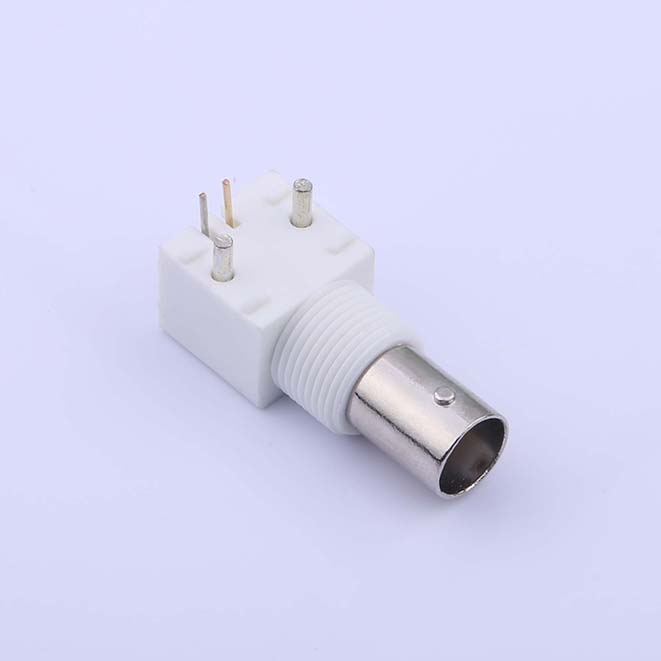
SMA Connector: Compact and Secure for RF Systems
SMA is threaded, and it takes longer to mate on purpose. Done up to the correct torque, the joint shrugs off sustained vibration in a way a bayonet joint cannot. Standard SMA runs 50Ω and is commonly rated from DC to 18 GHz, with precision versions reaching 26.5 GHz. Torque is usually specified between 0.79 and 1.13 N·m (7–10 in·lb), and under-torquing is behind most of the intermittent contacts that only show up after the unit ships.
- Wireless modules and RF front ends on space-constrained PCBs
- Antennas and antenna feeds, including GNSS and cellular
- Microwave assemblies and instrumentation above 4 GHz
- Any joint that has to survive vibration
When space, frequency or vibration is the binding constraint, SMA is the better fit.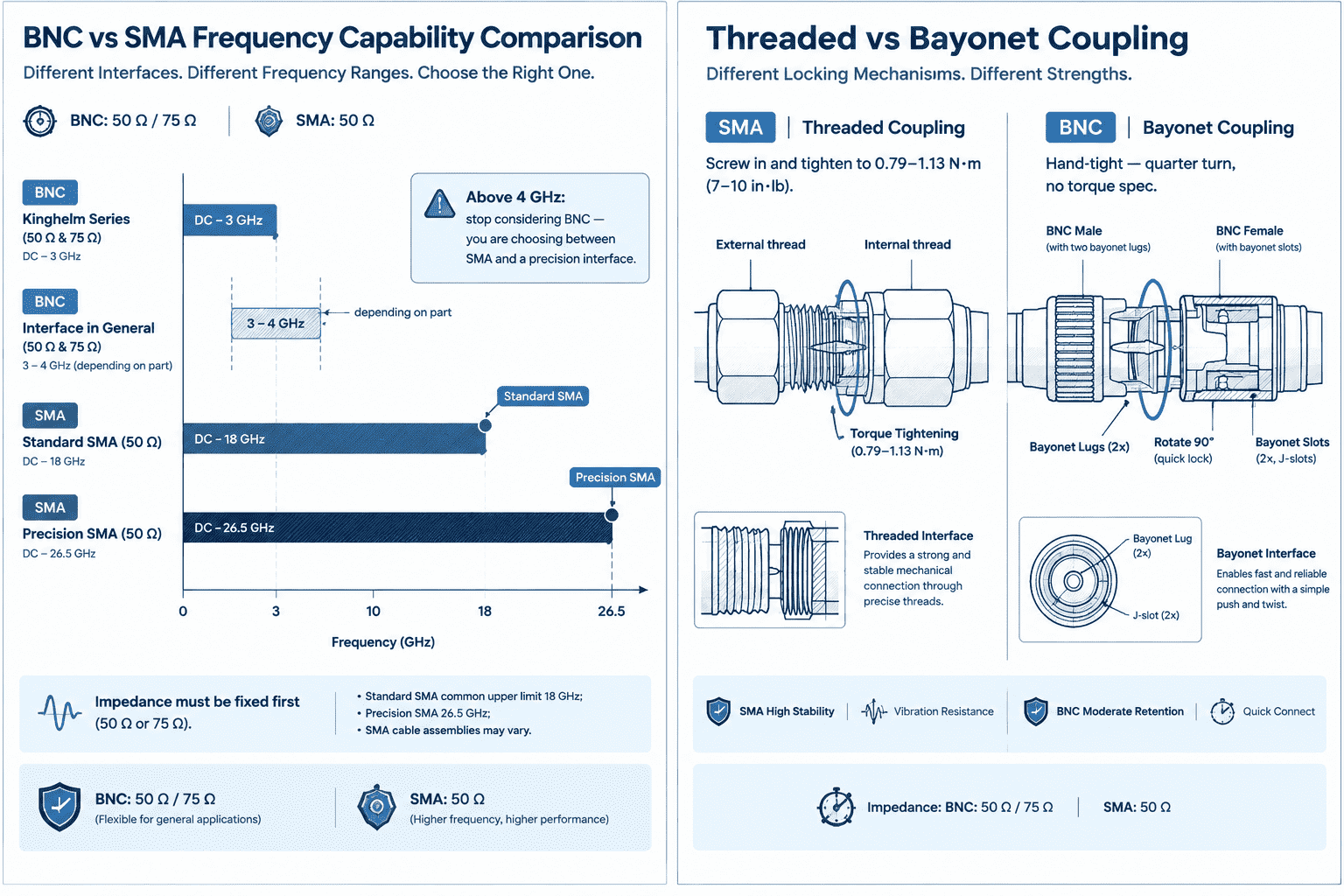
BNC vs SMA: Key Differences at a Glance
| Feature | BNC | SMA | Practical takeaway |
|---|---|---|---|
| Coupling | Quarter-turn bayonet | Threaded, torqued | BNC for speed, SMA for certainty |
| Interface standard | IEC 60169 series | MIL-STD-348 / IEC 61169 series | Standardized parts intermating across suppliers |
| Typical frequency rating | Commonly 3–4 GHz depending on part; Kinghelm BNC series DC–3 GHz | 18 GHz; precision to 26.5 GHz | Above 4 GHz, stop considering BNC |
| Impedance | 50Ω and 75Ω | 50Ω standard; 75Ω available | Fix impedance before anything else |
| Mating cycles (typical) | Around 500 | A few hundred to 1000, torque-dependent | Match the cycle count to your service plan |
| Cable pairing | RG-59 / RG-6 (75Ω), RG-58 (50Ω) | RG-58, RG-316, 0.085" semi-rigid | Choose cable and connector together |
| Size | Larger, easier to grip | Compact | SMA for dense boards, BNC for gloved hands |
| Vibration | Moderate retention | High retention | Threaded for anything that moves |
For the full connector taxonomy and for BNC sourcing criteria, see our RF connector guide and BNC procurement guide.
BNC vs SMA Connector: Factors to Consider Before Choosing
Start with impedance, frequency, space and environment. Price is the last line of the comparison, not the first.
Impedance and Compatibility
Match impedance along the whole path: connector, cable, and equipment interface. A 75Ω BNC on a 50Ω port does not fail on contact. It raises return loss, and in video that shows up as ghosting or ringing long before the part fails. This is the mismatch we get asked about most often.
BNC covers both impedances in one mechanical family, so video and RF test can share a panel design. Standard SMA is 50Ω. 75Ω SMA exists but is not the default, and availability is worth checking before it goes into a layout. Confirm connector, cable and equipment impedance together, and check gender before you order. Kinghelm's 75Ω part in this family, KH-BNC75-3511, is covered in detail below.
Power Handling Capability
BNC and SMA differ in geometry more than in ratings. The larger BNC body is commonly specified with higher working voltage. SMA's small dielectric and centre contact suit high frequency, but they carry less current and dissipate less heat. KH-BNC75-3511, for example, is rated 500 V RMS over DC to 3 GHz.
Power handling falls as frequency rises, so ask for the derating curve at your operating frequency and rate the finished assembly rather than the connector alone.
Environmental and Outdoor Suitability
Indoor benches reward connection speed. Outdoor hardware rewards protection. Check the seal at the mating interface, the plating and the strain relief, not just the temperature figure.
KH-BNC75-3511 is specified from −55°C to +155°C, and its housing, inner conductor and insulation are chosen to hold that range. A connector that measures well on the bench can still be the wrong part for a pole-mounted enclosure.
How to Verify Before You Commit
A datasheet tells you what a part should do. These four checks tell you what the assembly in front of you actually does.
- Impedance continuity: sweep the finished path with a TDR and confirm there is no impedance step at the connector or the termination.
- Insertion loss and return loss: measure S21 and S11 on the assembled cable at your highest operating frequency. The cable and termination usually dominate the result, not the connector alone.
- Torque: set SMA joints to the specified 0.79–1.13 N·m. A torque wrench costs less than the field failure it prevents.
- Mechanical retention: pull-test the crimp or solder joint, and count mating cycles if the part is serviceable in the field.
Ask for S-parameter data or a test report before you release volume orders.
Common BNC vs SMA Connector Selection Mistakes
Two mistakes cause most of the rework we see, and both are visible before production starts.
- Treating 50Ω and 75Ω as interchangeable. The symptom is on screen: ghosting in video, elevated return loss everywhere else.
- Paying for frequency you will not use. If the design runs to 3 GHz, an 18 GHz SMA adds cost without adding margin you need.
How to Choose the Right Connector
Work through these in order. The answer usually falls out by the second question.
- What impedance does the system run? 75Ω points to BNC; 50Ω leaves both options open.
- What is the highest frequency in the path? Above your chosen part's rating (3 GHz for this BNC series, around 4 GHz for the interface in general), move to SMA or a precision interface.
- How often will the joint be connected and disconnected? Frequent access favours BNC; a set-and-forget joint favours SMA.
- What does the environment do to it? Vibration, moisture and temperature narrow the choice further.
Then compare suppliers on specifications, mechanical construction, environmental ratings and production consistency, rather than on unit price alone.
Where Does the KH-BNC75-3511 Fit?
KH-BNC75-3511 is Kinghelm's 75Ω BNC female right-angle connector. The 75Ω interface keeps the transmission line matched, and the right-angle body keeps cable routing workable where panel depth is limited.
Specifications, from the Kinghelm datasheet:
- Impedance: 75Ω
- Frequency range: DC–3 GHz
- Working voltage: 500 V RMS
- Operating temperature: −55°C to +155°C
- Locking: bayonet
- Compliance: RoHS
- Packaging: tray; gross weight 8.5 g
Kinghelm lists four application areas for this part: broadcast and television, security and surveillance, communication testing, and instrumentation. The company runs an ISO 9001 quality management system and states compliance with EU RoHS and REACH; plating thickness, body material and dielectric data are stated on the part datasheet.
The same body is also offered in 50Ω as KH-BNC50-3511, with identical frequency, voltage and temperature ratings. If a product family needs both a 75Ω video path and a 50Ω RF path, one connector outline can cover both, which simplifies panel design and reduces the number of spares you carry.
The datasheet and a 3D model are available for layout review, and samples can be requested through the Kinghelm sample request page.
What to Put in Your RFQ
Six fields are enough to get quotes you can actually compare.
- Interface and impedance: BNC, 75Ω, female, right-angle.
- Highest operating frequency, plus the insertion loss and VSWR limit the design must stay inside.
- Expected mating cycles over the product's service life.
- Mounting style, termination type, and the space available behind the panel.
- Environment: operating temperature range, moisture, and corrosion exposure.
- Documentation and supply: datasheet, 3D model, plating and material statement, RoHS and REACH status, first-article samples, lead time, and whether a qualified second source is required.
Final Thoughts
Two numbers decide this: the impedance your system runs and the highest frequency in the path. Settle those and the connector family usually picks itself.
Working on a 75Ω design now? Send us the interface and frequency range, and our engineers will come back with the part, the datasheet and a sample request link.、
FAQ
Can I use a 75Ω BNC on a 50Ω port?
Do not. The mismatch raises return loss, and in video it appears as ghosting or ringing. Keep the entire path at one impedance.
Can I choose a connector just because it fits the equipment?
No. Physical compatibility says nothing about impedance or frequency range, and both are on the datasheet. Check them before you approve the part.
What is the frequency limit of a BNC connector?
BNC is commonly specified in the low-GHz range, around 3 to 4 GHz depending on the part. Kinghelm's BNC series is rated DC–3 GHz. Above that, use SMA or another threaded interface.
Can SMA be used in video systems?
75Ω SMA exists and appears in some broadcast and digital video equipment, but it is not the default. Check availability and price before designing one in.
Related Recommendations