Service Hotline
Resources

Resources
Kinghelm Tactile Switch KH-12X12X8H-TJ: Balancing Dimensions, Travel, and Actuation Feel
2025-11-17
402
In modern electronic interfaces, tactile switches remain one of the most widely used mechanical input components. Their structural configuration, contact behavior, travel distance, and actuation force collectively define the interaction quality between users and devices. As product form factors diversify, the dimensional and mechanical requirements for tactile switches continue to evolve, prompting engineers to consider spatial constraints, intended touch feedback, mechanical durability, and assembly compatibility when selecting a switch. This article examines the Kinghelm KH-12X12X8H-TJ tactile switch from an engineering perspective, focusing on its dimensional profile, mechanical travel, actuation characteristics, contact properties, and practical application boundaries. The discussion is intended for experienced engineers seeking a deeper understanding of the component’s behavior and design implications.
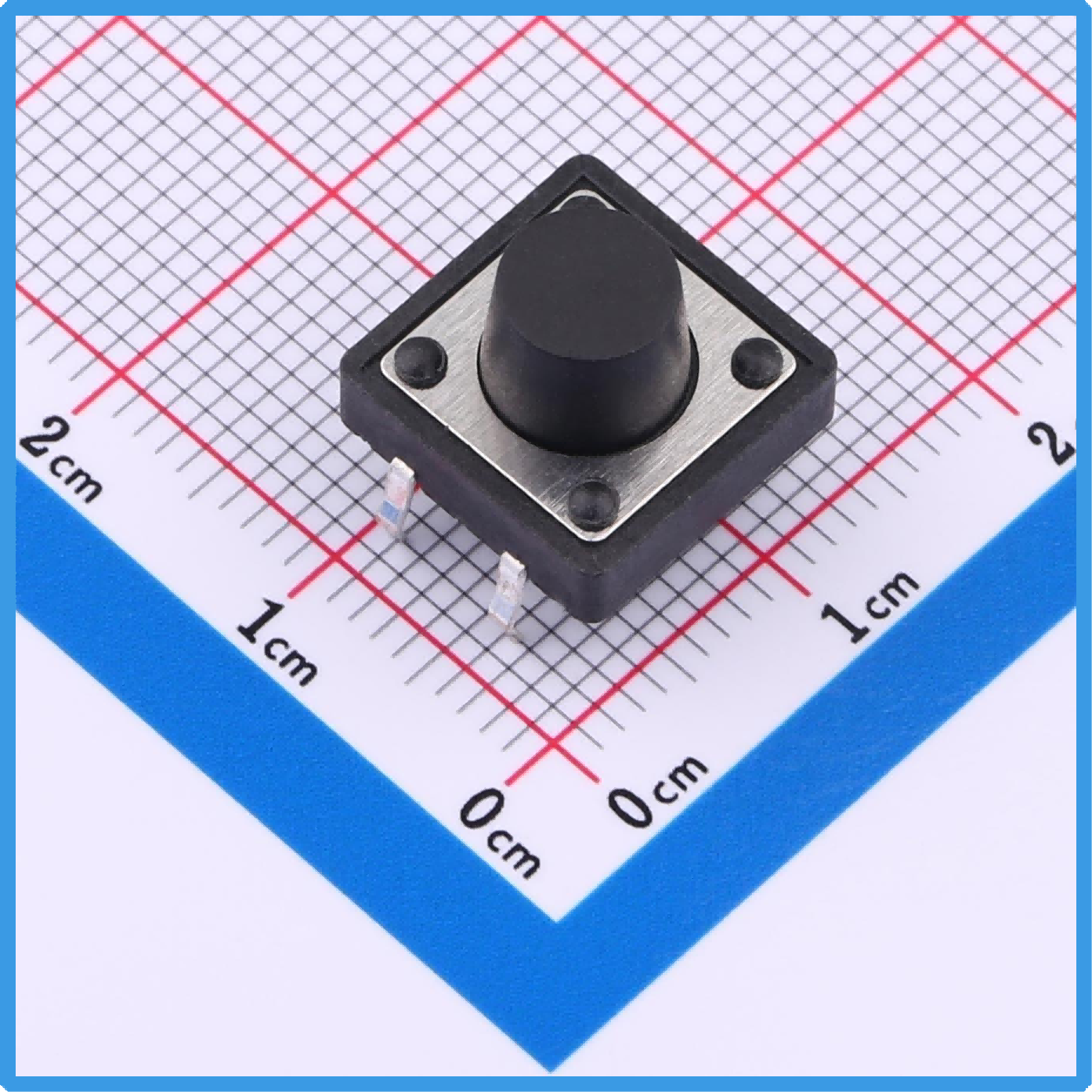
Kinghelm KH-12X12X8H-TJ Product Image
Structural Implications of the 12×12×8 mm Form Factor
The Kinghelm KH-12X12X8H-TJ adopts a 12 × 12 mm through-hole package with an overall height of 8 mm. Within the tactile switch family, the 12 mm series represents a mid-size structure often used when a clearer actuation feel or larger mechanical interface is required. Its geometry lends itself to control panels, appliance interfaces, automotive dashboards, and devices that incorporate thicker front shells or larger keycaps.
The dimensional system reflects several structural implications:
1. Compatibility with Thicker Front Panels
The 8 mm height supports integration behind moderately thick panels without requiring excessive keycap extension. This reduces the risk of mechanical misalignment, sticking, or uneven stress during operation. Appliances, automotive panels, and industrial terminals often benefit from this height range due to assembly tolerances.
2. Larger Contact Area for More Stable Actuation
The 12×12 mm top surface provides a broader mechanical interface, helping the switch maintain consistent triggering even when users apply off-center pressure. When paired with large keycaps or molded front-panel buttons, this stability helps avoid missed actuations or inconsistent tactile response.
3. Through-Hole Pins Better Withstand Mechanical Stress
Through-hole terminals tend to resist shear forces more effectively than surface-mount alternatives. In devices where the switch is repeatedly pressed or subjected to external mechanical stress—such as hand tools, test fixtures, or control modules—this improves long-term reliability and ease of replacement.
Short Travel of 0.25±0.1 mm and Its Mechanical Logic
The KH-12X12X8H-TJ offers a travel distance of 0.25±0.1 mm, placing it in the short-travel tactile switch category. Travel length directly influences tactile feedback, electrical bounce, and long-term behavior of the contact mechanism.
1. Concentrated Actuation Response
A short displacement enables a quick and precise transition from open to closed state. This benefits control interfaces requiring predictable actuation points, especially in automotive and industrial environments where consistency is crucial.
2. Crisp and Minimalistic Feedback
Short travel produces a clean, concise tactile response. It supports fast actuation cycles—useful for function switches or confirmation keys that require decisive interaction rather than gradual press movement.
3. Higher Sensitivity to Panel Tolerance
The ±0.1 mm tolerance means that slight deviations in keycap height, panel spacing, or assembly pressure can influence actuation performance. Designers must ensure the key interface does not impose unintended pre-load or introduce excessive free play.
Interpreting the 260±30 gf Actuation Force
The KH-12X12X8H-TJ specifies an actuation force of 260±30 gf, a level that aligns well with the 12 mm structural format. This force range defines the tactile profile and influences how the switch performs under different usage conditions.
1. Reduced Likelihood of Unintentional Activation
Higher actuation force requires deliberate input from the user, which can help prevent accidental triggering in automotive dashboards, portable equipment, and industrial control panels. It supports use cases where clear intentional interaction is preferred.
2. Better Pairing with Large or Heavy Keycaps
Large keycaps disperse finger force across a broader area. A higher force rating compensates for this distribution, ensuring the actuation behavior remains consistent even if the pressure point varies.
3. Increased Mechanical Stress on the Metal Dome
High actuation force increases the stress amplitude on the internal dome mechanism. Over long usage cycles, this makes material selection and dome geometry more critical. The switch’s rated life of 50,000 cycles should therefore be evaluated in the context of real-world frequency and load conditions.
Electrical Parameters and Contact Considerations
The switch is rated for DC 12V / 50 mA, appropriate for low-current signal applications. Its maximum contact resistance is 30 mΩ, consistent with typical mechanical dome designs.
1. Intended for Signal-Level Interfaces
The rating clearly positions it within low-power control paths rather than power switching. It is commonly integrated into MCU input circuits, logic-level triggers, and low-voltage control systems.
2. Contact Stability and Environmental Sensitivity
Maintaining contact resistance below the upper limit relies on consistent dome pressure, material finish, and environmental conditions. Dust, humidity, and corrosive gas exposure can accelerate contact degradation, emphasizing the need for appropriate enclosure design.
3. Importance of Debounce Management
Mechanical actuation inherently produces bounce. Both hardware (RC filters) and firmware debouncing remain essential in devices requiring clean signal transitions.
Application Contexts and Integration Notes
1. Suitable Application Areas
The KH-12X12X8H-TJ’s combination of size, force, and travel makes it applicable to:
Home appliance control boards
Automotive dashboard and center console keys
Industrial equipment control panels
Communication equipment front-panel keys
Low-frequency function keys in handheld devices
2. Mechanical Integration Guidelines
When incorporating keycaps, housings, or interface structures, the following aspects require attention:
Maintain keycap alignment to avoid off-axis stress.
Prevent continuous pre-load from structural interference.
Ensure panel openings do not restrict the switch’s motion envelope.
Control soldering temperature to protect the internal dome mechanism.
3. Assembly-Level Reliability Checks
During prototyping, waveform capture of switch bounce and actuation consistency can help validate alignment, force distribution, and panel tolerances.
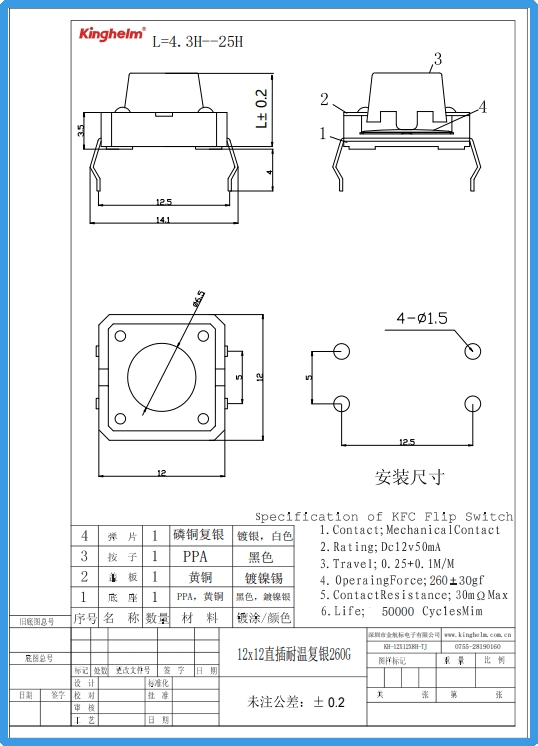
Kinghelm KH-12X12X8H-TJ Specification
Long-Term Use Observations and Engineering Recommendations
Tactile switch performance typically degrades due to dome fatigue, contamination, or environmental stress. For long-term stability, the following considerations are helpful:
Estimate usage cycles and ensure sufficient durability margin.
Evaluate environmental risks such as moisture or particulate ingress.
Test keycap mechanical alignment to limit uneven loading.
Monitor long-term actuation characteristics through life-cycle testing.
Although simple in construction, tactile switches exhibit complex mechanical and electrical behaviors that directly influence device interaction quality. The Kinghelm KH-12X12X8H-TJ represents a balanced configuration of size, travel, and actuation force, making it suitable for a range of panel-based electronic systems. Understanding its mechanical logic and contact behavior allows engineers to better anticipate performance over time and integrate the component more effectively into their designs.
About Kinghelm
Shenzhen Kinghelm Electronics Co., Ltd.(www.kinghelm.net)has technical backbones from Tsinghua University and UESTC, and has introduced overseas returnee professionals. Kinghelm is able to develop highly reliable and high-performance antenna and connector products.KH series products of "Kinghelm" brand include Beidou/GPS antennas, RF adapter connectors, plug connector, electrical data connectors, terminals, and customized vehicle harnesses, industrial / medical connectors, and special antenna connectors."Kinghelm connects world", Kinghelm has grown with the development of China's Beidou industry. Starting from supplying Beidou/GPS dual mode antennas, IPEX terminals, and RF adapter cables for automotive manufacturers, Kinghelm has continuously developed products. Currently, it has a series of WiFi, Bluetooth, NB-loT, LoRa, Zigbee, UWB, and GSM antennas, RFID tags, RF adapter cables, standard microwave antennas, vehicle grade SMA, SMB, FAKRA holders, coaxial cables, and can customize non-standard antenna connectors based on customer drawings or samples.
Related Recommendations