Service Hotline
Resources

Resources
Kinghelm 3.5mm Audio Connector (Headphone) KH-PJ-328-SMT: High-Temperature Capability, SMD Manufacturing, Compatible with Mainstream Devices
2025-11-19
406
As portable electronics, industrial terminals, consumer media devices, and audio-enabled control equipment continue to evolve, the demand for reliable and compact audio connectors remains significant. Despite the development of various digital transmission interfaces, the 3.5mm headphone jack still maintains widespread deployment due to its protocol-free signaling, ease of integration, and low implementation cost. The Kinghelm KH-PJ-328-SMT is a 3.5mm audio connector designed for surface-mount manufacturing workflows, offering compatibility with common headphone standards, support for automated production, and stable performance in environments where temperature fluctuations are present.
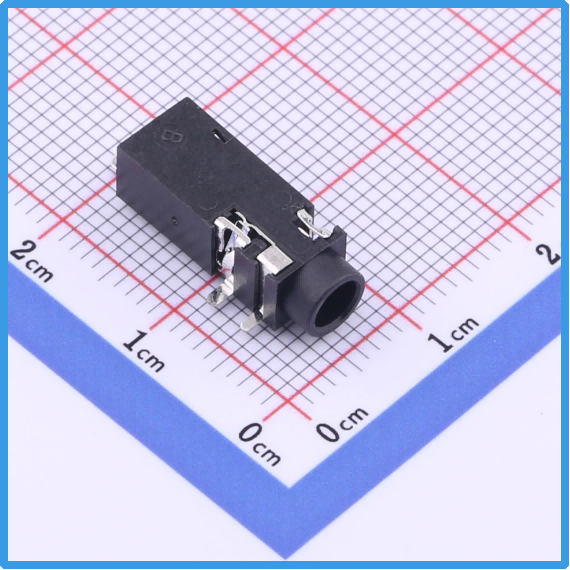
Kinghelm KH-PJ-328-SMT Product Image
1. Application Context and Product Positioning
The 3.5mm audio port has been widely adopted for many years because it provides a straightforward analog signal interface without requiring complex digital negotiation. Although wireless audio standards have gained traction in consumer products, many categories of professional, industrial, and embedded systems continue to use physical headphone jacks for input or monitoring. These categories include handheld controllers, car-mounted systems, audio analyzers, small-scale monitoring devices, and diagnostic terminals.
With device miniaturization becoming mainstream, traditional through-hole connectors pose layout limitations and require manual soldering or wave soldering processes. Surface-mount audio connectors such as the KH-PJ-328-SMT are designed to match contemporary automated manufacturing approaches, offering smaller footprint requirements and eliminating manual soldering variations. This type of product is suited for high-throughput production lines where consistent process repeatability is important.
2. Key Characteristics and Technical Interpretation
2.1 Standard 3.5mm Audio Interface Structure
The KH-PJ-328-SMT uses a standard mechanical 3.5mm headphone interface compatible with mainstream consumer headphones, audio cables, and monitoring devices. For product developers, this reduces system integration complexity and avoids the need for custom cabling or proprietary connectors. This standardization enables a broad usage range in:
Handheld media players
Small recording or monitoring terminals
Measurement instruments requiring real-time audio monitoring
Vehicle dashboards and control panels
Compact embedded industrial systems
For on-site maintenance, the availability of standard headphone interfaces also means simplified testing and troubleshooting without specialized equipment.
2.2 Surface-Mount (SMD) Package Optimized for Automated Assembly
One of the key engineering advantages of KH-PJ-328-SMT is its SMD manufacturing format. Surface-mount connectors allow the entire assembly process to be integrated into automated pick-and-place lines and reflow soldering environments. Compared with traditional THT parts:
No manual handling is required during soldering.
The process reduces variability associated with human-operated joints.
It speeds up mass manufacturing cycles and enables controlled repeatability.
SMD connectors also align with standard PCB assembly planning where electronic components are placed on a single side, minimizing the need for additional wave-solder fixtures or dual-sided assembly processes. This format is favored by contract manufacturers and PCB assembly plants seeking consistency and throughput.
2.3 Compact Layout Supporting High-Density PCB Design
With PCB real estate becoming increasingly valuable in compact devices, surface-mount connectors free significant routing space compared with wide through-hole pads. Engineers can place components, power rails, and signal lines closer to the connector footprint, supporting denser board designs.
Typical product categories benefiting from this include:
Pocket-sized or handheld data terminals
Miniaturized wearable devices
Ultra-light electronic assemblies
Low-profile industrial controllers
The dimensional design minimizes mechanical interference zones, allowing component groups to be positioned with clearer separation, especially when other high-frequency circuits or heat-generating modules share limited PCB area.
2.4 High-Temperature Performance for Reflow Soldering and Operational Environments
Because SMD audio connectors must withstand the full thermal load of reflow soldering, material selection and structural reinforcement are critical. The KH-PJ-328-SMT is manufactured using materials capable of remaining stable throughout high-temperature reflow cycles without deformation, softening, or loss of contact alignment. This ensures that the connector maintains electrical performance after assembly and does not introduce variance in contact resistance or mechanical fit.
The same characteristics benefit products deployed in environments with cyclical or elevated temperatures, such as:
Industrial monitoring terminals
Embedded systems with continuous processing loads
Control systems installed in engine bays or vehicle interiors
Manufacturing equipment operating under long duty cycles
Mechanical performance in these scenarios requires that the connector sustain repeated insertion loads without cracking, warping, or solder pad stress failures caused by long-term expansion and contraction.
2.5 Tape-and-Reel Packaging for Efficient Manufacturing Input
The connector is supplied in tape-and-reel packaging, which is standard in automated assembly. This allows high-speed placement equipment to feed, position, and process the connectors with minimal manual intervention. In addition to production speed, consistent component orientation reduces variability during placement and ensures stable alignment with reflow solder pads.
3. Structural and Materials Engineering Considerations
Audio connectors depend heavily on mechanical design because signal transmission quality is closely related to physical contact reliability. The KH-PJ-328-SMT uses internal metal contacts designed to exert stable pressure against the headphone plug, maintaining low contact resistance while preventing micro-vibration dropout during operation.
The polymer housing must tolerate reflow conditions and resist long-term stress aging. Likewise, the surface finish on terminals influences oxidation resistance and consistent coupling performance. Typical engineering considerations include:
Terminal elasticity and recovery after repeated insertions
Contact geometry preventing long-term plastic deformation
Surface finish that maintains stable resistance over the product’s service life
Mechanical reinforcement to prevent pad tearing during accidental lateral stress
Because SMD connectors rely entirely on soldered surface contacts, ensuring mechanical anchoring becomes critical. Some boards may use additional solder anchor points, enlarged pads, or mechanical support ribs to distribute insertion force and reduce solder fatigue over time.
4. Practical Engineering Guidelines in Application
4.1 PCB Routing and Signal Quality Considerations
Although analog audio signals do not require strict controlled-impedance routing, good PCB practices still benefit overall sound quality in applications sensitive to interference. Designers may consider:
Shorter trace lengths to reduce antenna effects
Maintaining separation from high-speed differential or switching power traces
Optional shielding via ground fills or guard traces
Stable reference ground return paths
These techniques help minimize audible noise, crosstalk, and distortion in compact system boards where switching regulators or digital buses operate close to analog domains.
4.2 SMT Reflow Process Window Control
During mass production, manufacturers should validate that reflow profiles match the connector’s rated thermal capability. Excessive temperature gradients or extended peak durations may risk internal material deformation or pad stress. Process checks may include:
Peak temperature compliance
Optimizing solder paste wetting on anchor pads
Preventing solder pooling or bridging under terminal contact zones
Verifying that assembly vibration does not shift connector position during reflow
High-density boards may additionally require solder stencil adjustments to ensure sufficient mechanical anchoring.
4.3 Endurance, Contact Wear, and Validation Testing
To ensure suitability for the intended product life cycle, engineering teams frequently perform:
insertion and extraction endurance cycles
Terminal resistance stability measurements
Mechanical impact and vibration testing
Thermal cycling and humidity exposure
These verification steps help avoid latent defects that may appear only after prolonged usage or repeated mechanical stress.
5. Typical Deployment Scenarios
5.1 Portable Consumer Audio Devices
Devices such as recorders, compact media players, pocket audio analyzers, and voice loggers often require a physical monitoring port. Compact SMD structures allow these devices to maintain small form factors without sacrificing board layout efficiency.
5.2 Industrial Monitoring and Audio Signaling Systems
Many factory control systems use audio tones for alarms, confirmation signals, or maintenance diagnosis. These environments may feature fluctuating ambient temperature, continuous operation, and equipment vibration. The mechanical anchoring characteristics of SMD connectors support long-term deployment in these conditions.
5.3 Automotive Panels and Embedded Control Boards
Within vehicle interiors and engine-compartment systems, audio ports may be used for maintenance testing, diagnostic output, or voice communication equipment. Automotive installations often involve thermal cycling, mechanical acceleration, and long operating hours; SMD-format connectors can reduce solder-joint stress loads associated with such conditions.
5.4 Medical and Measurement Instruments
Ultra-compact portable medical instruments and data loggers benefit from reduced PCB space usage and uniform SMT assembly. These devices typically require stability and repeatability across large production batches, which aligns with the characteristics of surface-mount audio connectors.
6. Supply Chain and Manufacturing Perspectives
Component selection affects not only product performance but also logistical and manufacturing processes. Using SMD connectors simplifies assembly flow, reduces dependency on manual labor stages, and supports predictable takt times in medium-to-large volume production settings.
In contract manufacturing environments, consistent SMD material handling helps reduce setup changeovers, material loading interruptions, and maintenance downtime. Tape-and-reel packaging is compatible with high-speed placement machinery, minimizing manual feeder adjustments and improving material tracking accuracy in MES systems.
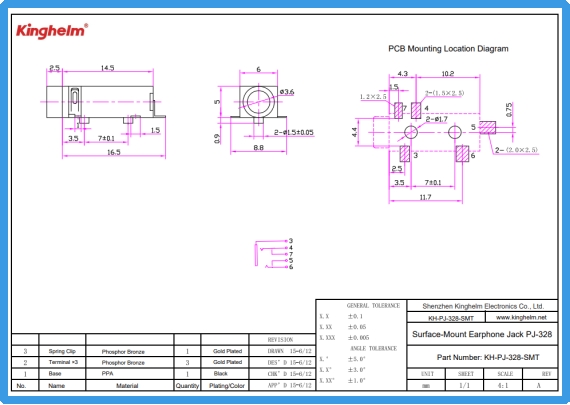
Kinghelm KH-PJ-328-SMT Specification
7. Conclusion
The Kinghelm KH-PJ-328-SMT 3.5mm audio connector is engineered to meet the needs of compact electronic systems that require a standard headphone interface, compatibility with automated SMT manufacturing, and consistent performance under real-world operating conditions. From material selection to mechanical anchoring, the design considerations reflect the practical needs of consumer electronics, industrial terminals, and embedded systems. This article provides a technical perspective on usage considerations, structural engineering, manufacturing process integration, and deployment scenarios, serving as a reference for hardware designers, manufacturing engineers, and system integrators evaluating SMD audio connectors for new electronic platforms.
About Kinghelm
Shenzhen Kinghelm Electronics Co., Ltd.(www.kinghelm.net)has technical backbones from Tsinghua University and UESTC, and has introduced overseas returnee professionals. Kinghelm is able to develop highly reliable and high-performance antenna and connector products.KH series products of "Kinghelm" brand include Beidou/GPS antennas, RF adapter connectors, plug connector, electrical data connectors, terminals, and customized vehicle harnesses, industrial / medical connectors, and special antenna connectors."Kinghelm connects world", Kinghelm has grown with the development of China's Beidou industry. Starting from supplying Beidou/GPS dual mode antennas, IPEX terminals, and RF adapter cables for automotive manufacturers, Kinghelm has continuously developed products. Currently, it has a series of WiFi, Bluetooth, NB-loT, LoRa, Zigbee, UWB, and GSM antennas, RFID tags, RF adapter cables, standard microwave antennas, vehicle grade SMA, SMB, FAKRA holders, coaxial cables, and can customize non-standard antenna connectors based on customer drawings or samples.
Related Recommendations