Service Hotline
Resources

Resources
What Is the Maximum Operating Frequency of Various RF Connectors?
2026-04-24
312
Comparative Analysis of Maximum Operating Frequency of Various RF Connectors
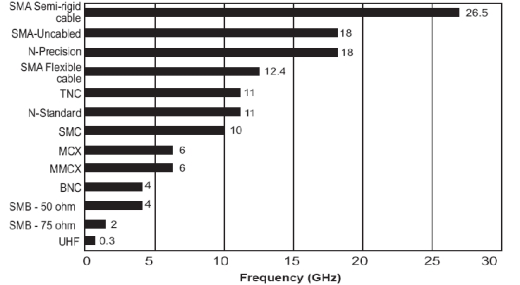
The maximum operating frequency of RF connectors determines their ability to maintain reliable impedance matching, low loss, and stable electrical performance during high-frequency signal transmission. The chart shows the highest operating frequency of various common RF connectors under typical conditions, allowing a clear comparison of how electrical structure, mechanical size, and precision affect their bandwidth performance.
Overall, the SMA series connectors exhibit the highest frequency capability. In particular, SMA connectors used with semi-rigid cables can reach up to 26.5 GHz, significantly outperforming other connector types. This is due to the SMA’s high structural precision, well-controlled characteristic impedance, and strict geometric tolerance of the inner and outer conductors, making it suitable for microwave, radar, and high-frequency communication front-end applications.
Next in line are:
SMA Uncabled (without cable) and N-Precision Connectors
Both have a maximum operating frequency of approximately 18 GHz. Compared with standard N-type connectors, precision N-type connectors offer higher mechanical and coaxial accuracy and are commonly used in professional instruments and high-end microwave links.
The third tier includes:
-
SMA Flexible Cable: 12.4 GHz
-
TNC: 11 GHz
-
N-Standard (traditional N-type): 11 GHz
Although traditional N-type and TNC connectors theoretically support high bandwidth, their mechanical precision is lower than SMA connectors, resulting in slightly lower maximum frequencies. However, their mechanical robustness and weather resistance make them widely used in base stations, antenna feeds, and outdoor microwave systems.
Further down the frequency range:
SMC Connector: 10 GHz
SMC connectors have entered the microwave range, suitable for instruments, small RF systems, and medium-to-high frequency RF modules.
Small RF Connectors:
-
MCX / MMCX: approximately 6 GHz
Small push-on connectors with relatively high bandwidth, suitable for compact RF modules, wireless devices, portable equipment, and high-density PCB applications. -
BNC, SMB (50Ω): approximately 4 GHz
Medium-frequency connectors, commonly used in test equipment, video transmission, and communication instruments. -
SMB (75Ω): approximately 2 GHz
Due to different characteristic impedance and structural design, its frequency capability is lower than the 50Ω version and is typically used for broadcast television signals. -
UHF: 0.3 GHz
This series is a typical “low-frequency large-size” RF interface and only supports several hundred MHz. Therefore, it is less used in modern high-speed communications and high-frequency instruments. If GHz-range bandwidth is required, UHF connectors should generally be avoided.
Overall Observed Trends:
-
1. Higher structural precision → wider reliable bandwidth
SMA and N-Precision connectors clearly outperform traditional structures. -
2. Larger size with wider geometric tolerances → generally lower bandwidth
UHF, BNC, and SMB connectors belong to this category. -
3. Connector-cable combination affects the final frequency specification
For example, SMA connectors with semi-rigid cables perform better than with flexible cables.
In practical design, connector selection should consider system bandwidth, mechanical strength, density, and environmental conditions to ensure signal integrity, electromagnetic compatibility, and long-term reliable operation.
About Kinghelm
Kinghelm is a high-tech enterprise specializing in RF and connectivity solutions. The company offers a wide range of products, including Beidou/GPS antennas, Wi-Fi, Bluetooth, NB-IoT, LORA, Zigbee antennas, RF cables and connectors, board-to-board and plug-in connectors, switches, terminals, and customized automotive and industrial components. With over 17 years of experience, Kinghelm serves industries such as automotive, telecommunications, industrial automation, medical devices, and consumer electronics. Known for durable, reliable components that meet international standards, Kinghelm supports applications ranging from renewable energy to IoT devices.
Related Recommendations