Service Hotline
News

News
What Is the Dielectric Withstanding (Breakdown) Strength of Various RF Connectors?
2026-04-24
306
Comparative Analysis of Dielectric Withstand Strength of Various RF Connectors
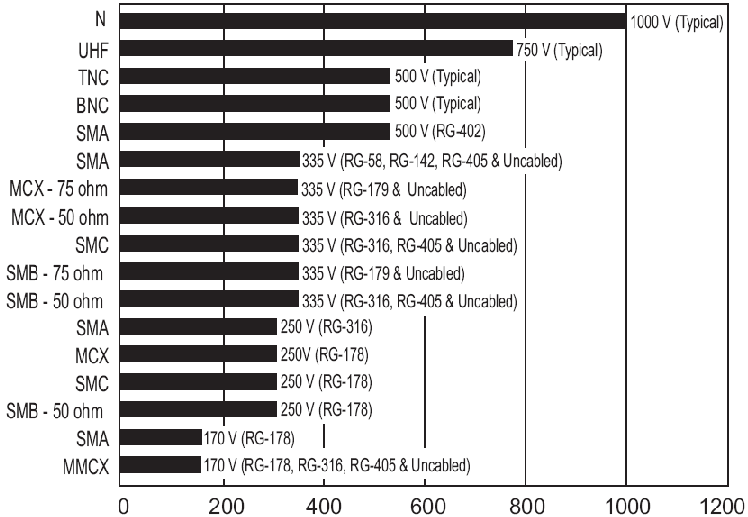
The dielectric withstand strength (voltage tolerance) of RF connectors typically reflects their ability to resist dielectric breakdown under high-voltage conditions, which is an important indicator of insulation performance. The image shows the voltage withstand ranges of various RF connectors under typical operating conditions, providing a clear view of how connectors with different structures, sizes, and dielectric spacing differ significantly in voltage tolerance.
Overall, larger RF connectors such as N-type, UHF, TNC, and BNC generally exhibit higher dielectric strength. Specifically:
1. N-Type Connector
Typical dielectric withstand voltage reaches approximately 1000V RMS, making it one of the strongest types shown. Its larger structure and longer creepage distance make it suitable for high-power applications, outdoor antennas, and communication base stations.
2. UHF Connector
Typical dielectric strength is around 750V RMS. It is also considered a high-voltage-tolerance connector, commonly used in high-power or strong electromagnetic environment devices.
3. TNC and BNC Connectors
Both have typical withstand voltages of approximately 500V RMS, representing a medium voltage tolerance level. They are widely used in test instruments, video systems, laboratory measurement equipment, etc., with moderate structural design and reliable performance.
For smaller connectors, dielectric strength decreases significantly:
4. SMA Connector
Depending on the cable used, dielectric strength generally ranges between 335V and 500V RMS. Its small form factor reduces the spacing between the inner and outer conductors, making it more suitable for medium-power, microwave communication, and high-density RF module applications.
5. SMB, SMC, MCX, MMCX, and other miniaturized connectors
Typical dielectric strength gradually decreases, with common values shown in the image:
-
●250V RMS (e.g., SMB, SMC, MCX)
-
●170V RMS (e.g., SMA RG-178, MMCX)
These miniaturized connectors are designed primarily for reduced size, high-density installation, and high-speed RF performance rather than high-voltage tolerance. Therefore, in systems with high-power or high-voltage requirements, these connectors are generally not preferred.
It is also observed that dielectric strength is often directly related to the type of RF cable used (RG-178, RG-316, RG-405, etc.). Differences in dielectric constant, insulation thickness, and shielding structure of the cable can lead to variations in the overall connector assembly’s dielectric withstand performance.
Summary of Observed Trends:
-
Larger connector size → wider dielectric spacing → stronger dielectric withstand capability.
-
High-power, high-voltage applications favor medium-to-large connectors such as N, UHF, and TNC.
-
Miniaturized connectors (e.g., MMCX, MCX, SMB) are intended for compact devices and generally have lower voltage tolerance.
-
Connector-cable combinations affect the final dielectric strength and should be evaluated together.
For practical engineering applications, the selection of RF connectors should consider system-rated voltage, power requirements, dielectric environment, humidity, and high-altitude operation, with an appropriate safety margin to ensure long-term reliable performance.
About Kinghelm
Kinghelm is a high-tech enterprise specializing in RF and connectivity solutions. The company offers a wide range of products, including Beidou/GPS antennas, Wi-Fi, Bluetooth, NB-IoT, LORA, Zigbee antennas, RF cables and connectors, board-to-board and plug-in connectors, switches, terminals, and customized automotive and industrial components. With over 17 years of experience, Kinghelm serves industries such as automotive, telecommunications, industrial automation, medical devices, and consumer electronics. Known for durable, reliable components that meet international standards, Kinghelm supports applications ranging from renewable energy to IoT devices.
Related Recommendations