Service Hotline
Resources

Resources
How Do Plating Materials (Gold, Nickel, Tin) Affect the Electrical Performance and Lifespan of Antenna Connector Contacts?
2026-05-18
382
The choice of plating material on antenna connector contacts directly determines the connector’s electrical stability, corrosion resistance, and service life. The core impacts are on contact resistance, wear resistance, and environmental durability.
Effects of Different Materials:
Gold Plating (0.1–1.0 μm):
Contact resistance ≤ 5 mΩ
Stable conductivity, excellent oxidation resistance
Mating cycles ≥ 1000 (precision versions ≥ 5000)
Best corrosion resistance
High cost
Suitable for high-end communication and other demanding applications
Nickel Plating (1–5 μm, often as an intermediate layer):
Contact resistance 10–20 mΩ
Stable conductivity
Good wear resistance and corrosion resistance (salt spray ≥ 48 hours)
Mating cycles 500–1000
Suitable for industrial, automotive applications or as a base layer for gold plating
Tin Plating (3–10 μm):
Contact resistance 20–50 mΩ
Prone to oxidation and sulfuration
Poor wear and corrosion resistance
Mating cycles 300–500
Lowest cost
Suitable for indoor, low-frequency, low-mating applications
Summary of Key Impacts:
Gold: highest electrical performance and corrosion resistance, longest life, high cost
Nickel: balanced performance, good durability, moderate life
Tin: low cost, limited durability, suitable for less demanding environments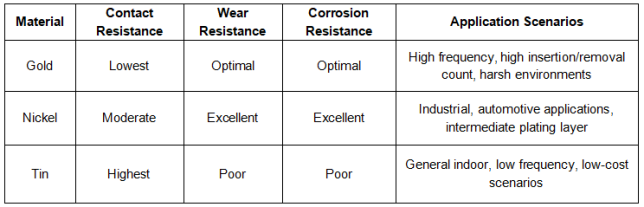
Related Recommendations