Service Hotline
Resources

Resources
『Product Highlight』Kinghelm FAKRA PCB RF Connector KH-2FK1-C-RM-101: A Stable Foundation for RF Connectivity in Intelligent Connected Vehicles
2026-04-23
289
With the continuous development of intelligent connected vehicles, automotive electronic systems are evolving from independent functional modules into highly interconnected communication architectures. Navigation positioning, telematics communication, driver assistance systems, and in-vehicle infotainment platforms now rely on constant data exchange, where multiple RF signals operate simultaneously inside limited vehicle space. Within this environment, connection interfaces play a direct role in signal transmission performance, making RF connectors an essential part of the overall communication structure.
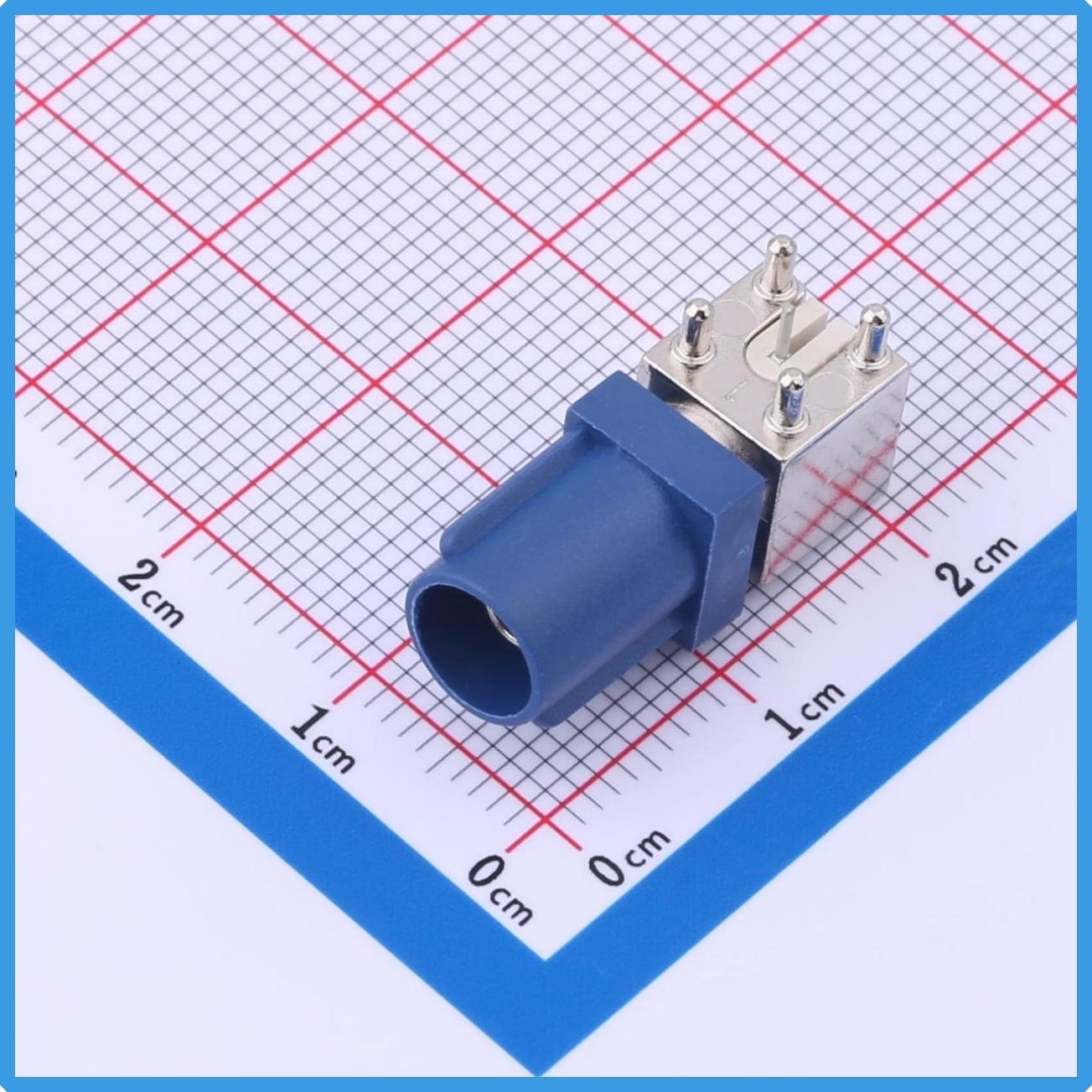
Kinghelm KH-2FK1-C-RM-101 Product Image
Compared with consumer electronics, automotive applications operate under more demanding conditions. Vehicles are exposed to long-term vibration, temperature fluctuations, and complex electromagnetic environments generated by power systems and electronic components. Variations in contact stability or impedance consistency at connection points may influence signal transmission quality. For this reason, the automotive industry has widely adopted standardized FAKRA interfaces, which help improve connection consistency through structured mechanical design and standardized assembly practices.
The Kinghelm KH-2FK1-C-RM-101 FAKRA PCB RF connector is developed with these automotive requirements in mind. The connector adopts a blue-coded FAKRA housing, allowing clear interface identification during assembly and helping reduce connection errors. Its locking structure is designed to maintain reliable mating status under vibration conditions, forming a dependable RF connection between vehicle communication modules.
As automotive electronic modules continue moving toward compact and integrated designs, PCB space utilization has become increasingly important. The KH-2FK1-C-RM-101 features a 90-degree right-angle PCB configuration, enabling RF cables to route along the board surface rather than vertically. This structure helps reduce height constraints and minimizes mechanical stress caused by cable bending, while also providing greater flexibility for system layout and module integration.
From an electrical perspective, the connector follows a 50-ohm impedance design and supports operating frequencies up to 6GHz, covering common automotive RF applications such as GNSS positioning, wireless communication, and vehicle connectivity systems. Optimization of the internal conductor path and shielding structure helps reduce signal reflection during high-frequency transmission and contributes to maintaining consistent signal behavior within complex electromagnetic environments.
Material selection reflects practical automotive design considerations. The housing is manufactured from PBT material to balance mechanical strength and thermal resistance. Brass contacts are used to maintain conductive performance over long operating periods. The internal insulator is made of LCP material, which supports reduced dielectric loss in high-frequency applications. A zinc alloy body enhances structural rigidity while also contributing to electromagnetic shielding performance. The coordinated use of these materials allows the connector to adapt to long-term automotive operating conditions.
Regarding environmental adaptability, the KH-2FK1-C-RM-101 supports an operating temperature range from −40°C to +105°C and complies with USCAR-2 and USCAR-17 related requirements. Under combined conditions of temperature variation and vibration, the connector is designed to maintain normal operating performance, aligning with general reliability expectations for automotive electronic components.
In practical applications, the connector can be used in navigation antenna modules, telematics control units, driver assistance systems, and in-vehicle wireless communication equipment. As the number of wireless functions in vehicles continues to increase, RF connection points are also expanding, and connectors are gradually becoming one of the fundamental elements within automotive communication architectures.
Overall, the evolution of intelligent connected vehicles is driving RF communication toward higher frequencies and more complex system layouts. Connector design must therefore address not only electrical connectivity but also mechanical compatibility and assembly efficiency. Through ongoing structural refinement and material optimization, Kinghelm positions the KH-2FK1-C-RM-101 as a solution suited to current automotive RF connection applications.
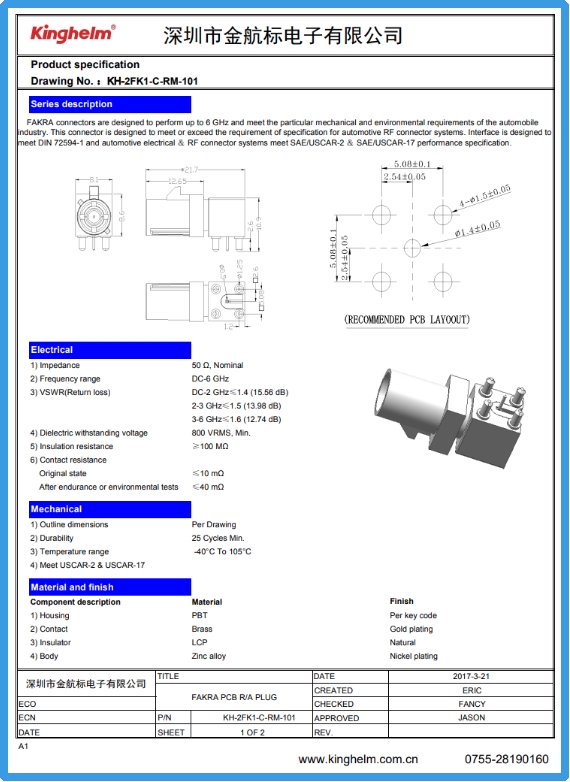
Kinghelm KH-2FK1-C-RM-101 Specification
Within complex electronic systems, long-term operational stability often depends on consistent performance at each connection interface. Although small in size, RF connectors serve as essential links within the signal chain, and well-considered connection design forms an important supporting element for RF communication systems in intelligent connected vehicles.
About Kinghelm
Shenzhen Kinghelm Electronics Co., Ltd.(www.kinghelm.net)has technical backbones from Tsinghua University and UESTC, and has introduced overseas returnee professionals. Kinghelm is able to develop highly reliable and high-performance antenna and connector products.KH series products of "Kinghelm" brand include Beidou/GPS antennas, RF adapter connectors, plug connector, electrical data connectors, terminals, and customized vehicle harnesses, industrial / medical connectors, and special antenna connectors."Kinghelm connects world", Kinghelm has grown with the development of China's Beidou industry. Starting from supplying Beidou/GPS dual mode antennas, IPEX terminals, and RF adapter cables for automotive manufacturers, Kinghelm has continuously developed products. Currently, it has a series of WiFi, Bluetooth, NB-loT, LoRa, Zigbee, UWB, and GSM antennas, RFID tags, RF adapter cables, standard microwave antennas, vehicle grade SMA, SMB, FAKRA holders, coaxial cables, and can customize non-standard antenna connectors based on customer drawings or samples.
Related Recommendations