






















Service Hotline
News

News

Unveiling the "Pig-Farming Scam" in Huaqiangbei Anti-Fraud
2026-10-27
56
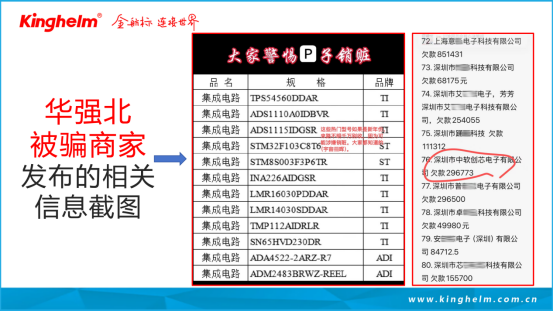 Screenshot of related information released by defrauded merchants in Huaqiangbei
Song Shiqiang of Huaqiangbei said earnestly, "You can't walk in the jianghu without getting cut. If you get cut, you get cut; after you get cut, you still have to keep walking!" Fraud is common in Huaqiangbei business. Our Huaqiangbei Mini Encyclopedia column has compiled this information in the hope of purifying Huaqiangbei's business environment, enabling practitioners to operate with integrity, helping consumers avoid being cheated, making buying and selling in Huaqiangbei reassuring, and making Huaqiangbei's overall business more prosperous. The "pig-farming scam" in Huaqiangbei electronic components has existed for many years, and several cases almost every year are reported. It uses the industry's credit-term rules: "pay small amounts on time in the early stage to build trust, then concentrate large-value goods fraud and run away." It is contract fraud with illegal possession as its purpose, specifically harvesting electronic component suppliers. Its targets are IC chips, passive components, and other spot goods. Often, the fraudulent company makes multiple suppliers fall victim, with involved amounts ranging from hundreds of thousands to tens of millions of yuan. A few months ago, a company called "Yuzhou*Hui" defrauded many Huaqiangbei merchants of tens of millions of yuan, and many of them were my friends. This time, the scammers packaged themselves as an SMT factory. When Kinghelm (www.kinghelm.net) and Slkor (www.slkoric.com) first entered the industry, we were also defrauded twice, with amounts of RMB 83,000 and RMB 256,000 respectively. The lessons were painful.
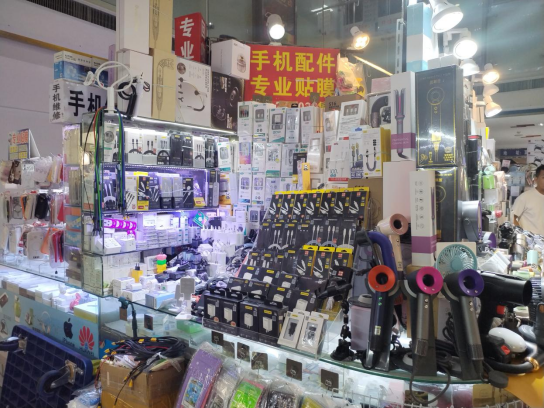 Photo taken at Chuangxin Cloud Electronics Market, New Trend Frontline, Huaqiangbei
Core Logic of the Huaqiangbei "Pig-Farming Scam":
1.Packaging the Entity (Setting the Stage)Scammers first use fake or borrowed ID cards to register shell companies. They rent offices in office buildings around Huaqiangbei, do simple decoration, recruit purchasing salespeople, and look like a regular trading company. They claim their customers are terminal production factories and large foreign trade orders, and inquire everywhere in industry groups and spot goods circles for suppliers. Even the salespeople do not know that the boss is running a scam; the whole staff cooperates in the act.
Features: There is no real purchasing demand. From the beginning, the scammers prepare for "disappearing afterward and making tracing difficult."
Scammers prioritize shops or companies with hot parts and sufficient inventory, offer slightly higher than market prices, and "raise" multiple suppliers at the same time. They first place small orders with cash on delivery and transfer payment immediately upon receipt, never delaying. After getting the goods, the scammers immediately dump them below market price to cash out, actively taking small losses. The purpose is to buy trust: after continuous multiple transactions, suppliers see stable payment and growing orders, judge the customer to be a high-quality big customer, and many suppliers gradually relax risk control. Next, the scammers begin testing: they continue placing orders in batches with gradually increasing amounts, then apply for short-term credit terms (7 days, 15 days), citing factory payment cycles and financial processes, promising a small amount of credit first, and settling on time when due.
Features: The scammers' active losses are the cost of buying trust. All transactions are groundwork; the goal is the final large-value goods fraud.
When the time is ripe, scammers often use the excuse that "a new project is going into production and a large order is needed, but funds are temporarily tight." They simultaneously place super-large orders with multiple suppliers and apply for extremely long credit terms. What they want are mostly common models and hot "internet-famous" chips in the market, which are easy to dump for cash. They request "deliver all goods first, agree on payment terms, and pay no deposit." Many suppliers, because of long-term timely payments before, are unwilling to lose a big customer and agree to ship. Once the goods are in hand, the scammers quickly dump chips and other components in the Huaqiangbei market at low prices to cash out. After cashing out: the office is emptied overnight, phone and WeChat are blocked, the company is deregistered or lost contact, suppliers cannot get payment, and the goods have already been sold.
Features: Behind large-volume orders, the entity is falsely registered, personnel are temporarily hired, and after the case, personnel disappear and assets are transferred in advance, making evidence collection and asset recovery difficult.
 Delivery cart, one of the early "Four Treasures of Huaqiangbei" defined by Song Shiqiang!
Derivative Variants of the "Pig-Farming Scam":
1.Batch-amplified credit-term version: Do not suddenly place a huge order; instead, slowly increase the credit limit and keep pressing goods, and run away only after accumulating a large enough amount.
2.Mixed-order scam: Mix in a small amount of real terminal demand, mixing true and false orders to further lower suppliers' vigilance.
3.Joint disguise: Forge factory workshop photos, purchase contracts, and customer project materials, and even intentionally or unintentionally invite suppliers to visit (the visited site is temporarily rented).
 Huaqiang Electronics World, photo by Kinghelm reporter (www.kinghelm.net)
Reasons for the High Incidence of the "Pig-Farming Scam":
Chips are easy to cash out + industry credit-term practices + lack of risk control among small merchants + low-cost packaging of shell companies by scammers + poor information sharing among suppliers + difficult post-event recovery. In addition, suppliers' information is not synchronized. Under the combined effect of these multiple factors, pig-farming goods fraud in Huaqiangbei repeatedly occurs.
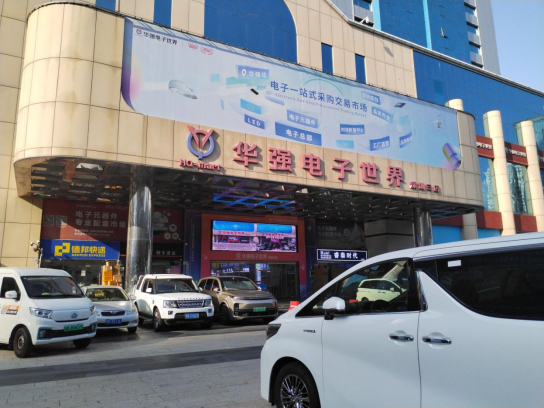 Huaqiang Electronics World Shenzhen Store 3: One-Stop Electronic Procurement and Trading Market
Avoidance Guide for the "Pig-Farming Scam":
- No credit terms for new customers; either cash before delivery or collect a deposit (not less than 30%).
- For new companies, must verify the legal representative's real name, business risks, and litigation records, conduct on-site visits to verify the authenticity of operations, listen more to peer evaluations and trade references, and use bank review where conditions permit.
- Multiple suppliers should exchange information; pay attention in industry WeChat and QQ groups to whether the same company is simultaneously inquiring with multiple suppliers for the same materials.
- Be highly alert to customers who only take spot goods, only care about delivery speed, and do not care about product quality; customers who continuously buy at high prices; and customers who suddenly increase order volume and demand large credit terms.
- For large orders, try to collect a deposit; for popular chips and high-value ICs, prioritize cash.
- When accounts receivable are overdue, directly freeze the customer's new orders to avoid "shipping while they owe."
 Shenzhen Huaqiang Small Loan Co., Ltd.
It is worth mentioning that the above points rely only on human prevention and will inevitably become lax over time. Therefore, many Huaqiangbei spot suppliers have chosen to use systems. For example, Longwei ERP's six recommended configurations turn the "pig-farming scam" into a management safeguard where "the system will not let it pass":
|
# |
Control |
Longwei ERP's Six Recommended Configurations |
|
1 |
Customer Risk Tagging |
Mismatch between registered capital / number of insured employees and purchase volume → Automatically flag the customer; no payment terms by default. |
|
2 |
Credit Limit |
Order amount exceeds remaining credit limit → System freezes the order; release requires approval. |
|
3 |
Payment-Term Tiers |
For new customers, the first 3 orders must be paid before shipment. Payment terms are unlocked progressively after on-time payments. |
|
4 |
Abnormal Growth |
A customer's monthly order value increases by more than 3× month over month → Mandatory risk-control review. |
|
5 |
Price Alerts |
Unit price deviates by ±20% from the market reference price, or falls below cost → Highlight in red and block the transaction. |
|
6 |
Overdue Account Linkage |
At T+1 after payment becomes overdue → Automatically freeze new orders; at T+30 → Escalate to collections. |
Note: The data and materials in this article refer to authoritative reports and materials. If there is any infringement or inaccuracy, please contact us.
Related Recommendations