






















Service Hotline
Perspectives

Perspectives

The Development Path of Huaqiangbei Distributors (Part I)
2026-11-02
337
If you want to live a remarkable life, start by learning to say something remarkable. Good afternoon, friends — here we are again, and here I am, talking big again. I am Song Shiqiang of Kinghelm, and this is the third year running that I have stood here and shared my thoughts with you.
In 2016 what I shared with you was The Present and the Future of the BeiDou Industry; last year it was The Road of Transformation for Huaqiangbei Distributors. Today I can tell you, with rather less bragging than usual, that in BeiDou we have become the first name in the industry. Kinghelm has made three major leaps — from trader to distributor to original manufacturer — established a complete BeiDou ecosystem, and secured key positions in the industry chain.
At the same time we have kept walking towards the centre of the electronics value chain. We took a stake in Slkor Electronics of Korea and gained access to world-class silicon carbide, or SiC, technology, so the transformation is complete. The Buddha warned that a man who can speak but cannot act has no real mastery; we would say that we have put knowledge into practice.
Today I am talking about The Road of Development for Huaqiangbei Distributors. I speak as someone who has survived in the Huaqiangbei electronics trade, bringing with me some cross-industry perspectives from my years in the property business.
Last year I gave you a fairly complete picture of the Huaqiangbei model. Today let me dwell on the weaknesses of our enterprises, because the strengths are real too and I shall come to them later. As far as I can see, the small companies in Huaqiangbei are in their present state for the following reasons.
One: small. Small in scale. Many of us start with a small counter and remain two- or three-person operations — husband and wife, brother and sister, or father and son — working from dawn till night. The couple often have to handle everything themselves. Is that not so? Otherwise, what would be the point. There is no scale effect, no real division of labour, and efficiency is low. Some say a married couple working together is highly efficient. I disagree. That is enthusiasm, and enthusiasm is a different thing from the efficiency that comes from clear division of labour and close coordination.
Once I went with Brother Bo of Ichunt and Mr Wu of ITTBANK to call on Cheng Yimu, chairman of the Electronics Chamber of Commerce. We remarked that Huaqiangbei's output had reached such a size, yet apart from the old state-owned enterprises not one company here had ever gone public. That tells you how many small companies there are, and it deserves some self-examination.
Two: scattered. Too many lines, nothing professional. Friends who came to today's event, take out your business cards and have a look: whose card does not list brands such as TI, NXP or Atmel? That is exactly the point — we do too many things, and we have neither a channel advantage nor an industry advantage.
With a model like that, staying alive is already an achievement, never mind developing. A small company ought to focus on a specific niche within an industry and strive to become a leader in that area. Everything looks the same here, too. You seem to be able to find anything, yet nobody has the best price or the best channel. Without differentiation, small companies run into trouble.
Take the way we grow, for example: it is a one-to-many model based on horizontal imitation within the industry, with one company copying another's business model and operating methods. You put on your own shoes, walk your old employer's road until they have no road left, and you may even cut across their shortcut. There is growth, but no development. We joke that to get on in Huaqiangbei you need three things: first, persistence; second, no shame; third, persistence without shame. Then everything will work out.
Three: disorderly. Management is disorderly — many firms do not even have a simple ERP system. The lines they chase are disorderly too; nobody digs steadily into one trade. The other day I met an old acquaintance from the trade in the lobby below my office, holding a VR headset. I asked what he wanted with it. Business is hard, he said — I am taking it apart to see what is inside, maybe we can do this. A few days earlier I had seen him working on power-bank boards. He is simply following the trend.
Even the property world is no tidier. The tycoon whose take-over battle with a large listed developer has filled the newspapers is said to have made a secretary into a wife — with a proper process of promotion in between, of course: by day she assists his wife, by night he assists hers, until at last she officially becomes his wife. His business, it is true, is very big. The founder of that developer, on the other hand, treats a wife as a secretary: in the days when he was off climbing mountains and sailing boats, a great deal of his business was handled for him by his first wife, the way a secretary would. Now, people say, the old gentleman has raised his standard and is looking for a lady companion instead. And the tycoon next door chimes in: Silly Wang, you mind your braised pork and your lady friends, and your developer will be mine. Disorderly enough for you?
Four: weak. No brand, no team, no core competitiveness. There are tens of thousands of electronics companies in Huaqiangbei, but few established and famous ones — Yingtelin, Emerson, Meilong, Zhongyifa and Kinghelm are about the lot of them. There are few well-known product brands either. The names people know are Huaxinbang, Slkor, Foster, Zhishang Micro, Huaguan, Kuaixin Micro and Kexin; in e-commerce, Anxin Mall and Ichunt.
There is little corporate culture worth the name and few teams worth the name either. Meilong Electronics, Anda Technology in Singapore and Hongxin Micro are the exceptions with a culture of their own; teams with real fighting spirit are rare indeed. Without a good team there can be no real growth, in development or in competition. Kinghelm, I may say, is doing rather well itself. By comparison, too many companies are weak.
Some people simply do not like publicity and are making a fortune quietly. Some operate in the shadows. Some do not want it on the books, for tax reasons. A great many companies grew strong only after leaving Huaqiangbei — Hytera and Tencent, for example.
Five: no core competitiveness and little added value. Neither our products nor our business models are innovative, and we sit at the bottom of the value chain: no pricing power, no voice, porters for the original manufacturers — temporary porters at that, and often asked to hold their stock and carry their credit as well. We joke that we do the hard work, the tiring work and the dirty work. Caught between manufacturers and customers, we face pressure from both sides. We have little technical expertise, no advantage from information asymmetry, no application know-how or bundled solution to offer as added value, and only a weak hold on customer relationships. Any day we can be replaced. We live in worry, and it is a hard life.
There was news the other day. Avago bought Broadcom and cancelled the distributorship of Shiqiang Electronics, one of its downstream agents. Shiqiang is a big name in our trade; I hear it shipped close to forty per cent of Avago's volume. That tells you how humble our position in the chain really is. WPG Holdings, another of the industry's giants, has been laying people off on a large scale. When the manufacturers remap the industry at the source, it is the fish downstream that get scorched. Such a company may collapse almost overnight, and by then the body will still be warm. A business model that can be wiped out overnight is like the tightening headband worn by the Monkey King in the classic Chinese novel — it shrinks whenever the monk recites a spell. What is to be done?
Six: no strategy and no plan. There is no long-term plan, and therefore no short-term targets broken down from one. Strategy is short-sighted; company plans, team training, brand planning and product-line planning hardly get a mention. Such companies cannot make long-term strategic investment, cannot develop technology, cannot accumulate a brand or a team, and cannot build anything honestly, layer upon layer.
Nor do they think about long and steady returns. To use the language of the economist Zhang Weiying, a company that does not discount the future at all must make its money now and make it fast. As a result, there is little sense of responsibility or commitment, and counterfeit goods and fraudulent practices become increasingly common.
Their model is to live on the spread, chasing the lowest purchase price upstream and maximising profit in the shortest possible time, which is why fake goods reach customers and why people get hurt. With no firebreak and no moat, a company can be reduced to nothing easily, and neither the firm nor its people have a future.
Seven: not open. A company's closed doors are the bottleneck to its development. There is a joke about firms like this: the boss comes from the family, the managers come from the hometown, and the employees come from the local village — and, one must stress, the female secretary belongs to the boss. When there is work, the secretary does the work; when there is no work, the boss has the secretary to keep him company. No company like that can take in outside talent and graft it onto the old team. The old model hardens, the times pass it by, and there is no growth. If we want to do something bigger, we must have an open and tolerant mind.
This is not a case of admiring everything foreign. Look at McDonald's and KFC: however dear the location, every shop keeps a washroom open to the public. I make use of it myself, and the sight of their logo has stopped me worrying about a full bladder. What brand advertising that is. I admire that openness, and you can read an attitude of tolerance in a small thing like that.
Take another example I have been turning over lately. Apple's iOS is closed and Android is open, and now Apple faces a crowd of manufacturers who build on Android and rework it in their own way. In the long run that may prove to be Apple's weak point. Good grief — I wonder whether Steve Jobs will sit up in his grave when he hears an outsider say so.
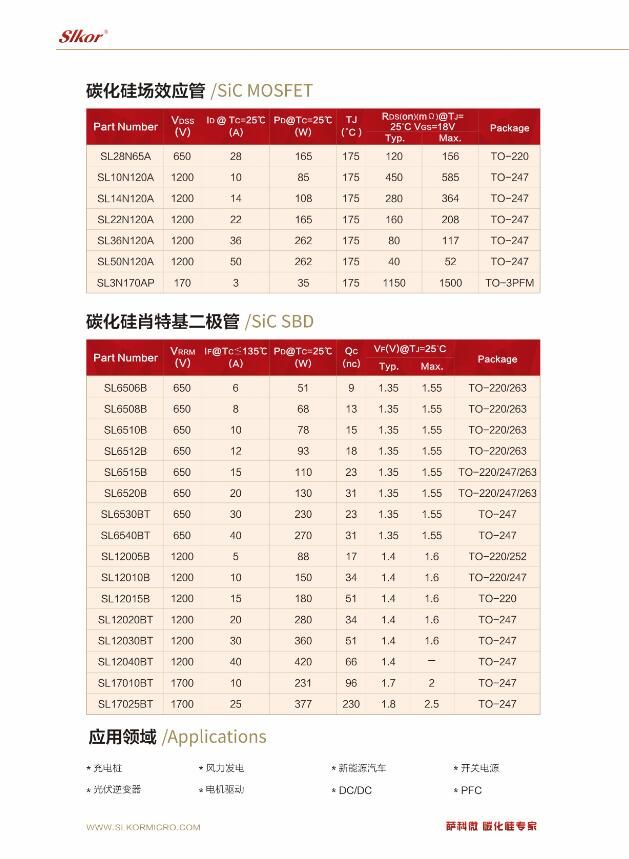
Silicon carbide device tables: SiC MOSFETs and SiC Schottky barrier diodes, with their application fields
So much for the problems. What, then, are Huaqiangbei companies to do? What are we to do? What are we to do? When facing a matter of life and death, you should ask yourself the question thirty times over. Here are a few of my own thoughts, which I am glad to share.
My answer is: learn, learn; think, think; think deeply. That is the only road out worth the name, and perhaps the only one there is. The first thing is the will to learn. In every company the boss, the key staff and the front-line employees must all want to learn; that is the inner driving force of development.
When leaders learn they carry the staff along; when the staff learn they push their leaders in return, and the whole team falls into the habit of learning. That raises the soft power of the individual and of the team. Once people taste what learning brings to their work they like learning the more, and the circle turns in your favour. Between a person who reads and a person who does not, to be plain, there is a difference.
Let me start with learning by the leader. A leader should raise himself by learning, and use that to examine and correct his own company's business model and to understand the laws of the industry. Only then can his company adapt to change and do better.
The other day I met Jason Fan of Anda Technology in Singapore, one of the big figures of Huaqiangbei, in Beijing. He had paid 830,000 yuan to enrol in the MBA programme jointly offered by Tsinghua University and INSEAD, and, to give me something to brag about, we shared a room at the Holiday Inn. At one in the morning, when I came back from drinking, he was still going over his lessons and listening to a foreign professor's lecture notes. He asked whether I cared to listen; I said my English is no good and I cannot follow a word. Then shall I turn the volume up, he said. I was quite put out. Was he not making me look small? It is like saying: your handwriting is poor, so here is a Parker or a Montblanc pen and now you will write beautifully. Still, he paid for the room and treated me to peaches, so I held my tongue. Look at a man whose business is doing well enough, and he is still learning. That is the spirit of the new Huaqiangbei entrepreneur.
I think learning should develop two key abilities. The first is the ability to analyse and generalise: it lets you see through a problem calmly to what it really is, and once you understand the objective laws of things and of the industry you are no longer fooled by appearances. Then you know where the key points are, where to put your strength, and how to take a rational risk and get twice the result with half the effort. The second is the power to deduce, to range widely and to reason logically: starting from the knowledge you already have and what the industry has taught you, you can reason logically from a single point, anticipate how events will run, and so keep control and shut out the noise.
I read Buddhist texts from time to time. There is a scripture called the Hundred Parables Sutra in which a story about blind men and an elephant makes this very point. Six blind men had no idea what an elephant looked like, so someone led one up and let them feel it, then asked them what it was. One felt the belly and said it was a wall; one felt a leg and said a pillar; one felt an ear and said a winnowing basket. That is the mistake you make when you have never had the whole picture. If you had seen a real elephant before, one touch of its belly, even if it felt as flat as a wall, would tell you what it was; know it better still and a single hair would do. That is the advantage of systematic and complete knowledge: you are not misled by appearances or by one part of the thing, you reach the essence and find the law. That is what learning is for.
From this comes a word: deconstruction. The idea is often associated with the German philosopher Heidegger and reached Chinese readers through the writings of the scholar Qian Zhongshu. It means taking a thing apart rationally and rebuilding it in a structure of your own. New technologies and new business models are all refined, worked over and developed out of what others did before. There is a Chinese idiom about the cook who carved up oxen for nineteen years and never touched a bone: once you have learned to a certain depth, the work becomes easy, the blade has room to move, and you get twice the result with half the effort.
So the boss must settle his business model — how to make money, how to make more of it, how to make it for longer, and, in the internet age, how to make it together with other people and how to share it.
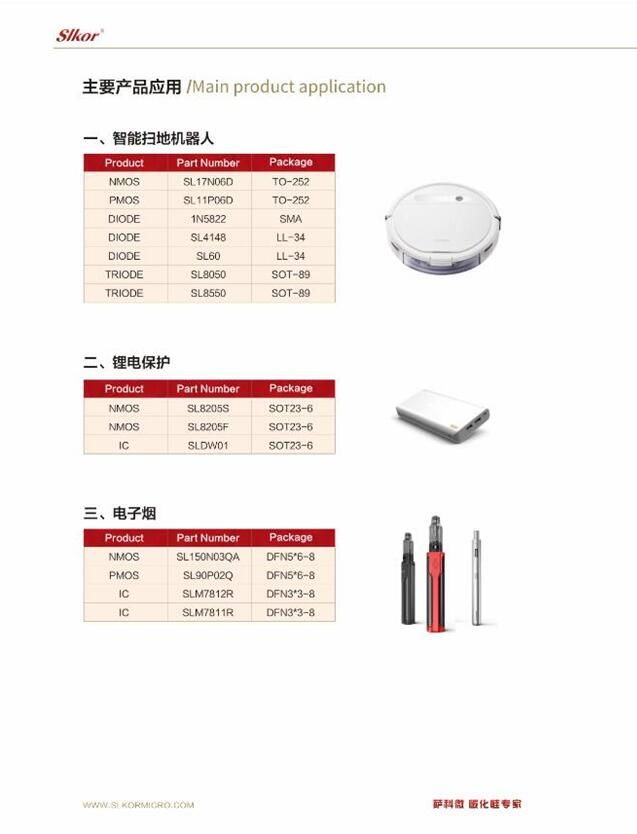
Slide: main product applications — robot vacuum cleaners, lithium-battery protection and electronic pens
Next comes learning by the team, and there I would note two things: tiers and redundancy. Building a team is a long and patient process; I will not labour the rest of it, but those two points matter. As my Chaoshan friends say about raising children: bring up the eldest well and you need not worry about the second and the third, because they follow the elder ones. The old saying about the mugwort that grows straight without being propped up among the hemp means the same thing. While building the team, the core employees who join at an early stage matter most: fix the DNA of the team first, then let the senior staff bring the newcomers along, and establish proper standards and systems for the company and the organisation, and it becomes much easier.
I have discussed this with Chen Haisheng of Meilong Electronics, who do it very well. They are already training a third tier and growing fast; you should go and learn from them when you have the time. Redundancy is about the key staff: ideally one person can cover two posts. In that way they learn more, communication and coordination become easier later on, and when somebody leaves or takes leave there is someone to fill in. In the foreign firms where we used to work we called this a designated deputy arrangement, and it is a good mechanism. The young people I am mentoring are still in the first tier of the team. It is tiring work, but they improve very fast.
What follows is learning sideways, that is, learning from others in the same trade. One part of it is to learn models and management from the companies that are doing well, to know the best of the market and of technology, and to discover and seize new chances. When I first came into this industry I learned humbly from Jason Fan of Anda, from Brother Bo, from Mr Chang of Shenmei, from Mr Hu of Zhishang Micro and from Huang Rusen of Shilianxin. They told me all they knew and held nothing back, which is why I am standing here sharing my thoughts with you today instead of having been pushed out of the trade long ago. I call that industry knowledge.
And here I must single out Dr Zhu, the boss of Zhongyifa and one of the most knowledgeable people in Huaqiangbei. He and I once spent a day in Beijing going through The Plum in the Golden Vase from every angle. We said that we understood and pitied Pan Jinlian — the red apricot branch stuck into a pile of dog dung — as much in the body as in the mind; we regretted the fate of Wu Dalang, who wore horns and lost his life with them; we discussed the business model of Ximen Qing, who ran a chain of pharmacies; we paid tribute to Wu Song's sense of justice, on the grounds of both law and feeling, and doubted it all the same, since he was the county's chief of police and knew better. A hero cannot be allowed to be ignorant of the law.
We condemned old Wang Po for pleading the case of love at the price of ten taels of silver, while noting objectively that her skill in pulling resources together and running a project was not bad at all — she had the makings of a public-private partnership. We were shocked that Pan Jinlian and Ximen Qing poisoned Wu Dalang between them: you should not drink a cow's milk and then kill the person who raised it. From the point of view of economics and of ethics we explained how the misallocation of resources upsets the balance of cooperation and distorts value and price until a case like this becomes almost inevitable. We blamed the great landowner Zhang, who first wronged Pan Jinlian and then, having failed to get her, made her over to Wu Dalang; we denounced the feudal proprieties in tears; and we cursed him to be born again in Huaqiangbei hawking counterfeit receipts, squatting at the mouth of the metro in the burning sun with a dry throat, shouting piao — piao — for the whole day.
After that long talk Dr Zhu said, with feeling: next time I want to drink, brag and trade jokes in Huaqiangbei, I shall come looking for you. That is how I found my way into the inner circle of Huaqiangbei's more respectable businesspeople — though, to be fair, much of the conversation in this circle is anything but refined.
Enough of that. There is also professional knowledge to acquire, including human resources management, finance, equity and financing, brand operations, and dealing with the local authorities. A company cannot do without any one of them. When people learn and improve, the soft power of the company rises and its competitiveness grows; for the staff, that is the best benefit of all.
Introduction to Mr. Song Shiqiang
Mr. Song Shiqiang is the general manager of both Slkor and Kinghelm. He is a member of the expert pool of the Chinese Institute of Electronics, an expert on the business of Huaqiangbei in Shenzhen, and a columnist and popular-science writer. Song Shiqiang began his career as a front-line technician and has served as the chief executive of an internationally listed property company. He has wide experience in technical management and business operation, and he combines macroeconomic theory with the practical realities of running a business, leading his companies to rapid growth.
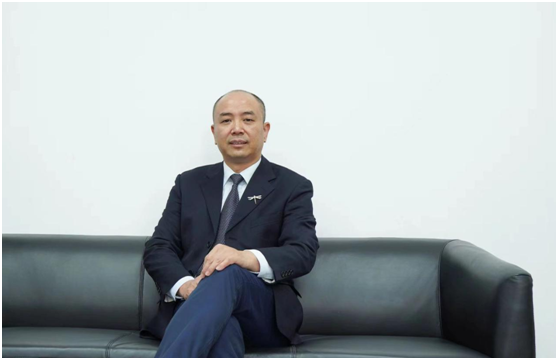
Mr. Song Shiqiang of Huaqiangbei
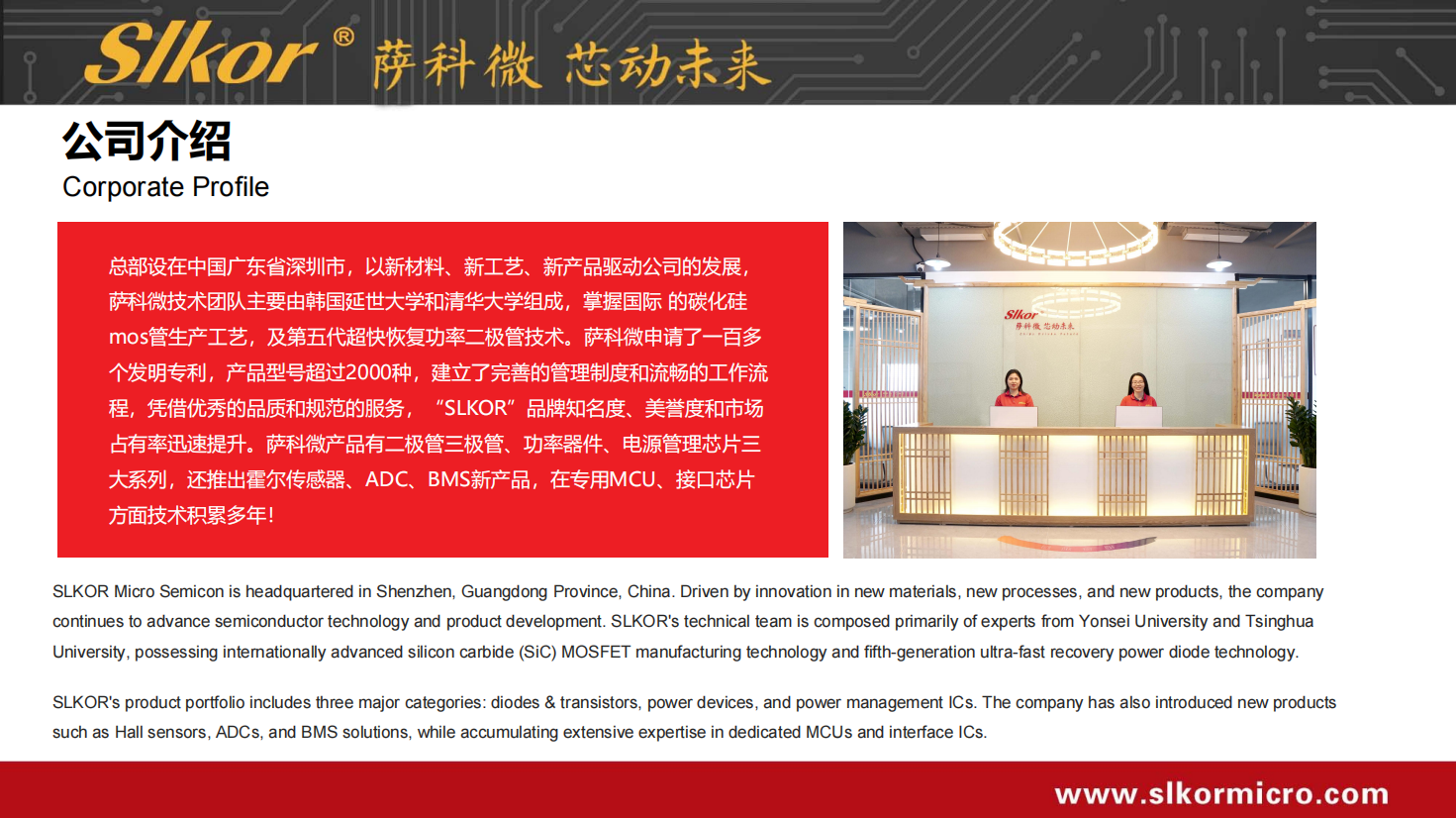
Slkor and Kinghelm, the two companies in which Mr. Song Shiqiang has invested, are headquartered in Shenzhen, China, and both are national high-tech enterprises. The Slkor (www.slkoric.com) and Kinghelm (www.kinghelm.net) brands have built an international presence and continue to expand their market reach. Shenzhen Slkor focuses on the development of new materials, new processes and new products; its technical team comes from Yonsei University in Korea and Tsinghua University, and it was among the first to master silicon carbide MOSFET technology. Slkor has grown from a fabless design house into a comprehensive company covering design and development, manufacturing, total solutions and sales service.
Related Recommendations