






















Service Hotline
News

News
Kinghelm Releases "A Comprehensive Summary of the Optical Communication Upstream and Downstream Industry Chain and Analysis of Domestic and Foreign Manufacturers (Part 2)"
2026-09-15
4
 Kinghelm General Manager Song Shiqiang at 2026 Shanghai Munich Electronics Show W5.317
In 2026, Kinghelm (www.kinghelm.net) officially entered the optical communication field. General Manager Mr. Song Shiqiang emphasized: "Optical communication covers the entire industry chain of optical chips, optical components, optical modules, optical fibers and cables, and system equipment. It is a core rigid-demand track for major projects such as 5G/6G data centers and the East-to-West Computing Resource Transfer Project. The characteristics of dual-driven technology iteration and market demand are very obvious, because its core demand has rapidly shifted from traditional operator public network construction to emerging scenarios such as AI data center interconnection, industrial optical private networks, and automotive optical interconnection, deeply bound with new demands such as computing power networks and AI large models. Advanced packaging and silicon photonics integration technologies have become core breakthrough directions. In 2026, China has listed high-end optoelectronic chips, CPO co-packaged optics, all-optical switching and other core technologies as key research directions. The space for domestic substitution in optical communication is broad. Kinghelm (www.kinghelm.com.cn), as a technology original manufacturer and an important participant in 'domestic substitution,' enters the optical communication field to open up new development tracks. It will aim at the 'heart' of the optical communication industry chain, which is the core key link of domestic substitution, covering transmitter/receiver chips and indium phosphide-based high-speed laser chips."
Kinghelm Chief Engineer Mr. Qin Xianghong at work
In view of this, Kinghelm Chief Engineer Qin Xianghong, combining years of deep industry research experience and drawing on the research achievements of existing industry pioneers and peers, follows the five main lines of the optical communication industry chain—optical chips, optical components, optical modules, optical fibers and cables, and transmission equipment—and has summarized and compiled the "Comprehensive Summary of the Entire Optical Communication Industry Chain and Analysis of Domestic and International Manufacturers." It will be developed from four aspects: 1. Overview of Optical Communication - Basic Principles; 2. Optical Communication Industry Chain - Analysis of Upstream, Midstream, and Downstream Industry Chains; 3. Key Companies in China's Optical Communication Industry Chain; 4. Outlook for the Optical Communication Industry. This initiative aims to promote information communication, resource sharing, and knowledge co-construction across the entire upstream, midstream, and downstream optical communication industry chain, achieve industry chain optimization, integration, and collaborative innovation, and thereby enhance the global industrial discourse power of Chinese enterprises.
 Kinghelm "Comprehensive Summary of the Entire Optical Communication Industry Chain and Analysis of Domestic and International Manufacturers"
Continued from Kinghelm Chief Engineer Qin Xianghong—"A Comprehensive Summary of the Optical Communication Upstream and Downstream Industry Chain and Analysis of Domestic and Foreign Manufacturers (Part 1)":
III. Key Companies in China's Optical Communication Industry Chain
(I) Optical Chips and Electrical Chips
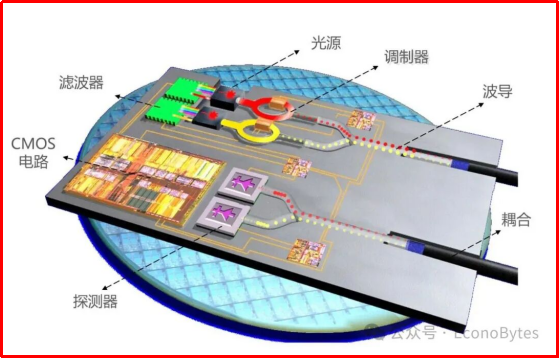 Optical chip application scenarios
Optical chips, scientifically known as optoelectronic chips or photonic integrated circuits (PICs), use semiconductor processes to integrate functions such as light emission, reception, modulation, multiplexing/demultiplexing, and amplification on a single chip. By function, they are divided into: laser chips (electrical → optical: VCSEL/DFB/EML), detector chips (optical → electrical: PIN/APD), modulator chips (signal loading), and PLC chips (passive optical circuits). Major manufacturers include Lumentum, Broadcom, Mitsubishi Electric, Sumitomo Electric, Coherent, Yuanjie Technology, Changguang Huaxin, Shijia Photons, Accelink Technologies, HGTECH, Hisense Broadband, Huawei HiSilicon, AAOI, etc.
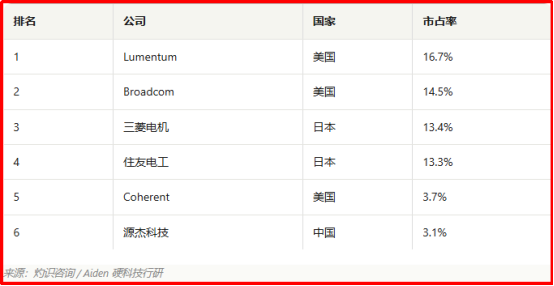 China's Yuanjie Technology ranks among the top global laser chip market players
- Yuanjie Technology:A leading optical chip supplier in China with collaborative expansion in both the "telecom market + datacom market." The company's main products are optical chips, including 2.5G, 10G, 25G, 50G, 100G, 200G and higher-speed DFB and EML laser series products, as well as 50mW, 70mW, 100mW, 150mW and other high-power silicon photonics light source products. The company's performance has improved rapidly, with net profit of 51.385 million yuan in the first three quarters of 2025, a year-on-year increase of 627.62%.
- Changguang Huaxin:Focused on the R&D, design, and manufacturing of semiconductor laser chips. It is one of the few companies that develops and mass-produces high-power semiconductor laser chips. It has built an IDM full-process platform covering chip design, epitaxial growth, wafer processing (lithography), cleavage/coating, packaging and testing, and fiber coupling. Today, Changguang Huaxin has built China's only and the world's second 6-inch GaAs high-power semiconductor laser chip production line, occupying an advantageous competitive position in the industry track.
- Shijia Photons:A leading optoelectronic core chip supplier in China. The company masters key technologies for independent chips, breaking through from a single PLC optical splitter chip to passive chips and active chips, and further expanding from wafer manufacturing and chip processing to packaging and testing. It now possesses a full-process capability from design to manufacturing, and from testing to packaging, basically forming a complete optical chip industry chain.
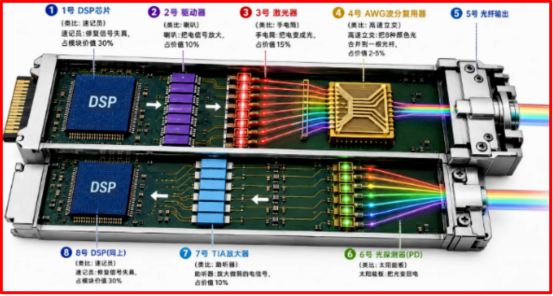 Application scenarios of DSP chips in electrical chips
Electrical chips are mainly imported from overseas, including four core chips: DSP, CDR, Driver, and TIA. Major manufacturers include Marvell, Credo, Broadcom, Huawei HiSilicon, Chaoran Semiconductor, Youxun Shares, etc.
- Youxun Shares:A leading enterprise in China's optical communication front-end transceiver electrical chip field. The company clearly positions its business as an electrical chip company. Its products (such as laser drivers, transimpedance amplifiers, etc.) need to be used in conjunction with optical chips and are the "nerve center" for achieving optoelectronic signal conversion in optical modules. In terms of electrical chip business development, Youxun Shares can provide full-application-scenario, full-series optical communication electrical chip solutions, and ranks first in China and second in the world in market share for products at 10Gbps and below. Currently, the company's 25G PON electrical chips have achieved batch delivery, 50G PON electrical chips have entered the sample testing stage, and it is focusing on R&D of electrical chip products for cutting-edge fields such as 400G-800G data centers and FMCW LiDAR, in order to seize market opportunities brought by AI computing power and autonomous driving.
(II) Optical Components
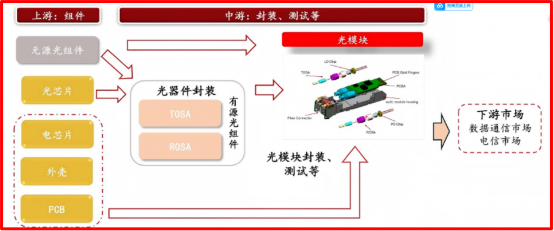 Optical components are the product and core content of optical device packaging
Optical components include ceramic sleeves/ferrules, optical transceiver interface components, etc. Major manufacturers include T&S Communications, AFR Optics, T&S Communication, Tengjing Technology, etc.
- AFR Optics:With a series of high-performance optical devices such as optical isolators, dense fiber array connectors, MEMS VOA optical switches, polarization beam splitters/combiners, couplers, wavelength division multiplexers, and lithium niobate modulators, it has successfully entered the global market. Its products are exported to more than 40 countries and regions and are widely used in core upstream fields of the industry chain such as fiber lasers, optical communications, and data centers.
- Tengjing Technology:A high-tech enterprise specializing in the R&D, production and sales of various precision optical components, fiber optic devices and optical test instruments. Its products are mainly applied in fields such as optical communication, fiber laser, scientific research, biomedicine and semiconductor equipment. The company has made in-depth layout in the cutting-edge field of AI computing power optical interconnection, and has become an important supplier of key devices for OCS optical switches.
(III) Optical Devices
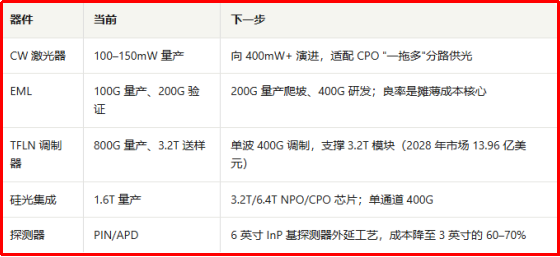 Optical devices: Evolving toward higher speeds and lower power consumption
According to whether a power source is needed, optical devices are divided into active devices and passive devices. Active optical devices mainly include laser chips (such as FP, DFB, VCSEL), detector chips (such as PIN, APD), optical amplifiers, optical modulators (such as DML, EML chips), and optical transceiver sub-modules (TOSA, ROSA, BOSA), etc. Passive optical devices mainly include optical isolators, optical connectors, optical switches, optical splitters/couplers, wavelength division multiplexers (WDM/AWG), optical attenuators, FA fiber arrays, etc. Major manufacturers include T&S Communications, Accelink Technologies, HGTECH, T&S Communication, Broadex Technologies, Coherent, Lumentum, etc.
- T&S Communications:The company's main products consist of two major segments: active optical devices and passive optical devices. Active devices mainly include high-speed optical engines, TO-CAN/BOX packaged devices and other core components of optical modules. Passive devices cover ceramic sleeves, fiber array units (FAU), isolators, and connectors, etc. From 2020 to 2024, T&S Communications' revenue compound annual growth rate was close to 40%, and net profit grew by nearly 50% annually. The key lies in focusing on the core link of optical devices. In the first half of 2025, T&S Communications' active optical device business experienced explosive growth, achieving revenue of 1.566 billion yuan, a year-on-year increase of 90.98%.
- T&S Communication:Focused on the R&D, production, and sales of passive optical devices. Core products include MPO/MTP high-density fiber connectors, MT/ceramic ferrules, flexible fiber routing boards, wavelength division multiplexing devices, etc. Products are mainly used in AI computing power data centers, cloud computing clusters, and telecom transmission networks, with a small layout in optical sensing business. The company's main business is centered on datacom high-density optical interconnection products, with the vast majority of revenue coming from the optical device business. Relying on self-developed and self-produced MT ferrules, it achieves vertical integration of key components. Products are indirectly supplied to overseas leading cloud vendors and AI computing clusters through cabling manufacturers. Export business accounts for a relatively high proportion of revenue, making it a relatively focused passive optical connection enterprise in the A-share market.
- Broadex Technologies:Main business is the R&D, production, and sales of integrated optoelectronic devices in the optical communication field. Main products include PLC optical splitters, PON optical modules, fiber arrays, dense wavelength division multiplexing devices, wireless bearer network optical transceiver modules, data center optical transceiver modules, active optical cables (AOC), and high-speed copper cables (DAC, ACC). The company currently provides high-quality optical signal power and wavelength management devices and high-speed optoelectronic transceiver modules for the globally rapidly developing optical fiber communication networks and Internet Data Center (IDC) markets. Among them, optical splitters and dense wavelength division multiplexing (DWDM) devices occupy leading global market shares.
(IV) Optical Modules
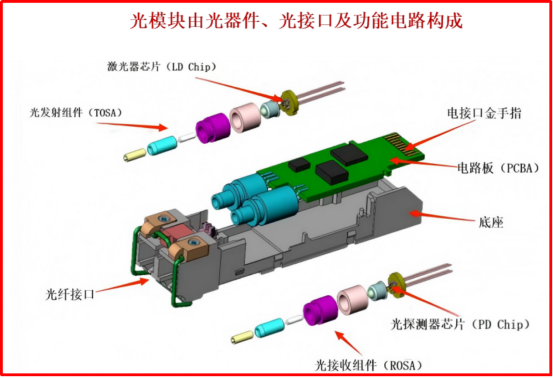 Optical modules play a core role
Optical modules are composed of optical devices, optical interfaces, and functional circuits. They play a core role in enabling high-speed, high-reliability, and low-latency data transmission in increasingly complex datacom and telecom networks, and are widely used in telecommunications, internet, radio and television, aerospace, and other fields. Chinese enterprises occupy world dominance in the global optical module manufacturing and packaging link.
- Zhongji Innolight:The company currently ranks first in global optical module market share. Its products are widely used in cloud computing data centers, data communications, 5G wireless networks, telecom transmission and fixed network access, etc., and it is committed to promoting the development of optical modules toward high speed, miniaturization, low power consumption, and low cost. Currently, the company's product portfolio covers 200G to 1.6T high-speed optical modules, as well as 5G fronthaul/midhaul/backhaul optical modules, transmission network optical modules, and FTTX optical devices and other overall solutions. In the second half of 2025, while 800G optical modules significantly increased in volume, more customers began deploying 1.6T products. It is expected that 1.6T optical module shipments will usher in significant volume growth in 2026.
- Eoptolink:The company's products mainly serve data centers, AI computing clusters, 5G/6G telecom networks, and other fields. In optical module technology, the company covers traditional pluggable optical modules, linear drive (LPO), near-package optics (NPO), and co-packaged optics (CPO) and other advanced interconnect forms, and possesses core technologies and capabilities such as optical engines. Its product system includes 400G, 800G, and 1.6T high-speed optical modules based on various solutions such as VCSEL/EML, silicon photonics, and thin-film lithium niobate, as well as 400G/800G ZR/ZR+ coherent optical modules and 800G/400G optical modules based on LPO solutions. With leading technology and products, the company has entered the supply chain systems of major global cloud computing vendors (such as Amazon, Meta, etc.) and communication equipment vendors, and is one of the core suppliers in the optical communication industry.
- Accelink Technologies:The company boasts vertical integration capabilities covering optical chips, devices, modules and subsystems. In the optical module business, its products cover all scenarios of transmission, data and access. In the first three quarters of 2025, it achieved an operating revenue of 532 billion yuan, representing a year-on-year increase of 58.65%. According to market rankings, Accelink Technologies ranked 5th among global optical module manufacturers and 4th in the market share of data communication optical modules in 2024. At present, the company has realized mass delivery of 800G optical modules, and is actively deploying next-generation technologies such as 1.6T silicon optical modules and CPO (co-packaged optics) to consolidate its high-growth advantages in the AI data center sector.
V) Optical Fibers and Cables
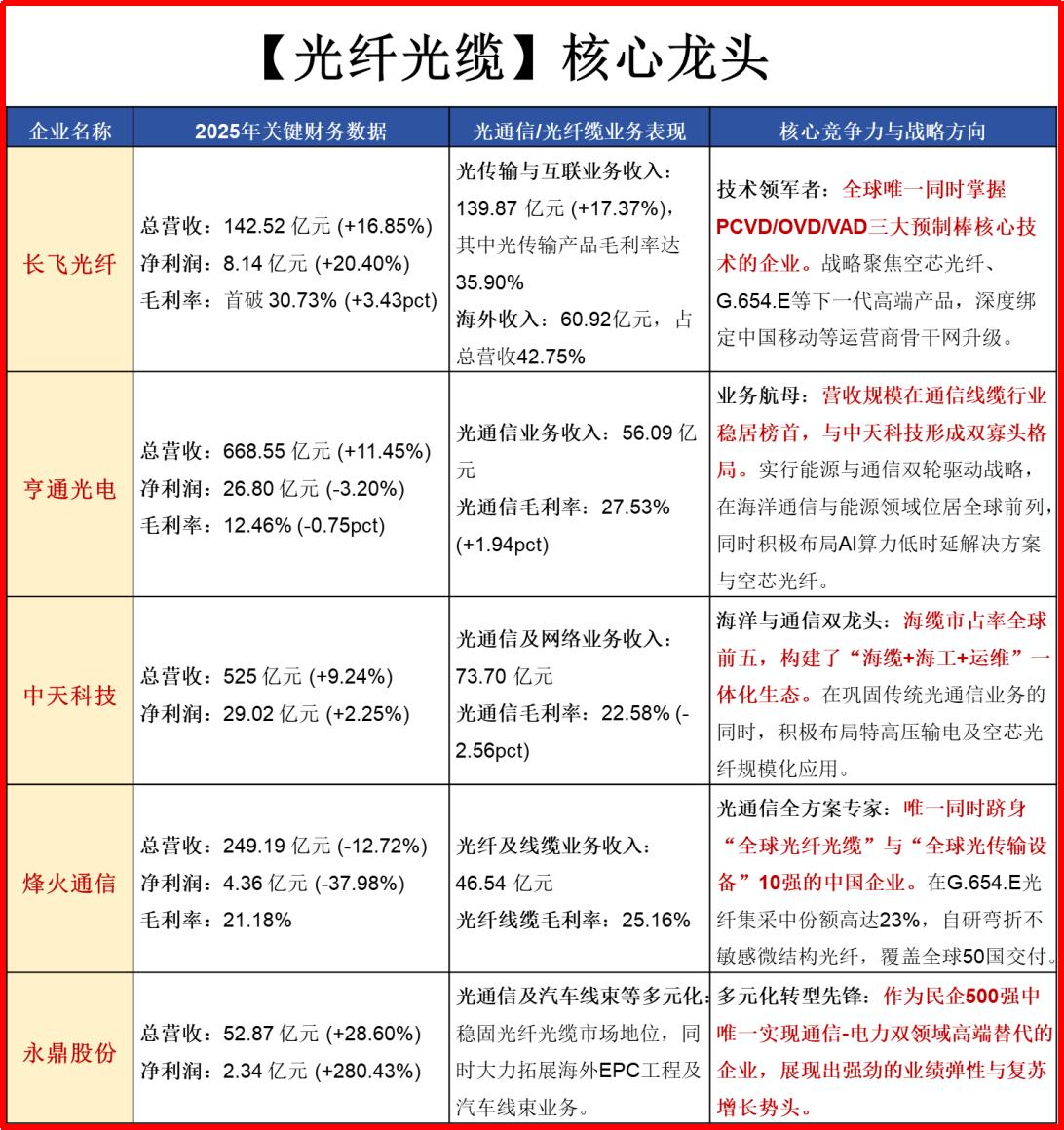
Core leaders in optical fibers and cables: YOFC, Hengtong Optic-Electric, ZTT, FiberHome, Yongding Shares
The value of the optical fiber and cable industry chain presents a pyramid structure. The upstream (optical fiber preform) has the highest technical barriers, the midstream (fiber drawing/cable assembly) is the manufacturing core, and the downstream is application services. Major manufacturers include YOFC, Hengtong Optic-Electric, ZTT, FiberHome, Yongding Shares, Tongding Interconnection, Tefa Information, Kingsignal, Huamai Technology, Shijia Photons, Orient Cable, etc.
- YOFC:A globally leading provider of optical fiber preforms, optical fibers, optical cables, and comprehensive solutions. It mainly produces and sells various standard specifications of optical fiber preforms, optical fibers, and optical cables widely used in the communication industry, as well as various optical modules, specialty fibers, active optical cables, submarine cables, and RF coaxial cables, accessories, and other products based on customer needs.
- Hengtong Optic-Electric:Strong market application competitiveness in specialty fiber products such as ultra-low-loss fiber, laser fiber, multimode fiber, and marine fiber. Globally, only a few manufacturers possess independent intellectual property rights for optical fiber preform manufacturing. The new-generation green optical fiber preform developed by its subsidiary Hengtong Photoconduction effectively broke through multiple key technical bottlenecks, filled domestic gaps, led the direction of China's optical fiber preform technology, and promoted the industry's green and environmental transformation and upgrading.
- ZTT:The company provides infrastructure services such as cables, components, devices, and antennas for network construction from multiple dimensions of cloud, pipe, and terminal. Products include various preforms, optical fibers, optical cables, ODN, antennas and RF cable types, active terminals, optical transceivers, data centers, high-performance raw materials, and other products, as well as engineering consulting, design, construction, and integration services.\
(VI) Core Equipment - Optical Circuit Switch (OCS)
OCS (Optical Circuit Switch) is a core device that routes purely by optical signals. It does not need to convert optical signals into electrical signals and then back again; it can directly let optical signals find the correct path. Its working principle is very much like adjusting a set of parallel mirrors—when a mirror rotates by an angle, the reflected light shifts accordingly, precisely controlling the direction of the optical signal. This technology solves the delay and high energy consumption problems caused by signal conversion. Its theoretical efficiency is 1000 times that of traditional electrical switches, while power consumption is only one-tenth. It is particularly practical for ultra-large-scale data centers with high electricity cost proportions and has become the preferred choice for next-generation data center networks.
Currently, leading domestic OCS complete machine and integration enterprises are as follows:
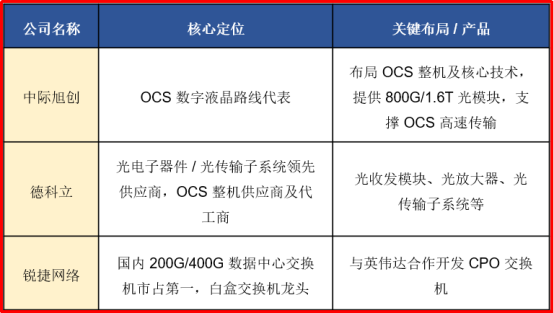
IV. Outlook for the Optical Communication Industry
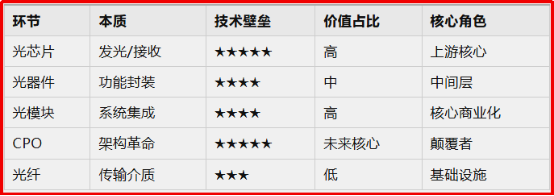 Summary of the five major links in the optical communication industry chain
The optical communication industry is standing at a historic inflection point of AI computing power explosion and digital infrastructure upgrading. It is comprehensively evolving from a traditional "communication pipe" to the "nervous system" of the AI computing power era. The next five years (2026-2030) will be a "golden development period" for the optical communication industry. The industry will present four core trends: "demand explosion, technology iteration, pattern reconstruction, and domestic substitution." At the same time, the structural contradiction of shortage of upstream core materials is also relatively prominent. In August 2026, the Ministry of Industry and Information Technology issued the "14th Five-Year Plan for the Development of the Information and Communication Industry," proposing to strengthen R&D of ultra-high-speed large-capacity optical transmission, optical access, and submarine cable optical communication technologies, accelerate R&D and application of new fiber technologies such as hollow-core fiber, and carry out research on industry-integrated application technologies such as automotive optical communication and industrial control optical networks. Promote R&D of large-capacity and high-bandwidth optical communication equipment, focus on building 1.6Tb/s optical transmission systems, 200G-PON optical access systems, hollow-core fiber optic cables and other ultra-large-capacity all-optical bearer products, and accelerate R&D of 100G and above high-speed inter-satellite and satellite-ground optical communication equipment.
 The Ministry of Industry and Information Technology has issued the 14th Five-Year Plan for the Development of the Information and Communication Industry.
(I) Demand Explosion: AI Computing Power + Network Bandwidth Demand
AI computing power demand becomes the core engine: The explosive growth of AI large models is driving the explosive growth of GPU clusters and ultra-large-scale data centers (IDCs). AI optical modules (such as 800G and 1.6T) have become the main demand force. The AI optical communication market space is expected to maintain a compound annual growth rate of more than 40%, and is expected to exceed US$90 billion by 2030.
Upstream core links are in short supply: Supply and demand are mismatched in core links such as optical chips and indium phosphide substrates. The global supply-demand gap for EML optical chips required for optical modules exceeds 30%.
Long expansion cycles: Optical fiber preform technology has high barriers, and the expansion cycle is as long as 18 to 24 months. The short-term supply shortage pattern is difficult to reverse.
Network bandwidth demand is growing: The digital economy and AI are driving a surge in global data traffic, creating increasing demand for network bandwidth. The optical transmission equipment market will grow steadily. According to Omdia data, the global market size in 2024 was US$16.7 billion, and it is expected to grow by 4.2% annually from 2024 to 2029, reaching US$20.5 billion by 2029.
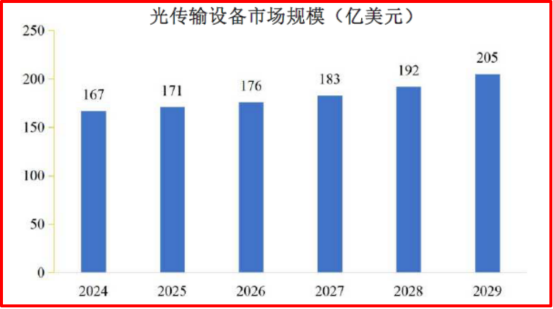 The global optical transmission equipment market will reach US$20.5 billion by 2029.
(II) Technology Iteration: CPO + Silicon Photonics Integration + Automotive Optical Communication + Hollow-Core Fiber Technology
Continuous rate iteration: Optical modules are accelerating from 800G to 1.6T and 3.2T rates. CPO (co-packaged optics) technology entered the stage of large-scale mass production in August 2026.
Silicon photonics integration breakthrough: Silicon photonics integration technology has become the key to breaking through the performance bottleneck of traditional optical chips. China's first 8-inch silicon photonic chip mass production line is expected to be completed within 2026.
Emerging scenarios landing: Automotive optical communication is rising with the development of L3 autonomous driving. The global automotive optical fiber network market is expected to reach US$3.13 billion in 2026.
Frontier material positioning: Next-generation transmission media such as hollow-core fiber are gradually achieving industrialization. Latency is reduced by nearly half compared with traditional optical fiber, making it a new high ground for technological competition.
(III) Pattern Reconstruction
Differentiation between datacom and telecom demand: The growth rate of the datacom market (intra-data center interconnection and inter-data center interconnection) far exceeds that of the telecom market (5G/6G bearer networks and fixed network upgrades). Demand for optical interconnection in data centers is growing exponentially, and fiber usage per rack is soaring. The industry is shifting from "oversupply" to a "fiber famine."
Fiber volume and price rise together: In 2026, the global fiber supply-demand gap rate is about 16.4%. Prices of high-end specialty fibers have risen sharply, and the industry has entered a seller's market where goods are hard to obtain.
Market scale expansion: In 2026, the global optical module market size is expected to reach 201.6 billion yuan, and China's optical module market size will reach 56.4 billion yuan.
Application scenarios continue to broaden: Industry boundaries are extending to emerging fields such as satellite internet (low-orbit satellites), quantum communication, and integrated sensing, communication, and computing, opening up new incremental space for optical communication.
(IV) Domestic Substitution
Optical fiber preform field: Leading enterprises such as Hengtong Optic-Electric and YOFC continue to expand production. Cross-border player Han's Laser has also entered the hollow-core fiber direction with 2.52 billion yuan.
Optical chip and optical module field: Source Photonics, a subsidiary of Dongshan Precision, is investing 8.1 billion yuan to expand optical chip and optical module capacity. Shijia Photons plans to raise 2.8 billion yuan through a private placement for high-speed optical chip development.
Upstream materials field: Xiandao Technology Group is investing 12 billion yuan to build an indium phosphide substrate industrialization base.
Domestic substitution rate needs improvement: Optical chips at 10G and below have achieved domestic substitution, but the domestic substitution rate for high-speed active optical chips at 25G and above is still relatively low.
In summary, the future prospects of optical communication are broad, with a trillion-yuan market that can penetrate every aspect of development, covering AI, data, industry, healthcare, and more. Application scenarios such as data centers, telecom networks, data center interconnection, industrial internet, intelligent driving, quantum communication, smart grids, satellite communication, fiber sensing, and aerospace all rely on optical communication to achieve high-speed and stable data transmission and are drivers of demand growth. A rough estimate is as follows:
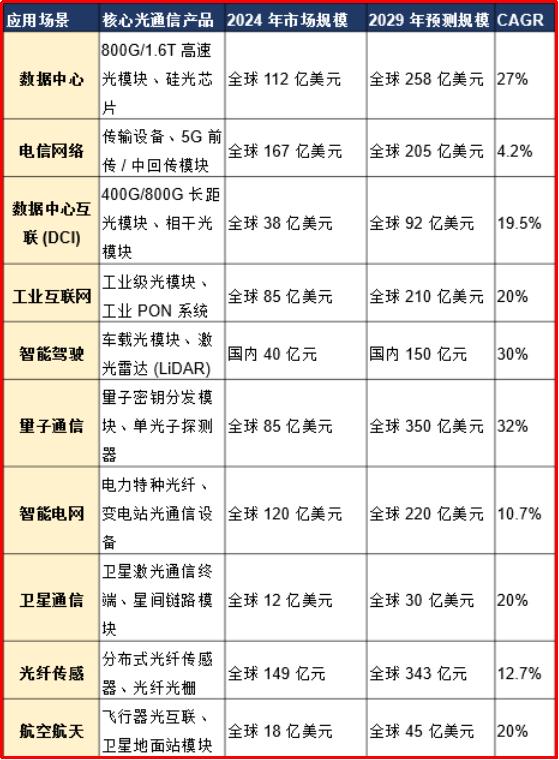
Statement: The above images and materials are partly sourced from the internet, solely for promoting industry exchange and development, not for commercial purposes. If there is any infringement, please contact us.
Related Recommendations