






















Service Hotline
News

News
Kinghelm Releases "A Comprehensive Summary of the Optical Communication Upstream and Downstream Industry Chain and Analysis of Domestic and Foreign Manufacturers (Part 1)"
2026-09-15
8

Kinghelm General Manager Song Shiqiang at 2026 Shanghai Munich Electronics Show W5.317
In 2026, Kinghelm (www.kinghelm.net) officially entered the optical communication field. General Manager Mr. Song Shiqiang emphasized: “Optical communication covers the entire industry chain of optical chips, optical devices, optical modules, optical fibers and cables, and system equipment. It is a core rigid-demand track for major projects such as 5G/6G data centers and the East Data West Computing project. The dual-wheel drive of technological iteration and market demand is very pronounced, because its core demand has rapidly shifted from traditional operator public network construction to emerging scenarios such as AI data center interconnection, industrial optical private networks, and automotive optical interconnection, and is deeply bound to new demands such as computing power networks and AI large models. Advanced packaging and silicon photonics integration technologies have become core breakthrough directions. In 2026, China has listed high-end optoelectronic chips, CPO co-packaged optics, all-optical switching and other core technologies as key research directions. There is broad space for domestic substitution in optical communication. Kinghelm (www.kinghelm.com.cn), as an original technology manufacturer and an important participant in ‘domestic substitution’, will enter the optical communication field to open a new development track, aiming at the ‘heart’ of the optical communication industry chain. This is the core critical link of domestic substitution, covering transmitter/receiver chips and indium phosphide-based high-speed laser chips.”
 Kinghelm Chief Engineer Mr. Qin Xianghong working
In view of this, Kinghelm (www.kinghelm.net) Chief Engineer Qin Xianghong, combining years of deep industry research experience and drawing on the existing research results of predecessors and peers, followed the five main lines of the optical communication industry chain—optical chips, optical devices, optical modules, optical fibers and cables, and transmission equipment—and summarized and compiled “A Comprehensive Summary of the Optical Communication Upstream and Downstream Industry Chain and Analysis of Domestic and Foreign Manufacturers.” It will unfold from four aspects: 1. Overview of optical communication – basic principles; 2. Optical communication industry chain – analysis of upstream, midstream and downstream industry chains; 3. Key companies in China’s optical communication industry chain; 4. Outlook for the optical communication industry. This initiative aims to promote information communication, resource sharing, and knowledge co-construction across the upstream, midstream and downstream of the optical communication industry chain, realize industry chain optimization, integration and collaborative innovation, and thereby enhance the global industrial discourse power of Chinese enterprises.
 Kinghelm “A Comprehensive Summary of the Optical Communication Upstream and Downstream Industry Chain and Analysis of Domestic and Foreign Manufacturers”
(I) Overview of Optical Communication
Optical communication essentially uses “light” as the information carrier, and optical fiber is the dedicated high-speed highway. Its core relies on mutual conversion between electrical and optical signals to achieve information transmission.
The transmission process is very clear: information initially exists as electrical signals, like packaged goods; the laser chip at the transmitting end is the “conversion station,” converting electrical signals into optical signals—just like loading goods onto an optical train and transmitting them along the optical fiber highway; after reaching the receiving end, the detector chip converts the optical signals back into electrical signals, like unpacking the goods so the receiver gets the complete information.
Information flow is divided into three steps: birth of optical signals, transmission scheduling, and identification. Key components each have their roles: the optical transceiver unit is the core, managing the generation, adjustment, and detection of optical signals; optical splitters are like traffic signs, AWG, VOA, and optical switches are dispatchers, and optical amplifiers are energy boosters, jointly ensuring smooth transmission.
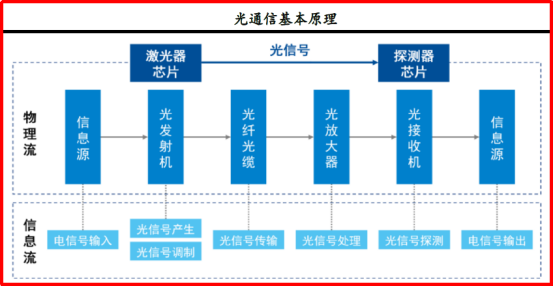 Basic Principles of Optical Communication
(II) Full Process of Optical Communication
The entire optical communication process is actually like a complete “production line,” advancing from beginning to end in the order of “optical chip → optical component → optical module → optical communication equipment → terminal market.”
The upstream of the chain mainly consists of optical chips (optical communication chips), optical components (optical communication components), and optical modules (optical transceiver modules) as core links. Among them, optical chips are the “source core component” of the entire process, located at the very front, and are also the key to enabling optical components and optical modules.
First, optical chips and a series of components are assembled into optical components, then further packaged into optical modules. After that, optical modules are installed into midstream optical communication equipment, and finally these devices are applied in downstream telecom markets, data communication markets, and some emerging markets.
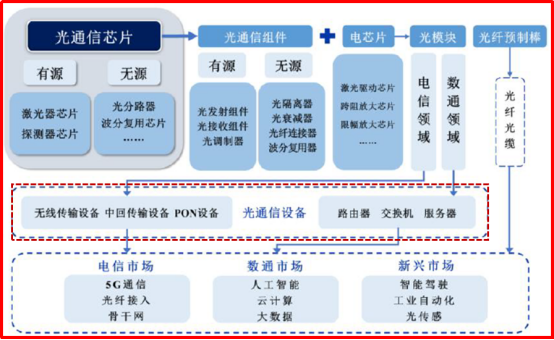
Full Process of Optical Communication
(III) China’s Optical Communication Industry
Optical communication is a communication method that uses light waves as the transmission medium. This field is an important part of China’s implementation of the innovation-driven development strategy and an important development direction in China’s transformation toward a manufacturing power and a science and technology power.
The optical communication industry includes multiple links. The stronger discourse power is concentrated at the upstream and downstream ends. Upstream chip manufacturers and downstream customers are relatively strong, while the cost control level of midstream optical module manufacturers determines their overall profitability. According to LightCounting’s global top ten optical module ranking, Chinese manufacturers occupy seven seats, among which Innolight and Coherent are tied for first, HiSilicon ranks fourth, Accelink ranks fifth, Hisense Broadband ranks sixth, Eoptolink ranks seventh, HGTECH ranks eighth, and Source Photonics ranks tenth.
(I) Overview of the Optical Communication Industry Chain
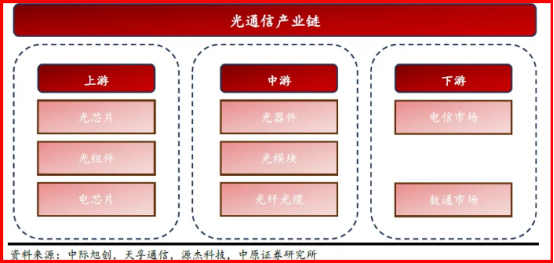 The upstream, midstream and downstream of the optical communication industry chain
In the upstream, midstream and downstream of the optical communication industry chain, the upstream mainly consists of core component links including optical chips, optical components, and electrical chips; the midstream includes optical devices, optical modules, and optical fibers and cables; the downstream is divided by application scenario into the telecom market and the data communication market.
With technological progress and cost reduction, the application scope of optical communication products continues to expand, and market demand continues to increase:
- Optical chips are III-V compound semiconductor materials that realize photoelectric signal conversion;
- Optical components mainly include ceramic sleeves/ferrules, optical transceiver interface components, etc. At present, China is the world’s largest production base for optical components, and market competition is fierce;
- Optical chips and optical components are key elements in manufacturing optical devices: various optical components are processed and assembled to obtain optical devices, and multiple optical devices are packaged to form optical modules;
- Optical devices are various functional devices made using the electronic conversion effect, and are key and core components of optoelectronic technology;
- An optical module is an optical device used for high-speed data transmission. Its function is to realize mutual conversion between optical signals and electrical signals, thereby enabling data transmission in communication networks.
(II) Upstream Core of Optical Communication: Optical Chips
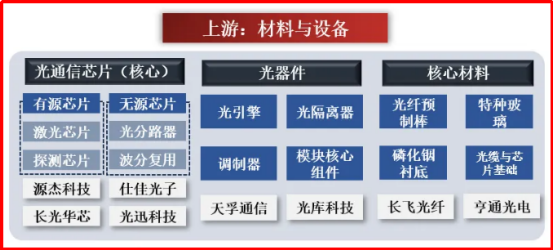 Upstream Core of Optical Communication: Optical Chips
In the upstream of the entire optical communication industry chain, the most core link is optical chips. Optical chips are the core components for mutual conversion between optical signals and electrical signals, equivalent to the “power engine” of information transmission. Their performance directly determines the transmission speed of the optical communication system. After integrating and packaging optical chips with a series of supporting components, optical modules with practical functions are formed.
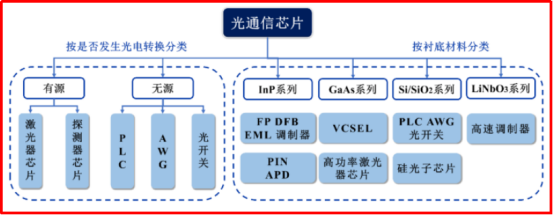
Optical chips are the “source core components” of the optical communication industry chain and the key to the normal operation of optical components and optical modules. Whether it is fiber broadband used at home, 4G/5G networks that mobile phones depend on, or data centers storing massive amounts of data, optical chips are crucial. They directly affect the speed of information transmission in these networks and whether they can operate stably without interruption. They are classified according to different standards as follows:
 Classification of Optical Chips
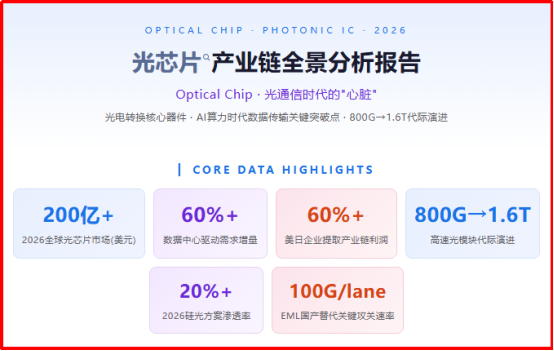
The global optical chip market is growing steadily, becoming the “growth engine” of the optical communication industry. Global data traffic is surging, and all industries need greater bandwidth, which has fueled high-speed optical modules and supporting chips. Among them, high-speed optical chips above 40G run much faster than low- and medium-speed versions. From 2019 to 2025, the proportion of high-speed optical chips above 25G used in data centers and telecom fields has continued to increase. It is expected that 1.6T and even higher-speed optical modules will become the demand trend for connections within data centers, to match future GPU requirements for greater bandwidth and higher computing power. At present, the process of batch commercialization of 1.6T optical modules is accelerating. This trend places higher demands on optical chips: various chips including 200G PAM4 EML and CW light sources will become optical chip solutions in 1.6T optical modules.
 Global Optical Chip Market Size Expected to Exceed US$20 Billion in 2026
The global optical chip market size is expected to exceed US$20 billion in 2026, with data centers contributing more than 60% of the increment. For AI clusters represented by NVIDIA DGX series, the optical module ratio has increased from 1:4 to more than 1:8. 800G optical modules began large-scale volume in 2024, and 1.6T began batch delivery. Amazon, Google, Microsoft and other cloud computing companies are expected to lead the development of new AI applications, which will require major upgrades to their AI clusters, and AI clusters need to use a large number of optical connections.
(III) Midstream of Optical Communication: Optical Modules + Optical Fibers and Cables
 Optical Communication Midstream: Optical Modules + Optical Fibers and Cables
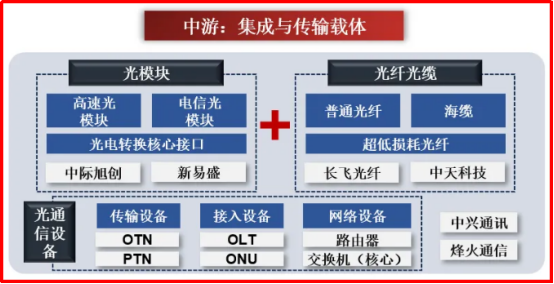
The midstream of optical communication is the “integration and transmission carrier.” Its core is to connect upstream components with downstream scenarios and realize the implementation of optical signal “conversion—transmission—networking.” Optical modules are the core interface for photoelectric conversion (including high-speed and telecom types); optical fibers and cables are the transmission carrier of optical signals; optical communication equipment is system-level networking equipment, mainly including core equipment such as switches. At present, the domestic computing infrastructure market supporting data and AI computing has grown from RMB 339.7 billion in 2020 to RMB 614.4 billion in 2024. In this market, computing resources rank first, with a scale of RMB 385.8 billion in 2024, accounting for about 63%; network resources rank second, with a scale of RMB 151.6 billion in 2024, accounting for about 25%. Network resources mainly include products such as switches and optical modules: switches grew from RMB 31.5 billion in 2020 to RMB 44.7 billion in 2024, and are expected to reach RMB 66.9 billion in 2029; communication resources such as optical modules are expected to reach RMB 97.8 billion in scale later.
1.Optical Modules
 Definition of Optical Module
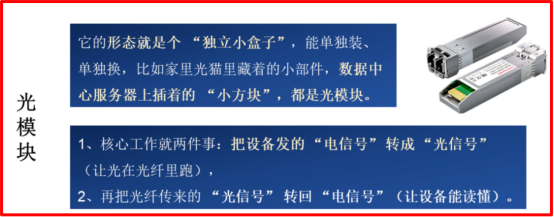
An optical module is like the “dedicated translator” between electrical signals and optical signals—the information in computers and mobile phones is all electrical signals, which cannot travel long distances at high speed through optical fibers. The optical module first converts electrical signals into optical signals, allowing the information to “fly” along the optical fiber to its destination; after arrival, the optical module converts the optical signals back into electrical signals, so that the equipment can read the information.
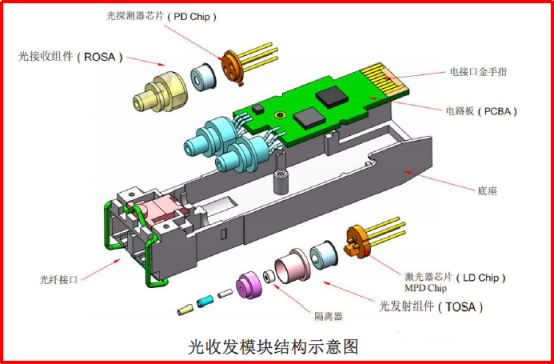 Schematic Diagram of Optical Module Structure
An optical module is mainly composed of optical transmit/receive components (TOSA, ROSA), a circuit board with electrical chips, a package housing, and interfaces. In terms of cost, optical devices (including optical chips) account for more than 70% and are the core of photoelectric conversion; auxiliary materials such as the housing, PCB, and control chips (electrical chips) account for nearly 30%, responsible for physical packaging and signal adaptation. Together they form the hardware foundation of the optical module.
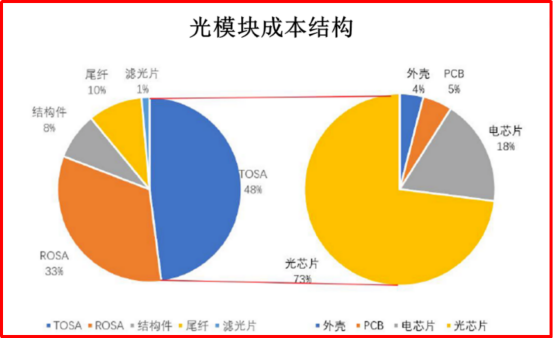 Optical Module Cost Structure
High-speed optical modules must rely on high-end optical chips as the “core power.” Large models such as ChatGPT are competing for computing power, AI servers need to install more GPUs, and optical modules must also be upgraded to 800G or above to be sufficient. Google’s TPU clusters rely on all-optical networks to transmit data, and demand for 800G/1.6T optical modules is growing more and more intense. Moreover, under the same computing power, TPUs require far more optical modules than GPUs, and also have higher requirements for optical transmission density.
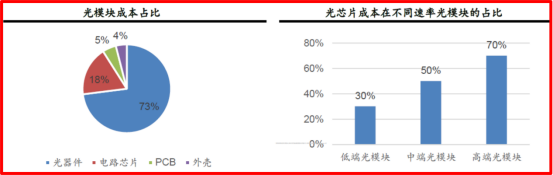 Optical Module/Optical Chip Cost Proportion
In optical module costs, optical devices account for 73%, among which optical chips are key—the higher the speed of the optical module, the higher the cost proportion of optical chips, reaching 30%–70%. Now domestic optical chips are gradually gaining strength in the high-end market, and the pace of substitution is accelerating, allowing domestic manufacturers to earn more profits. Simply put, the level of optical chips determines the grade of optical modules; the higher the module speed, the more valuable the chip.
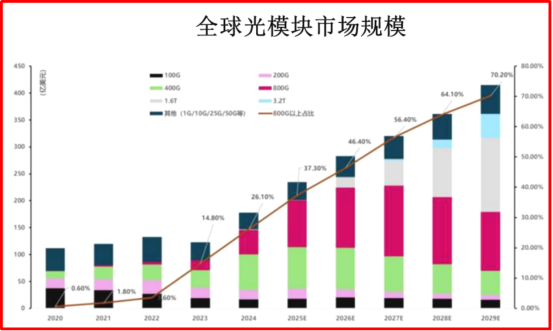 2020–2029 Global Optical Module Market Size
The global optical module market has grown steadily for many years, mainly driven by applications requiring high-speed data transmission such as AI, cloud computing, and 5G—AI servers must support the operation of large models, and optical modules are their key components. From 2020 to 2024, the global optical module market size rose from US$11.2 billion to US$17.8 billion, with an annual growth rate of 12.2%, and is expected to reach US$41.5 billion in 2029, with an annual increase of 18.5%. Among them, 800G, as the mainstream high-end model of high-speed optical modules, had an annual growth rate of 188.1% from 2020 to 2024; the next-generation 1.6T optical module, driven by demand for higher bandwidth and lower power consumption, is expected to have an annual growth rate of 180% from 2024 to 2029 and will usher in explosive growth.
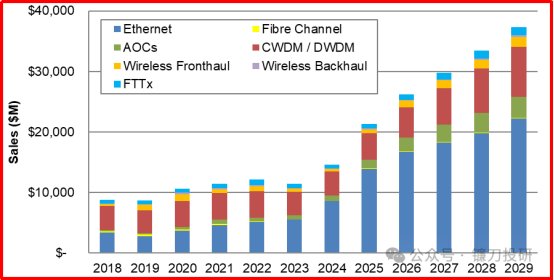 Global Optical Module Market Size Expected to Exceed US$37 Billion in 2029
According to LightCounting’s forecast, the global optical module market will continue to expand at a compound annual growth rate (CAGR) of 22% from 2024 to 2029, and the market size is expected to exceed US$37 billion in 2029. Growth is mainly driven by strong demand for Ethernet optical transceivers from AI clusters and continuous upgrades of DWDM networks by cloud service providers.
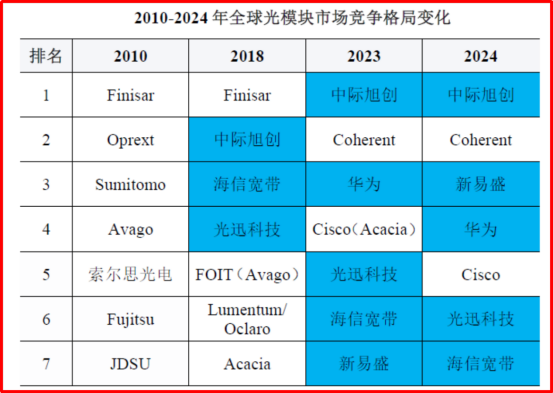 Chinese Manufacturers Occupy a Dominant Position in the Global Ethernet Optical Module Market
Chinese manufacturers occupy a dominant position in the global Ethernet optical module market. In 2021, China’s optical component and module manufacturers achieved a historic breakthrough: the revenue of the top ten domestic suppliers exceeded the sales of Western competitors for the first time. From 2022 to 2023, the sales gap between domestic optical module manufacturers and foreign manufacturers continued to widen, highlighting the competitiveness of Chinese suppliers in the global market. 2025 is regarded as the first year of commercial use of 1.6T optical modules. Chinese manufacturers occupy a dominant position, with shipments in the first half of 2025 accounting for 45% of the global total, and the yield rate of high-end products exceeding 90%.
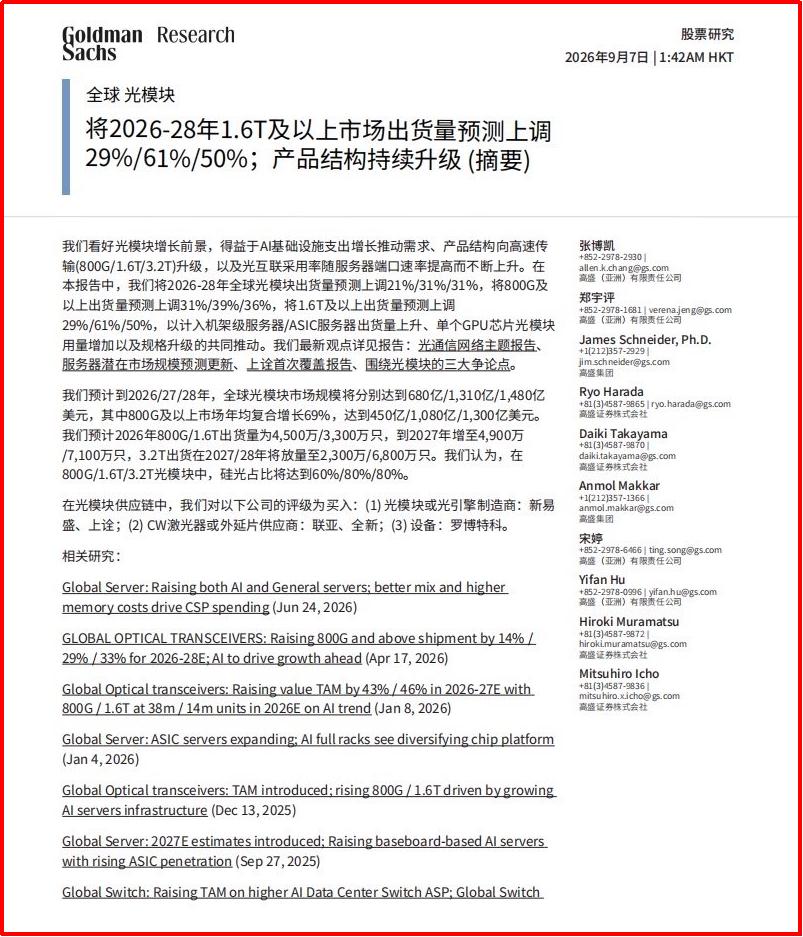
On September 7, 2026, Goldman Sachs Released an In-Depth Report on the Global Optical Module Industry
The industry is expanding capacity rapidly. Some analyses predict that global 1.6T optical module production capacity may exceed 30 million units in 2026. On September 7, 2026, Goldman Sachs released an in-depth report on the global optical module industry. Based on growth in AI infrastructure spending, product structure upgrading toward high-speed transmission, and rising adoption of optical interconnection, it raised its forecasts for global optical module shipments from 2026 to 2028 by 21%, 31%, and 31%, respectively, and raised its forecasts for shipments of 1.6T and above by 29%, 61%, and 50%, respectively. Goldman Sachs expects the global optical module market size to reach US$68 billion, US$131 billion, and US$148 billion from 2026 to 2028, up 33%, 81%, and 115% respectively from previous forecasts. Among them, the market for 800G and above has a CAGR of 69%, reaching US$45 billion, US$108 billion, and US$130 billion, respectively.
2.Optical Fibers and Cables
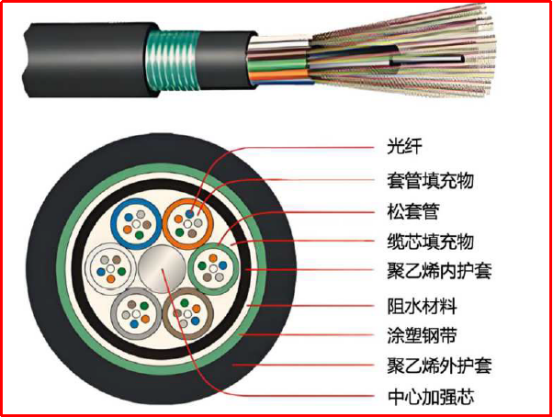
Optical fiber is a slender fiber made of glass or plastic. Its core consists of a high-purity quartz core that transmits optical signals and a low-refractive-index cladding that achieves total reflection, with an outer resin coating to enhance hardness. An optical cable is a finished cable made by bundling multiple optical fibers together and combining them with protective structures such as reinforcing steel wires and sheaths. It can protect optical fibers and adapt to different scenarios. The optical fiber preform, which accounts for 70% of optical cable costs, is mostly produced by manufacturers themselves.
China is the “number one producer and user” of optical fibers and cables in the world. The continuous advancement of domestic communications infrastructure has driven steady growth in optical cable line length. As of the first half of 2025, the total length of optical cables nationwide had reached 73.77 million kilometers (equivalent to nearly 1,845 times around the Earth), up 9.9% year on year. Among them, access network optical cables accounted for nearly 60%, local network relay optical cables accounted for 38.5%, and long-distance optical cables accounted for only 1.6%.
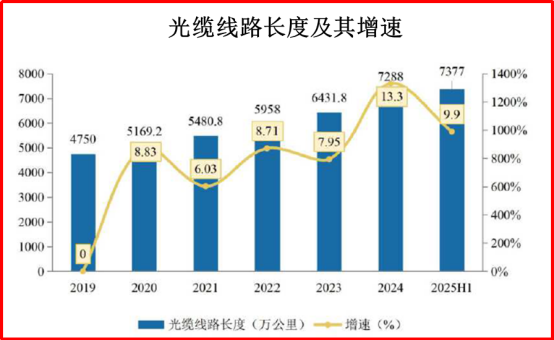 Optical Cable Line Length and Its Growth Rate
In response to shrinking local market demand, domestic optical cable enterprises have strengthened overseas layout under a complex geopolitical environment: from 2019 to 2022, China’s optical cable export volume increased from 255,500 tons to 408,800 tons (an increase of 60%), and export value increased by 41%, reaching a peak in 2022.
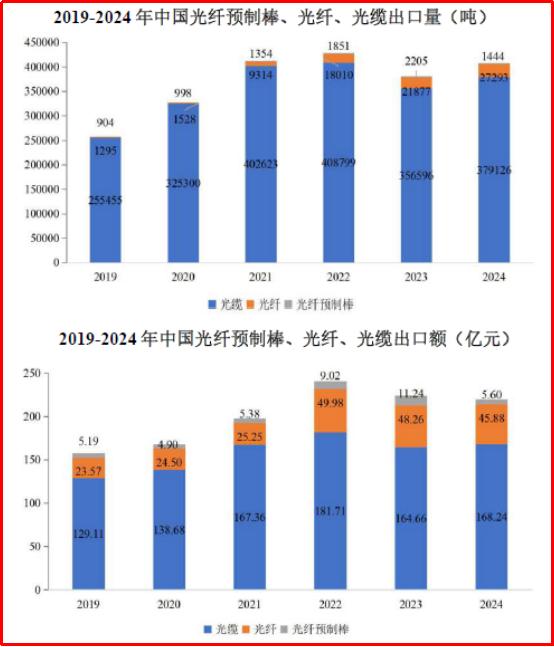
2019–2024 China Optical Fiber Preform, Optical Fiber, and Optical Cable Export Volume and Export Value
In 2024, the global optical fiber and cable market share was relatively concentrated. The top 10 enterprises belonged to 5 countries including the United States, China, and Japan, together accounting for 92% of the market share: Corning ranked first with 19%. Four Chinese enterprises including YOFC and ZTT entered the top ten. Among them, YOFC (13%), ZTT (11.3%), and Hengtong Optic-Electric (11.2%) ranked second to fourth, and FiberHome Telecommunication (9.8%) ranked sixth.
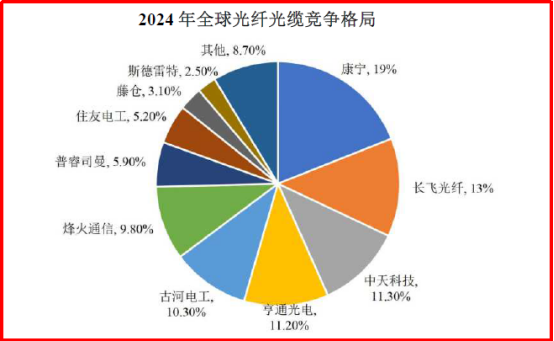 2024 Global Optical Fiber and Cable Competitive Landscape: Four Chinese Enterprises Including YOFC Enter the Top Ten
(IV) Downstream of Optical Communication: Optical Communication Equipment + Terminal Application Scenarios
 Downstream of the Industry Chain: Optical Communication Equipment + Terminal Application Scenarios
Optical communication equipment is equipment that transmits information using light waves, and its core consists of three parts: signal sending, transmission, and reception. By application field, it is divided into transmission equipment and data communication equipment: transmission equipment includes transmission network and access network equipment. Common transmission equipment includes optical transceivers, fiber optic transceivers, etc.; common access network equipment includes OLT, ONU, and ODN equipment, etc.; data communication equipment mainly includes routers and switches.
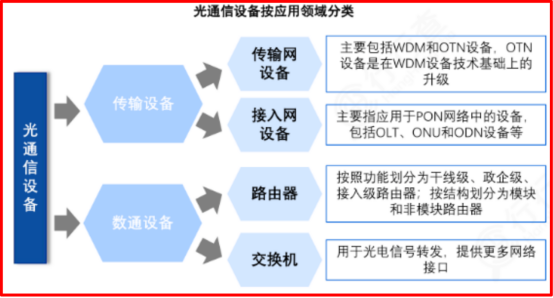 Common Classification of Optical Communication Equipment
Kinghelm Qin Xianghong—“A Comprehensive Summary of the Optical Communication Upstream and Downstream Industry Chain and Analysis of Domestic and Foreign Manufacturers (Part 2)” is coming soon. Please stay tuned!
Statement: Some of the above images and materials are from the Internet, only for promoting industry exchange and development, not for commercial use. If there is any infringement, please contact us.
Related Recommendations